
Why Every Landlord Needs a Trusted Insurance Partner
Insurance brokers for landlord insurance connect property owners with specialized coverage from multiple carriers, saving you time and money while ensuring your rental investment is properly protected. Unlike direct insurers who only sell their own products, brokers compare policies across dozens of top-rated companies to find the best fit for your specific property type, location, and risk profile.
What Insurance Brokers for Landlord Insurance Do:
- Shop Multiple Carriers – Access quotes from 50+ leading insurance companies instead of just one
- Provide Expert Guidance – Explain complex policy terms and help you choose the right coverage limits
- Customize Your Policy – Tailor protection for single-family homes, multi-family properties, condos, or short-term rentals
- Assist with Claims – Advocate for you during the claims process to ensure fair settlements
- Review Coverage Annually – Adjust your policy as your rental portfolio grows or property values change
Investing in rental properties offers a consistent stream of income and the potential for long-term financial stability. However, being a landlord also comes with a unique set of challenges and risks. A frozen pipe bursts and floods your basement unit. A tenant slips on an icy walkway and breaks an ankle. A fire damages your property, forcing tenants to relocate for months. These aren’t hypothetical scenarios—they’re real claims that happen to landlords every day.
Standard home insurance won’t protect you when you rent out a property. Landlord insurance is a specialized business insurance policy that covers the building, your liability as a property owner, loss of rental income, and landlord-owned contents like appliances and furnishings. Without it, you’re personally liable for expensive repairs, legal fees, and lost rent.
The challenge? Navigating the landlord insurance market can be overwhelming. Policy terms are confusing. Coverage options vary wildly between carriers. Premium costs seem to fluctuate for no clear reason. This is where insurance brokers for landlord insurance become invaluable partners.
A skilled broker doesn’t just sell you a policy—they educate you on your risks, compare options from multiple carriers, and build a custom insurance program that protects your investment without overpaying. As a brokerage with a wide network of top insurers, we have access to a range of solutions at competitive rates. We advocate for you during claims, review your coverage as your portfolio grows, and ensure you’re never left vulnerable to a catastrophic loss.
I’m Geoff Stanton, President at Stanton Insurance in Waltham, Massachusetts, and I’ve spent over two decades helping landlords in Massachusetts and New Hampshire protect their rental properties through insurance brokers for landlord insurance who understand the unique risks of the New England market. From winter ice dams to coastal storms, choosing the right broker makes all the difference in safeguarding your investment.
Insurance brokers for landlord insurance terms to learn:
Why Your Rental Property Needs Specialized Protection
Being a landlord is a unique venture that comes with its own set of responsibilities and, inevitably, risks. While the thought of passive income from a rental property is appealing, the reality involves managing a significant asset and the potential for unexpected challenges. We often hear from property owners who initially believe their standard home insurance policy will suffice, only to learn the hard way that it simply doesn’t cover the distinct risks associated with a rental property.
Imagine a scenario where a tenant or a visitor slips and falls on an icy walkway leading to your property, sustaining a serious injury. Without proper landlord insurance, you could face a costly lawsuit for bodily injury. Or consider a fire caused by faulty wiring or even tenant negligence. The repair costs alone could be astronomical, not to mention the loss of rental income while the property is uninhabitable. These are not just theoretical concerns; they are common claims scenarios that can lead to significant financial distress for an unprepared landlord.
The financial implications of inadequate coverage can be devastating. Beyond the immediate costs of repairs or legal fees, you could face a prolonged period without rental income, potentially jeopardizing your mortgage payments and even risking foreclosure if your mortgage lender requires specific insurance that you lack. The peace of mind that comes with knowing your investment is properly protected is truly invaluable.
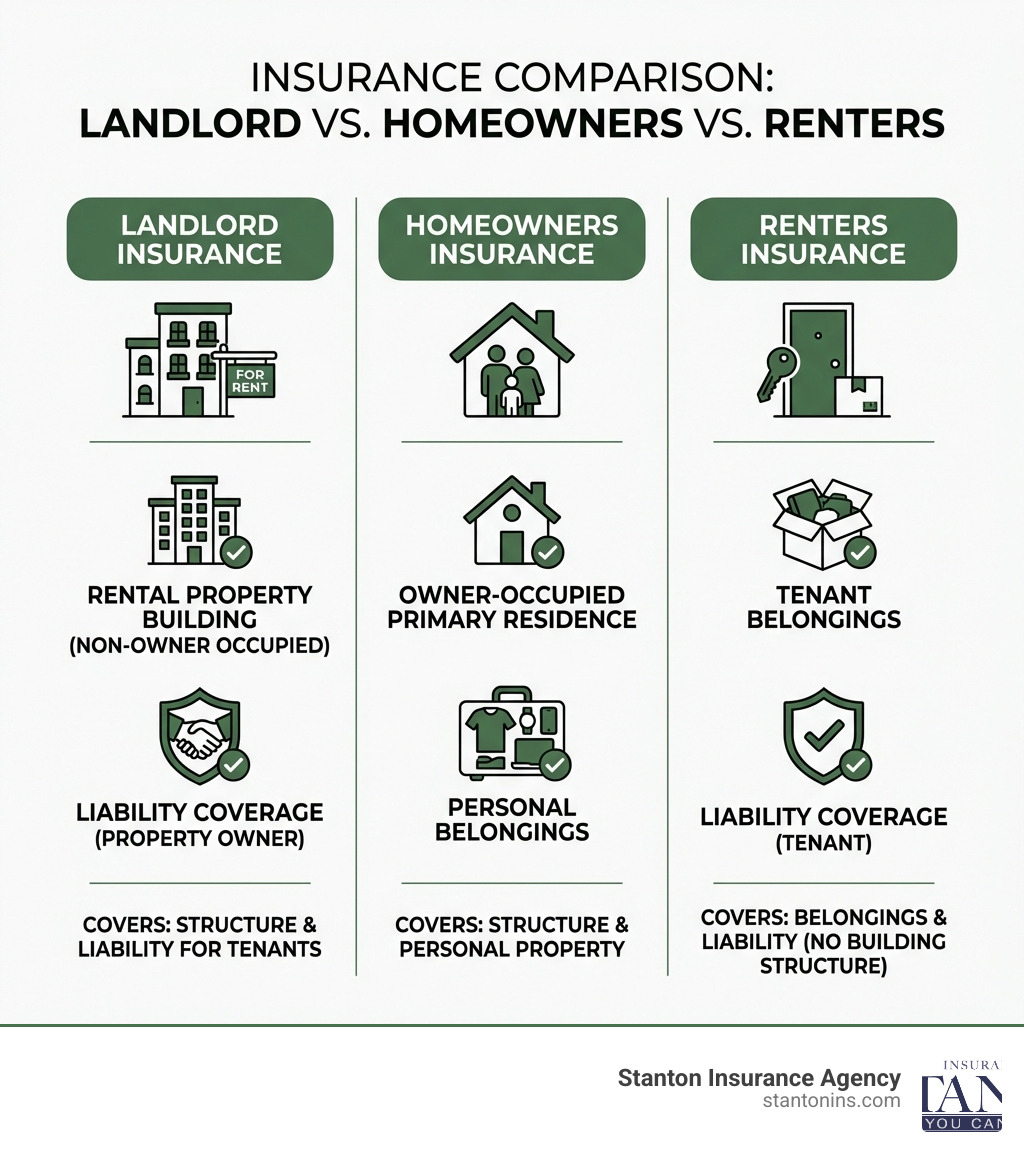
This is why understanding the crucial distinction between landlord insurance and tenant insurance is paramount. While both are important for a rental situation, they protect different parties and different assets. Landlord insurance safeguards your property and your financial interests as the owner, while tenant insurance protects your tenants’ personal belongings and their liability. As a best practice, we strongly recommend requiring your tenants to have their own policy. This not only protects their possessions but can also help mitigate your own liability in certain situations.
Landlord Insurance vs. Homeowners Insurance
One of the most common misconceptions we encounter is the belief that a standard homeowners insurance policy will cover a rental property. Let’s clear this up: it won’t. Homeowners insurance is designed to protect a property that you, the owner, occupy as your primary residence. It covers your personal belongings, the structure, and your liability as a resident.
However, once you rent out a property, it transitions from a personal residence to a business venture. Landlord insurance, sometimes referred to as rental property insurance, is essentially a business insurance policy custom for a non-owner-occupied residence. It specifically addresses the business-specific risks that come with renting out property. These risks include liability for tenants and their guests, damage to the property, and the potential for lost rental income. Because a rental property is perceived as a higher risk by insurers (tenants might not be as invested in the property’s upkeep, and there’s increased foot traffic), the coverage needs to be different and more comprehensive.
The High Cost of Being Uninsured
The decision to forego adequate landlord insurance can quickly turn a profitable investment into a financial nightmare. The costs associated with being uninsured or underinsured can far outweigh the annual premium.
Consider these potential financial burdens:
- Legal Fees from Lawsuits: If a tenant or visitor is injured on your property due to perceived negligence on your part, you could face a lawsuit. The legal fees, settlements, or court-awarded damages could easily run into hundreds of thousands of dollars, potentially bankrupting you if you lack robust liability coverage.
- Rebuilding Costs After a Disaster: A significant event like a fire, severe storm, or burst pipes can render your property uninhabitable. Without insurance, you’re solely responsible for the entire cost of repairs or even rebuilding the structure. This can be an enormous sum, especially with today’s construction material and labor costs.
- Loss of Rental Income During Repairs: When a property is damaged and tenants must vacate, you lose your steady rental income. If repairs take months, that’s months of lost revenue. Without landlord insurance that includes loss of rental income coverage, you’ll still be responsible for mortgage payments, taxes, and other expenses, but with no income to offset them.
- Foreclosure Risk if Mortgage Covenants are Breached: Many mortgage agreements for rental properties explicitly require landlords to maintain specific insurance coverage. Failing to do so can put you in breach of your loan terms, potentially leading to forced-place insurance (often more expensive) or even foreclosure.
- Peace of Mind: Beyond the financial aspects, the psychological toll of constantly worrying about potential disasters or lawsuits can be immense. Comprehensive landlord insurance provides invaluable peace of mind, allowing you to focus on managing your property and enjoying the benefits of your investment, rather than stressing over what could go wrong.
Deconstructing Your Landlord Policy: Core & Optional Coverages
Understanding your landlord insurance policy is like assembling a puzzle. Each piece represents a different type of coverage, and fitting them together correctly ensures your investment is fully protected. A policy is certainly not one-size-fits-all. What works for a single-family home in a quiet suburban neighborhood might not be enough for a multi-unit building in a busy urban area or a coastal property prone to storms. Our goal is always tailoring coverage to your specific property and risks, ensuring you have the right protection without overpaying for what you don’t need.

Standard Coverages You Can’t Afford to Skip
These are the fundamental pillars of any robust landlord insurance policy:
Property Damage Protection: This is the core of your policy, covering the physical structure of your rental property from a variety of perils. This includes damage from events like fire, windstorms, hail, lightning, and even vandalism. For larger properties, such as apartment buildings or complexes, this falls under Commercial Property Insurance, which is designed to protect commercial structures and their associated risks. It’s crucial to ensure your property is insured for its full replacement cost, not just its market value, especially in areas like Massachusetts and New Hampshire where rebuilding costs can be high.
Liability Coverage: This is arguably one of the most critical components for any landlord. It protects you against lawsuits for bodily injury or property damage that occurs on your premises and for which you are found legally responsible. This could stem from a tenant or visitor tripping on a broken step, a dog bite from a tenant’s pet (if you’re found liable), or even a fire spreading from your property to a neighbor’s. Your liability coverage helps pay for legal defense costs, medical expenses, and any settlements or judgments against you.
Loss of Rental Income (Fair Rental Value Coverage): Life happens, and sometimes your rental property becomes uninhabitable due to a covered claim, such as a fire or a major water leak. When this occurs, your tenants might have to move out temporarily, and you lose your rental income. Loss of Rental Income coverage (also known as Fair Rental Value coverage) reimburses you for that lost rent during the period the property is being repaired and is unrentable. This ensures you can continue to meet your financial obligations, like mortgage payments, even when your property isn’t generating income.
Optional Endorsements for Improved Protection
While the standard coverages form a solid foundation, there are several optional endorsements or add-ons that can significantly improve your protection, especially given the unique environmental and property conditions in Massachusetts and New Hampshire:
Sewer & Drain Backup: This coverage is vital, as standard policies often exclude damage caused by sewer or drain backups. A municipal sewer system backing up into your basement or a clogged drain causing water to overflow can lead to extensive and costly damage. This endorsement protects against such occurrences.
Flood Insurance: Especially critical in coastal New England areas and regions prone to heavy rainfall and snowmelt, standard landlord policies typically do NOT cover flood damage. Flood insurance is usually purchased as a separate policy, often through the National Flood Insurance Program (NFIP) or a private insurer. Given the increasing frequency of severe weather events, we consider this an essential add-on for many landlords in our service areas. You can find more info about Flood Insurance here.
Guaranteed Replacement Cost: This endorsement ensures that if your property is completely destroyed, your insurer will pay the full cost to rebuild it, even if that cost exceeds your policy’s dwelling coverage limit. This is particularly valuable in fluctuating construction markets or if building codes change, increasing rebuilding expenses.
Umbrella Policies for Rental Properties: An umbrella policy provides an extra layer of liability protection above the limits of your primary landlord insurance policy. If a lawsuit exhausts your landlord policy’s liability limits, your umbrella policy kicks in to cover the remaining costs. This is highly recommended for landlords with significant assets or multiple properties, as it offers broad protection against catastrophic claims.
Vandalism and Malicious Mischief: While some basic landlord policies might include limited coverage for vandalism, a specific endorsement can offer more comprehensive protection against intentional damage caused by tenants or other individuals. This is distinct from normal wear and tear, which is generally not covered.
Coverage for Different Property Types
The type of rental property you own directly influences the kind of landlord insurance you need. We understand that portfolios vary widely, and our brokers are adept at finding custom solutions for each:
Insurance for Multifamily Properties: Whether you own a duplex, a triple-decker, or a larger apartment building, these properties come with increased complexity and risk. We help landlords secure comprehensive coverage that accounts for multiple units, shared spaces, and the higher potential for liability claims.
Condo Insurance for landlords: If you own a condo unit and rent it out, your insurance needs are unique. The condo association typically has a master policy that covers the building’s exterior and common areas. However, as a landlord, you’ll need a policy that covers the interior of your unit, your liability as the unit owner, and any contents you provide for your tenants.
Single-family homes: These are often the entry point for many landlords. While seemingly straightforward, they still require dedicated landlord insurance to protect against property damage, liability, and loss of rental income.
Short-term rentals (e.g., Airbnb): Renting out a property for short periods (like through Airbnb or Vrbo) introduces a different set of risks. Standard landlord insurance often excludes coverage for short-term rental activities. You’ll need specialized short-term rental insurance that addresses the higher turnover of guests, potential for property damage, and specific liability concerns. It’s crucial to inform your insurer if you engage in short-term rentals, as failing to do so could void your policy.
Absentee landlord insurance for out-of-state owners: For property owners who live outside of Massachusetts or New Hampshire (or even outside the country) where their rental property is located, absentee landlord insurance is essential. This specialized coverage accounts for the increased risks associated with an owner not being physically present to oversee the property regularly. It provides protection for the physical property, landlord-owned contents, liability, and loss of rental income, offering peace of mind for owners managing their investments from afar.
The Value of Using Insurance Brokers for Landlord Insurance
You might be wondering, “Why should I bother with a broker when I can just go directly to an insurance company?” It’s a fair question, but the answer highlights the significant advantages of working with insurance brokers for landlord insurance. We believe the broker advantage is undeniable, especially when navigating the complex and nuanced world of rental property protection.
Going direct means you’re limited to the products and pricing of a single insurer. You’re responsible for understanding all the fine print, comparing different offerings on your own, and determining if you’re truly getting the best value and coverage. For busy landlords, this can be a time-consuming and often confusing process.
A broker, like us, acts as your advocate and guide. We’re not tied to any one insurance company. Instead, we have relationships with a wide network of reputable carriers. This allows us to shop the market on your behalf, comparing policies, coverages, and prices to find the optimal solution for your specific needs in Massachusetts and New Hampshire. We save you time, money, and the headache of deciphering complex policy language. Our expert advice is custom to you, ensuring you understand exactly what you’re buying and why it matters.

How Brokers Simplify the Process
Our role is to explain landlord insurance and make the process as smooth as possible for you:
Access to Multiple Carriers: As a brokerage, we have partnerships with a wide range of top insurers. This means we can access a broader spectrum of coverage options and competitive rates than any single insurance company could offer. We shop among leading insurance companies to offer you a range of options, ensuring you get comprehensive coverage at some of the best rates available in Massachusetts and New Hampshire.
Objective Advice Based on Your Needs: Unlike agents who work for a specific company, our loyalty is to you, the client. We provide objective advice, helping you understand the pros and cons of different policies without bias towards a particular insurer’s offerings. Our recommendations are solely based on what best protects your investment and fits your budget.
Explanation of Complex Terms and Policy Details: Insurance policies can be filled with jargon and intricate clauses. We take the time to explain complex terms, exclusions, and coverage limits in simple, clear language, ensuring you fully understand what your policy covers and, just as importantly, what it doesn’t.
Assistance During the Claims Process: Should you ever need to file a claim, we don’t disappear. We act as your advocate, guiding you through the claims process, helping you compile necessary documentation, and communicating with the insurance company on your behalf. Our goal is to ensure a fair and efficient settlement, minimizing stress and disruption for you.
What to Look for in Insurance Brokers for Landlord Insurance
Choosing the right broker is almost as important as choosing the right policy. Here’s what we believe sets a great insurance broker for landlord insurance apart:
Specialized Expertise: Look for a broker who has extensive experience with rental properties, particularly in Massachusetts and New Hampshire. The nuances of landlord insurance, tenant laws, and regional risks (like our harsh winters or coastal weather) require specialized knowledge.
Independent Insurance Agency Status: Independent brokers work with multiple insurance companies, offering you more choices and potentially better rates. This contrasts with “captive” agents who can only sell policies from one specific insurer.
Strong Carrier Relationships: A broker with established relationships with a wide array of reputable carriers can often secure more favorable terms and access specialized policies that might not be readily available elsewhere.
Positive Client Testimonials and Reviews: What do other landlords say about their experience? Reputable brokers will have a track record of satisfied clients who can attest to their service, expertise, and responsiveness.
Proper Licensing and Credentials: Ensure your broker is fully licensed and credentialed in Massachusetts and/or New Hampshire. You can verify their insurance license status through the respective state’s Division of Insurance.
How a Broker Helps Determine Your Premium
The cost of landlord insurance isn’t pulled out of thin air. Many factors influence your premium, and a skilled broker helps you understand these and, where possible, find ways to save without compromising coverage.
| Factor | Influence on Premium |
|---|---|
| Property Location & Age | Properties in high-risk areas (e.g., flood zones, high crime) or older buildings may have higher premiums. |
| Construction Type | The materials and construction type of your building (e.g., wood frame vs. masonry) affect fire risk and rebuilding costs. |
| Claims History | A history of previous claims, both yours and for the property, can increase rates. |
| Chosen Deductibles & Coverage Limits | Higher deductibles generally lead to lower premiums, but mean more out-of-pocket during a claim. Higher coverage limits increase premiums. |
| Tenant Type (e.g., student housing) | Certain tenant types (e.g., student rentals, short-term rentals) are often perceived as higher risk by insurers. |
| Safety Features (alarms, sprinklers) | Installing monitored security systems, smoke detectors, and sprinkler systems can often lead to discounts. |
A broker can also advise on other factors like the number of units, the presence of attractive nuisances (like a swimming pool), and whether the property is furnished or unfurnished. We leverage our knowledge of these factors and our relationships with insurers to negotiate the best possible rates for you.
Frequently Asked Questions about Landlord Insurance
Is landlord insurance tax-deductible?
Yes, in most cases, landlord insurance is considered a business expense for your rental property and can be deducted from your rental income on your tax return. This helps offset the cost and is another reason why it’s a crucial part of managing your investment.
Does landlord insurance cover damage caused by my tenants?
It depends. Most policies cover accidental damage caused by a tenant, such as a kitchen fire or a burst pipe due to negligence. However, intentional damage or vandalism may require a specific endorsement or might not be covered at all. Normal wear and tear is never covered by insurance. This is why it’s wise to require your tenants to carry their own renters insurance.
How much liability coverage do I need for a rental property?
While minimums vary, most experts and mortgage lenders recommend at least $1 million in liability coverage. For landlords with multiple properties or significant assets, a personal umbrella policy is often recommended to provide an extra layer of protection above the primary policy’s limits.
Your Partner in Protection: Finding the Right Broker
Choosing a broker for your landlord insurance isn’t just about finding the cheapest policy; it’s about finding a long-term partner who understands your needs and is committed to protecting your investment. At Stanton Insurance Agency, we pride ourselves on being that partner for landlords across Massachusetts and New Hampshire.
We don’t just sell policies; we advocate for you during claims, ensuring you receive fair and prompt settlements. We regularly review your coverage as your portfolio grows and your needs evolve, making sure your protection keeps pace with your success. An expert local broker understands the unique risks in your area, from the challenges of winter ice dams and heavy snow to the potential for coastal storms and flooding that our New England climate presents. We know the local market, the local regulations, and the best ways to protect your properties against these specific threats.
Stanton Insurance Agency has decades of experience helping landlords in Massachusetts and New Hampshire protect their investments with custom coverage. We are dedicated to exceeding customer expectations and providing trusted protection for your valuable assets. We believe in building relationships, offering personalized service, and ensuring you have the peace of mind you deserve as a property owner.
Ready to partner with an expert who puts your needs first? Explore our Multi-Family Insurance options and let us build the right protection for you.