
Understanding Your $1 Million Liability Insurance Options
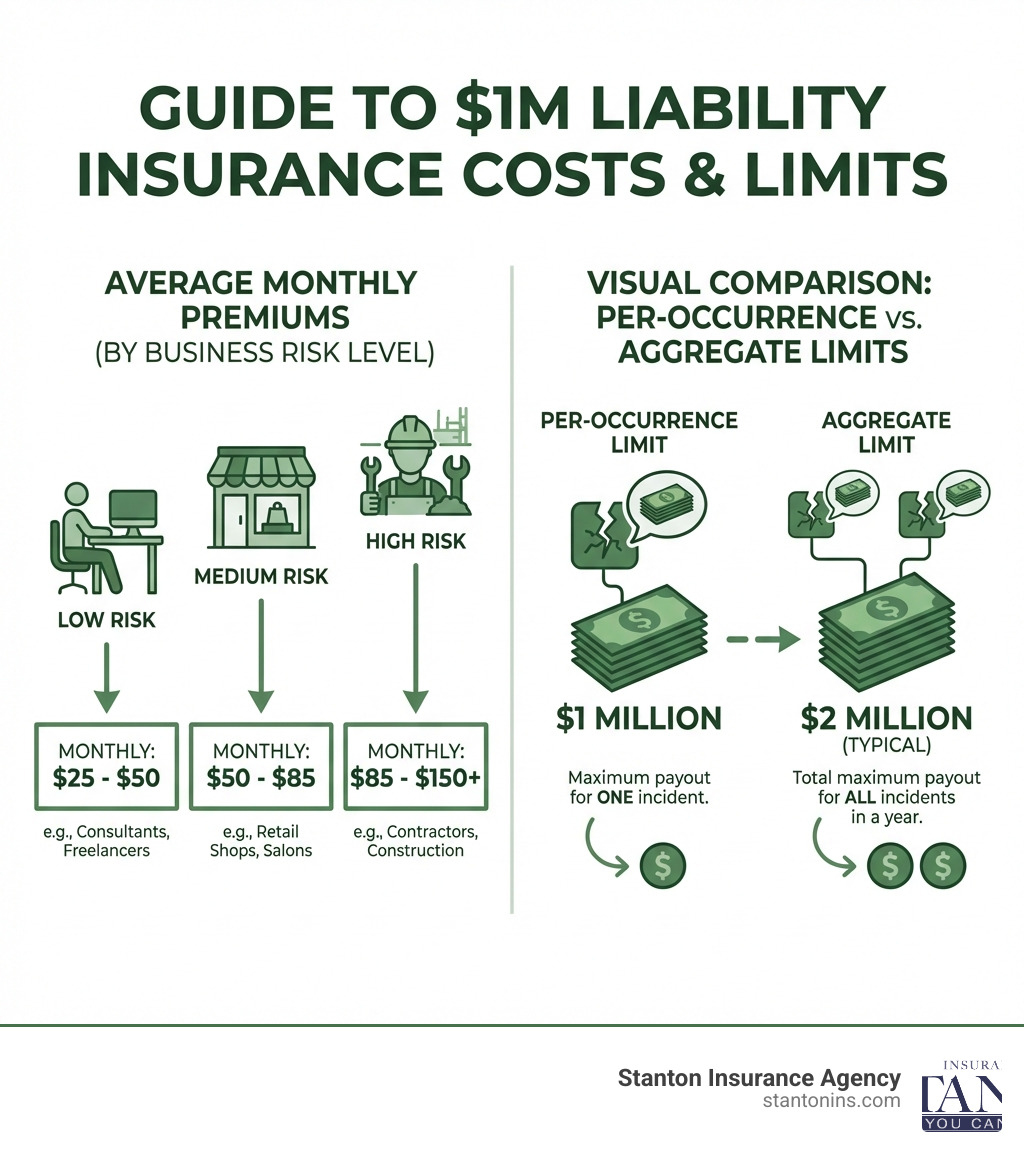
Liability insurance 1 million typically costs between $42 to $85 per month for small businesses, though your actual premium depends on several key factors:
- Industry Risk Level: Construction companies pay more than consultants
- Business Location: Urban areas often cost more than rural
- Claims History: A clean record means lower premiums
- Revenue & Size: Larger operations generally pay higher premiums
- Coverage Structure: Most $1M policies include a $2M aggregate limit
What You’re Actually Buying: A $1 million policy means your insurer will pay up to $1 million per incident (per-occurrence limit), with most policies capping total annual payouts at $2 million (aggregate limit).
The cost of protecting your business from liability claims doesn’t have to break the bank. Whether you’re a contractor working on client sites, a consultant providing professional advice, or a retail shop owner welcoming customers daily, understanding what drives your premium helps you make smarter coverage decisions.
As President of Stanton Insurance Agency in Waltham, I’ve spent over two decades helping Massachusetts and New Hampshire business owners steer liability insurance 1 million dollar policies, from small startups to established contractors. My focus on Commercial Property & Liability means I’ve seen how the right coverage protects businesses when unexpected claims arise.
Liability insurance 1 million terms to know:
- definition for liability insurance
- Personal Liability Insurance
- personal liability umbrella insurance cost
What Does $1 Million in Liability Insurance Actually Mean?
When you see “liability insurance 1 million,” it refers to the maximum amount an insurer will pay out for a covered claim. However, it’s not just one single number. Policies are typically structured with two key limits that work together to define your total protection.
Per-Occurrence vs. Aggregate Limits: A Practical Example
Most small businesses start with a policy structured as $1 million per-occurrence and $2 million aggregate. Here’s how that works:
-
Per-Occurrence Limit: This is the maximum amount your policy will pay for a single incident or claim. If a customer is injured on your property and the damages total $800,000, your $1 million per-occurrence limit would cover it. If the claim was $1.2 million, you would be responsible for the remaining $200,000 out of your own pocket. This limit ensures you have substantial coverage for a single major event.
-
Aggregate Limit: This is the absolute maximum your policy will pay out for all claims combined during your policy term (usually one year). Using the $1M/$2M example, after paying the $800,000 claim, you would still have $1.2 million left in your aggregate limit to cover any other claims that might occur that year. If you faced three separate claims totaling $1.3 million, your $2 million aggregate limit would cover them all, assuming each individual claim was within your per-occurrence limit.
Understanding this distinction is crucial. Many small business owners buy a general liability policy with $1 million in coverage per-occurrence limit and $2 million total for the year. It ensures you have substantial coverage for a single major event while also being protected against multiple smaller claims. For more details on how these limits function, you can review this guide on Aggregate Limit of Liability.
The Cost of a $1 Million General Liability Insurance Policy
One of the first questions business owners ask is, “How much will this cost?” While there’s no single answer, we can look at averages and the factors that determine your specific premium.
What is the Average Cost for a $1 Million Liability Insurance Policy?
Based on industry data, the average cost for a $1 million liability insurance policy ranges from $42 to $69 per month (approximately $500 to $825 annually) for small business owners. Some insurers note that for many industries, a standard $1M per-occurrence / $2M aggregate policy can be secured for as low as $350 per year. Another large insurer reported a median monthly cost of $60 and an average rate of $85 per month for new customers in 2024.
However, this is just an average. Your final price can be higher or lower depending on your business’s unique risk profile, and it can even range from less than $300 to over $2,000 annually.
Key Factors That Influence Your Premium
Insurance companies calculate your rate based on risk. The higher the perceived risk of a claim, the higher your premium will be. Key factors include:
-
Industry and Risk Exposure: A contractor working on-site with heavy machinery faces more physical risks and potential for property damage than a home-based consultant and will typically pay more. Insurers use classification codes to determine base rates. For instance, a home organizing business might pay significantly less than a food truck for the same limits due to higher expected risks.
-
Location: Operating in a densely populated area, like many parts of Massachusetts, or a state with a history of higher legal costs and activity, can increase your premium. Claims can get expensive fast if your business is based in an area with a higher cost of living or where lawsuits are more common.
-
Business Size and Revenue: More employees, a larger physical location, and higher revenue can all lead to increased exposure and a higher premium. The amount of payroll, the number of employees, and the size of your physical footprint are all considered.
-
Claims History: A business with a history of frequent claims will be seen as a higher risk and will likely pay more than a business with a clean record. Maintaining a good claims history is one of the best ways to keep premiums down.
-
Coverage Limits and Deductibles: While this guide focuses on a $1 million limit, choosing higher limits (e.g., a $2M per-occurrence / $4M aggregate policy) will increase your cost, though often not proportionally. For example, some providers offer a $2M/$4M policy for only slightly more than a $1M/$2M policy. Similarly, adjusting your deductible (the amount you pay out-of-pocket before insurance kicks in) can impact your premium. A higher deductible can lower your premium, but ensure it’s an amount your business can comfortably afford.
How to Find an Affordable Liability Insurance 1 Million Policy
While you can’t change your industry overnight, you can take proactive steps to get the best possible rate for your liability insurance 1 million policy:
-
Implement a Safety Program: Documented safety procedures and training for employees can significantly reduce accidents and potential claims. Following guidelines from organizations like the Occupational Safety and Health Administration (OSHA) not only creates a safer workplace but also demonstrates a commitment to risk management, which insurers appreciate. For example, a painting contractor can maintain a clutter-free workspace to reduce the risk of someone tripping over supplies.
-
Bundle Your Policies: Many insurers offer a discount if you bundle your general liability with other coverages. A Business Owner’s Policy (BOP) combines general liability and commercial property insurance, often at a lower price than buying them separately.
-
Choose an Appropriate Deductible: A higher deductible (the amount you pay out-of-pocket before insurance kicks in) can lower your premium. However, it’s crucial to select an amount your business can comfortably afford in the event of a claim. The average deductible chosen by many small businesses is $500.
-
Shop Around: Rates vary significantly between insurers. Working with an independent agent like us allows you to compare quotes from multiple carriers to find the best value and coverage that meets your specific needs. Don’t settle for the first quote you receive! Get a quote today to see your options.
What a $1M General Liability Policy Covers
A standard Commercial General Liability (CGL) policy is designed to protect your business from claims made by third parties (i.e., not your employees or your own property). A liability insurance 1 million policy typically covers legal fees, settlements, and judgments related to:
-
Third-Party Bodily Injury: This covers claims if someone other than an employee is physically injured on your business premises or as a result of your business operations. For example, a customer slips on a wet floor in your retail store and breaks their arm, leading to medical bills and potentially lost wages. Your CGL policy would help cover these costs.
-
Third-Party Property Damage: This coverage kicks in if your business operations or employees cause damage to someone else’s property. Imagine your employee is working at a client’s home and accidentally damages an expensive piece of art, or a contractor accidentally damages a client’s flooring while doing repairs. The CGL policy would cover the repair or replacement costs.
-
Personal and Advertising Injury: This less common but vital coverage protects your business from claims of non-physical harm, such as libel, slander, false arrest, malicious prosecution, copyright infringement, or invasion of privacy arising from your business’s advertisements or marketing activities. For instance, if you’re sued for making false statements about a rival in an ad, your policy would help cover defense costs.
It’s just as important to know what a $1 million general liability policy does not cover. CGL does not cover:
- Employee Injuries: These are typically covered by Workers’ Compensation Insurance.
- Professional Mistakes: Errors or omissions in the professional services or advice you provide require Professional Liability (E&O) insurance.
- Damage to Your Own Business Property: This falls under Commercial Property Insurance.
- Auto Accidents: Incidents involving business vehicles are covered by Commercial Auto Insurance.
- Cyber Attacks or Data Breaches: These require specialized Cyber Liability Insurance.
- Intentional Acts: CGL policies are designed for accidental occurrences, not deliberate harm.
Beyond General Liability: Building Your Business’s Safety Net
While a liability insurance 1 million policy is a foundational piece of your risk management strategy, it doesn’t cover everything. Depending on your operations and specific risks, you may need additional policies to be fully protected and ensure your business’s longevity.
Professional Liability Insurance (Errors & Omissions)
If your business provides professional services or advice, such as consultants, IT professionals, accountants, architects, marketing agencies, or even personal trainers, you absolutely need Professional Liability Insurance, also known as Errors & Omissions (E&O) insurance. This coverage protects you from claims of negligence, errors, or omissions in your professional work that cause a client financial harm. For example, if a consultant gives flawed advice and the client loses money, E&O would cover the legal defense and potential damages. This is distinctly different from general liability, which covers physical injury or property damage to third parties.
Business Owner’s Policy (BOP)
A Business Owner’s Policy (BOP) is a convenient and cost-effective package that combines general liability and commercial property insurance, often at a lower price than buying them separately. It’s an excellent option for many small to medium-sized businesses in Massachusetts and New Hampshire, providing broad protection against common risks. Some BOPs can even include business interruption insurance, which helps cover lost income if your business has to temporarily close due to a covered property damage event.
Other Essential Coverages
-
Workers’ Compensation Insurance: If you have employees in Massachusetts or New Hampshire, workers’ compensation insurance is generally required by law. It covers medical bills, lost wages, and rehabilitation costs for employees who are injured or become ill on the job. It also protects your business from lawsuits related to employee injuries. On average, workers’ compensation insurance costs around $86 a month, or $1,032 a year. You can get a Workers Compensation Quote to learn more.
-
Commercial Auto Insurance: If you use vehicles for business purposes – whether it’s a single car for client visits or a fleet of trucks for deliveries in New Hampshire or Massachusetts – a personal auto policy won’t cover you. You need a dedicated commercial auto policy to protect your business from liability arising from accidents involving your business vehicles. On average, small business owners pay about $574 a month for commercial auto insurance.
-
Cyber Liability Insurance: In today’s increasingly digital world, businesses of all sizes face the threat of data breaches and cyberattacks. Cyber Liability coverage helps cover the costs associated with these incidents, including data recovery, notification costs, credit monitoring for affected customers, legal fees, and regulatory fines. It’s an essential protection for any business that handles sensitive customer data or relies heavily on technology.
-
Commercial Umbrella Insurance: When your primary liability limits (like your $1 million general liability policy) are exhausted, a commercial umbrella policy kicks in to provide additional coverage. These policies are often available in $1 million increments and can provide extra financial protection for catastrophic claims that exceed your underlying policy limits, helping to safeguard your business’s assets.
Frequently Asked Questions about $1M Liability Insurance
Do I need more than $1 million in liability coverage?
It absolutely depends on your business’s unique risk profile, industry, and contractual obligations. While a liability insurance 1 million policy is a common starting point and often sufficient for low-risk businesses like consultants or small retail shops, many businesses in Massachusetts and New Hampshire may need more. Consider these factors:
- Industry Risk: If you’re in a high-risk industry like construction, manufacturing, or healthcare, where the potential for severe bodily injury or property damage is higher, $1 million might not be enough. Some general contractors, for example, need $5 million or more for large projects.
- Business Assets: If your business has significant assets that could be at risk in a lawsuit, higher limits provide greater protection.
- Client or Contract Requirements: Many clients, landlords, or government contracts will explicitly require higher liability limits (e.g., $2 million, $5 million, or even more) before you can work with them.
- High-Traffic Locations: Businesses with high foot traffic or public interaction, such as restaurants or event venues, face a greater chance of slip-and-fall incidents.
- Exposure to High Legal Costs: Operating in areas with higher legal costs or a tendency for large jury awards can make higher limits prudent.
If you find that $1 million isn’t enough, a commercial umbrella policy can provide additional coverage over your standard limits, offering an extra layer of financial protection.

What is the difference between general liability and professional liability insurance?
This is a common and critical question! While both protect your business from lawsuits, they cover very different types of risks:
-
General Liability Insurance: This is your primary defense against claims of bodily injury, property damage, and personal/advertising injury caused by your business operations. Think of it as covering the “oops” moments that cause physical harm or damage to a third party. For example, a customer slips and falls in your office, or your employee accidentally damages a client’s property.
-
Professional Liability Insurance (Errors & Omissions – E&O): This specialized coverage protects you from claims of financial loss due to mistakes, errors, negligence, or omissions in the professional services or advice you provide. It’s about protecting your expertise. For example, an architect makes a design error, an accountant gives incorrect tax advice, or a software developer delivers faulty code that causes a client financial losses.
A law firm, for instance, needs both: general liability for a client slipping on a wet floor in their office and professional liability for giving incorrect legal advice that harms a client financially.
Can I get liability insurance if I’m a sole proprietor or independent contractor?
Yes, absolutely! In fact, it’s highly recommended, even if you’re a sole proprietor or independent contractor working from home in Massachusetts or New Hampshire. Many clients, especially larger businesses, will require you to show proof of liability insurance 1 million (or higher) before they will hire you. This demonstrates your professionalism and assures them that you have protection in place if something goes wrong. More importantly, it helps protect your personal assets from business-related lawsuits, as a sole proprietorship generally doesn’t offer the same liability protection as an LLC or corporation.
Secure Your Business’s Future Today
Choosing the right liability insurance 1 million policy is one of the most important decisions you’ll make as a business owner. A $1 million policy provides a strong foundation of protection, shielding your business from claims that could otherwise lead to financial ruin. By understanding the factors that influence cost and the scope of coverage, you can make an informed decision that fits your budget and your needs.
Navigating business insurance can be challenging, but you don’t have to do it alone. The experienced team at Stanton Insurance Agency is here to help you assess your risks and find the most comprehensive and affordable coverage options available in Massachusetts and New Hampshire. We’re committed to providing trusted protection for your valuable assets. Contact us today to discuss your business insurance needs and get a personalized quote.
