
What is Bodily Injury: The 2 Crucial Pillars
Understanding the Basics of Auto Liability Insurance
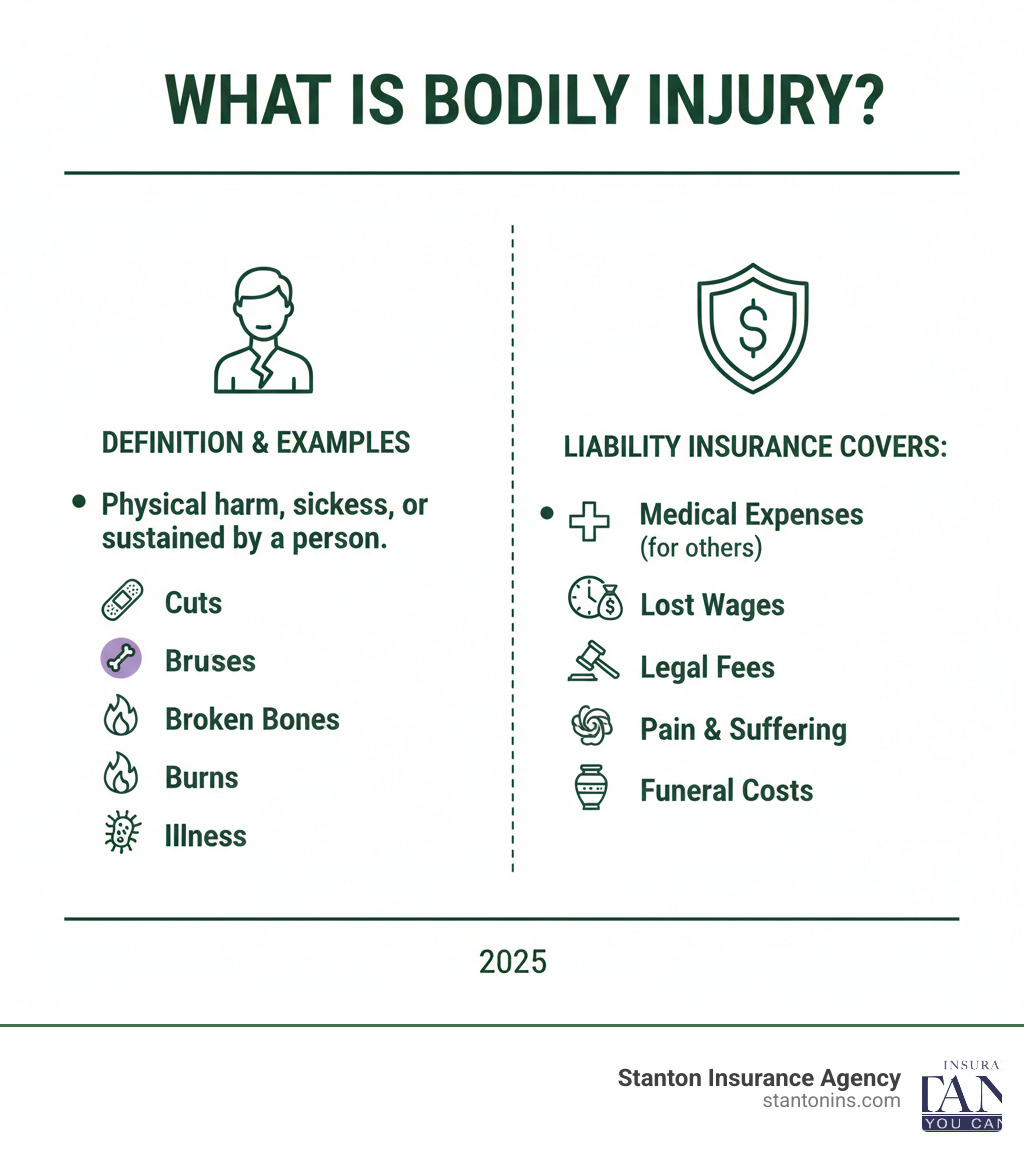
What is bodily injury in the context of auto insurance? Bodily injury refers to physical harm, sickness, disease, or death sustained by a person as a result of an accident. In insurance terms, it covers a wide range of physical damage—from minor cuts and bruises to severe injuries like broken bones, burns, or impairment of bodily functions. It can also include any injury to the body, no matter how temporary.
Quick Definition:
- Bodily Injury = Physical harm to another person’s body
- Covered by: Bodily Injury Liability insurance on your auto policy
- Pays for: Medical bills, lost wages, legal fees, pain and suffering, and funeral costs for others you injure in an at-fault accident
- Does NOT cover: Your own injuries (those are covered by PIP or MedPay)
When reviewing your auto insurance policy, you’ll see “bodily injury” and “property damage” paired together. These are the two core components of liability coverage—the part of your policy that protects you financially when you cause an accident. While property damage covers harm to someone else’s car or property, bodily injury specifically addresses harm to people.
Understanding this term is essential for every driver, especially in Massachusetts where minimum coverage may not be enough to fully protect your assets. The financial consequences of being underinsured can be devastating, as medical bills from a serious accident can easily reach hundreds of thousands of dollars.
I’m Geoff Stanton, President of Stanton Insurance Agency. For over two decades, I’ve helped families in Waltham and the greater Boston area steer complex insurance topics like bodily injury. My goal is to break down these confusing terms so you can make informed decisions about your coverage.
Defining the Core Components of Liability Insurance
Your auto insurance policy’s liability coverage has two main parts: bodily injury and property damage. Bodily injury liability covers harm to people, while property damage liability covers damage to things. Together, they protect your financial future when you’re responsible for an accident.
What is Bodily Injury?
So what is bodily injury? The legal definition of bodily injury is broad: any physical harm, sickness, or disease sustained by a person, including death. This covers everything from minor cuts and bruises to more severe issues like broken bones, burns, or impairment of a bodily function. Essentially, any injury to the body, no matter how temporary, can be considered bodily injury.
When you review your auto insurance, this term applies when someone else is hurt in an accident where you’re at fault. Your bodily injury liability coverage is designed to cover the financial fallout from those injuries.
What is Property Damage?
While bodily injury is about people, property damage liability is about the stuff you might damage in an accident. This most often means the other driver’s vehicle, but it can also include buildings, fences, guardrails, or other physical property. If your vehicle damages someone else’s tangible property, this coverage helps pay the bill.

How Bodily Injury Differs from Personal Injury
People often confuse “bodily injury” and “personal injury,” but they have distinct meanings in the insurance and legal worlds.
Bodily injury is straightforward: it’s physical harm to someone’s body, like a broken bone or a concussion. This is the term your auto liability policy uses.
Personal injury is a much broader legal term. It can include bodily injury, but it also covers non-physical damages like emotional distress, mental anguish, libel, slander, or reputational damage.
Think of it this way: bodily injury is a subset of personal injury. A claim for a broken arm is a bodily injury claim. A lawsuit for the broken arm plus the resulting anxiety and depression is a personal injury claim. Your auto liability insurance primarily addresses the physical harm you cause to others, but understanding this distinction helps clarify why some claims extend beyond just medical bills.
How Bodily Injury Liability Coverage Works in an Accident

Bodily Injury Liability isn’t for you—it’s for others. When you’re at fault in an accident and someone gets hurt, this coverage becomes your financial lifeline, paying for their injury-related costs so your personal assets stay protected. Without it, you’d be paying for medical bills, lost income, and pain and suffering out of your own pocket.
Who and What Does It Cover?
Your bodily injury liability coverage pays for costs associated with injuries to other drivers, their passengers, or pedestrians. It does not cover you or your passengers. Key covered expenses include:
- Medical Expenses: Hospital stays, ambulance rides, doctor visits, and rehabilitation.
- Lost Wages: Compensation for income the injured person loses while recovering.
- Pain and Suffering: Compensation for physical discomfort and emotional distress.
- Legal Fees: Your legal defense costs if you are sued, up to your policy limits.
- Funeral Costs: In the tragic event of a fatality.
For a deeper dive, see our guide on Liability Car Insurance Coverage.
Understanding Your Coverage Limits (Per Person / Per Accident)
Your policy’s bodily injury liability limits are shown as two numbers, like 20/40 or 100/300. These numbers represent thousands of dollars and are critical to your financial protection.
In Massachusetts, the minimum is 20/40, meaning $20,000 per person and $40,000 per accident. The first number is the most your insurance will pay for any single person’s injuries. The second is the total cap for all injuries in one accident.
Here’s a real-world example. You cause an accident injuring two people. Person A has $25,000 in medical bills, and Person B has $10,000. With a 20/40 policy:
- Your insurance pays $20,000 for Person A (the per-person limit).
- It pays the full $10,000 for Person B.
Even though the total payout of $30,000 is under the $40,000 accident limit, you are personally on the hook for the remaining $5,000 of Person A’s bills. If Person A’s injuries were more severe—say, $100,000 in expenses—you’d be personally responsible for $80,000. This kind of debt can lead to financial ruin.
This is why carrying only the minimum car insurance coverage in Massachusetts is so risky. Medical costs escalate quickly, and state minimums, which vary across the country (e.g., New Hampshire is 25/50), are often not enough to protect your assets in a serious accident.
Bodily Injury vs. Other Key Auto Coverages
An auto policy includes many coverages like PIP, MedPay, and UM/UIM. Understanding how they differ from bodily injury liability is crucial, as each serves a specific purpose.
Here’s a straightforward comparison:
| Coverage | Who It Covers | What It Pays For | Fault Requirement |
|---|---|---|---|
| Bodily Injury Liability | Other people (drivers, passengers, pedestrians) | Medical bills, lost wages, pain & suffering for others. | You must be at fault. |
| Personal Injury Protection (PIP) | You and your passengers | Your own medical bills, lost wages, and replacement services. | Covers you regardless of fault (No-Fault). |
| Medical Payments (MedPay) | You and your passengers | Your own medical bills. | Covers you regardless of fault. |
Bodily Injury Liability vs. PIP/MedPay
The most important distinction is who is covered. A simple way to remember it is: “BI for others, PIP and MedPay for us.”
Bodily Injury (BI) Liability covers others when you are at fault. It pays for their medical bills and lost wages, not yours.
Personal Injury Protection (PIP) and Medical Payments (MedPay) cover you and your passengers. In Massachusetts, mandatory PIP operates on a “no-fault” basis, meaning it pays for your medical expenses and lost wages regardless of who caused the accident. MedPay is an optional coverage that also pays for your medical bills regardless of fault but typically doesn’t cover lost wages.
Bodily Injury vs. Uninsured/Underinsured Motorist Coverage
What happens if you’re injured by a driver with little or no insurance? This is where Uninsured/Underinsured Motorist (UM/UIM) coverage becomes your lifeline. While your BI liability pays for damage you cause to others, UM/UIM coverage pays for your bodily injuries when the at-fault driver can’t.
- Uninsured Motorist (UM) Bodily Injury applies when you’re hit by a driver with no insurance. It covers your medical expenses, lost wages, and pain and suffering.
- Underinsured Motorist (UIM) Bodily Injury applies when the at-fault driver has insurance, but their limits are too low to cover all your damages. Your UIM coverage can make up the difference.
UM/UIM coverage protects you from other drivers’ failure to carry adequate insurance. To learn more, check out our guides on if you need uninsured motorist coverage and the specifics of Uninsured Motorist Bodily Injury Liability.
Why Your Bodily Injury Coverage Limits Matter

Choosing your liability limits is one of the most important financial decisions you’ll make as a driver. Opting for state minimums might save a few dollars on your premium, but it can expose you to devastating financial risk.
The Risks of Being Underinsured
If you cause a serious accident, medical costs can skyrocket. A severe injury can easily result in hundreds of thousands of dollars in damages. If those costs surpass your policy limits, you are personally responsible for the rest. This means your savings, home, and even future wages could be at risk to cover the shortfall. For example, with Massachusetts’ minimum of $20,000 per person, a $200,000 claim would leave you personally liable for $180,000.
Choosing the Right Amount of Coverage
A good guideline is to carry bodily injury liability limits at least equal to your net worth. If you have $300,000 in assets (home equity, savings, investments), you should consider liability coverage of at least $250,000 per person and $500,000 per accident. Higher limits mean a slightly higher premium, but it’s a small price to pay to protect the assets you’ve spent a lifetime building and to secure your peace of mind.
Extending Your Protection with Umbrella Insurance
For those with significant assets, a personal umbrella policy offers the ultimate safety net. It provides an extra layer of liability coverage—typically $1 million or more—that kicks in after your auto or home insurance limits are exhausted. If a catastrophic accident results in a $1.5 million claim and your auto policy covers $250,000, your umbrella policy would cover the remaining $1.25 million. A $1 million umbrella policy is surprisingly affordable and offers robust protection for a worst-case scenario. Learn more in our guides on what is personal umbrella insurance? and what is umbrella insurance?.
Understanding what is bodily injury coverage and choosing the right limits is about protecting everything you’ve worked for. We’re here to help you find the right balance of protection and affordability.
Frequently Asked Questions About Bodily Injury Claims
Here are answers to the most common questions we hear about what is bodily injury coverage.
Does bodily injury liability cover my own injuries in an accident?
No. This is a common misconception. Your bodily injury liability coverage is designed to pay for injuries you cause to someone else. Your own injuries are covered by other parts of your policy. In Massachusetts, your Personal Injury Protection (PIP) coverage handles your medical bills and lost wages, regardless of fault. Optional Medical Payments (MedPay) coverage can also pay for your medical expenses.
What is “pain and suffering” and how is it calculated?
“Pain and suffering” refers to the physical discomfort and emotional distress resulting from an injury, such as chronic pain, anxiety, or post-traumatic stress after a traffic accident. There is no fixed formula for calculating it. The amount is subjective and determined through negotiation or by a jury, based on the severity of the injury, recovery time, and its impact on the person’s life. It can range from a few thousand dollars to hundreds of thousands for life-altering injuries.
What happens if the at-fault driver doesn’t have enough bodily injury insurance?
If you’re injured by a driver whose insurance is insufficient to cover your bills, you would turn to your own policy. Your Underinsured Motorist (UIM) Bodily Injury coverage steps in to cover the gap. If the at-fault driver has no insurance at all, your Uninsured Motorist (UM) Bodily Injury coverage applies. Without these protections, you could be stuck with massive medical bills. That’s why having adequate Uninsured Motorist Bodily Injury Liability coverage is so crucial. We recommend matching your UM/UIM limits to your bodily injury liability limits.
Secure Your Financial Future on the Road
Understanding what is bodily injury coverage is about more than just insurance jargon—it’s about protecting everything you’ve worked to build. Grasping how liability limits, PIP, and Uninsured Motorist coverage work together allows you to build a financial safety net and drive with confidence.
The reality is that state minimums often fall short. The minimum $20,000 per person coverage required in Massachusetts may not be enough for a serious accident, potentially leaving you personally liable for hundreds of thousands of dollars. This could put your savings, home, and financial future at risk.
Choosing limits that genuinely safeguard your assets is a smart, proactive decision. Being underinsured can turn a bad day into a financial disaster, and we’ve seen it happen to careful drivers.
At Stanton Insurance Agency, we empower our clients with knowledge. Our trusted advisors have served families in Waltham and the greater Boston area for over two decades, helping them steer these complexities. We know the local risks and the solutions that provide real protection.
To ensure you have the right coverage that truly shields your family, contact us today to review your auto liability insurance options. Let’s ensure you can drive forward with confidence.
