
Uninsured Motorist Bodily Injury Liability: 1 Crucial Shield
Why Uninsured Motorist Bodily Injury Coverage Matters
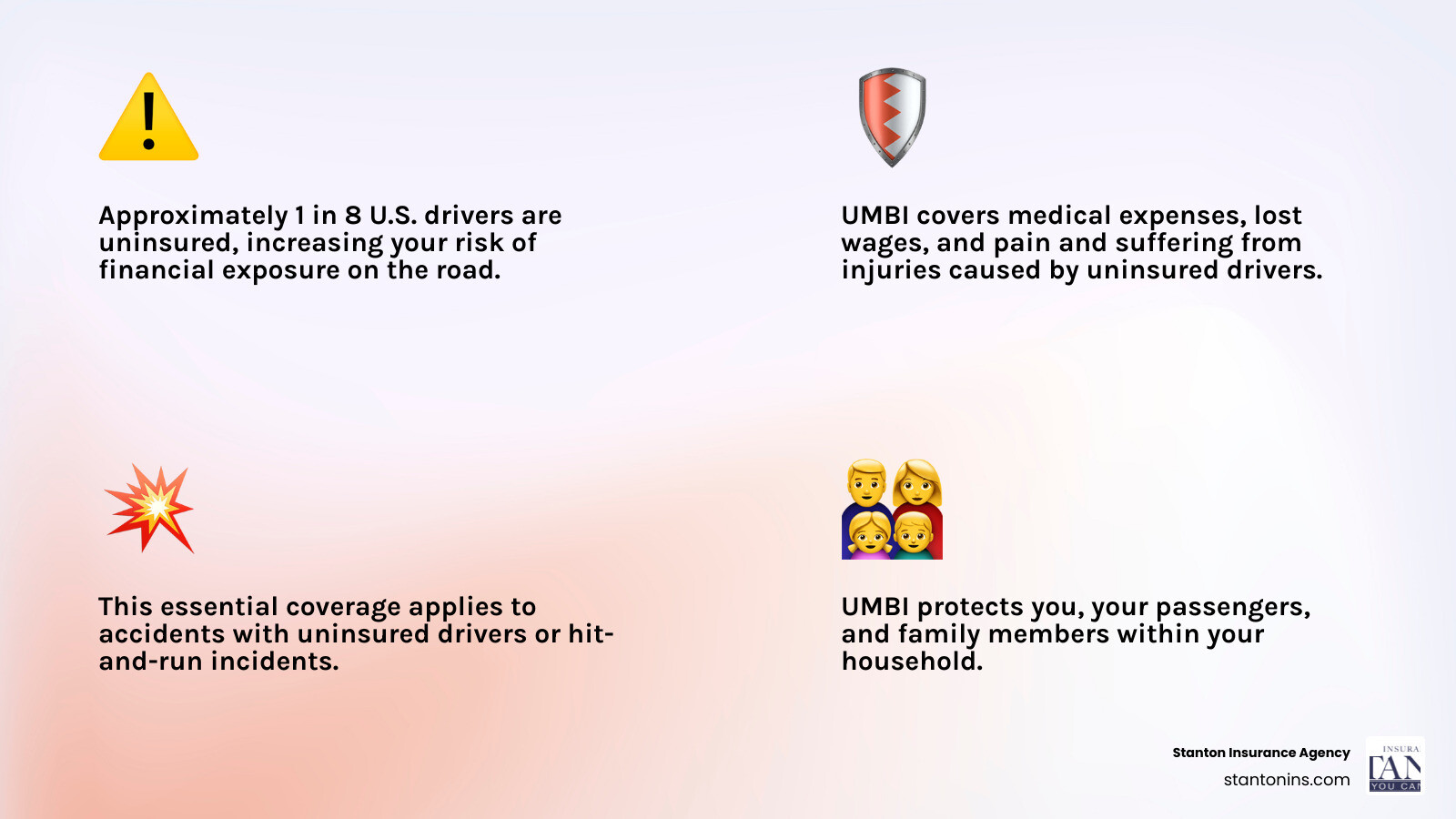
Uninsured motorist bodily injury liability coverage protects you when the at-fault driver has no insurance to pay for your injuries. This essential coverage steps in to pay your medical bills, lost wages, and other damages when an uninsured or hit-and-run driver causes an accident.
Quick Answer for UMBI Coverage:
- What it covers: Medical expenses, lost wages, pain and suffering, rehabilitation costs
- When it applies: Accidents with uninsured drivers or hit-and-run incidents
- Who it protects: You, your passengers, and family members in your household
- Cost: Relatively inexpensive add-on that can save thousands in out-of-pocket expenses
The statistics are sobering. Roughly 13% of drivers nationwide — or about 1 in 8 — drove uninsured in 2019. That means every time you get behind the wheel, there’s a real chance you could encounter a driver who can’t pay for the damage they cause.
In Massachusetts and New Hampshire, this coverage isn’t optional. Both states require uninsured motorist bodily injury coverage because lawmakers recognize the financial devastation an uninsured driver can cause to innocent victims.
I’m Geoff Stanton, President of Stanton Insurance Agency in Waltham, Massachusetts, and I’ve been helping families understand uninsured motorist bodily injury liability coverage for over two decades. Through my experience in claims and as a Certified Insurance Counselor, I’ve seen how this coverage becomes a financial lifeline when the unexpected happens.
The Financial Shield: What Uninsured Motorist Bodily Injury Liability Covers
Uninsured motorist bodily injury liability (UMBI) coverage serves as your crucial financial safety net when an accident occurs with a driver who lacks proper insurance. Imagine this: you’re driving along, minding your own business, and suddenly, boom! Someone hits you, and they don’t have insurance. Without UMBI, you could be left holding the bag for thousands, or even hundreds of thousands, of dollars in medical bills and other expenses. This coverage is designed to protect you, your loved ones, and even your passengers, from the financial fallout when others fail to meet their legal and ethical obligations on the road.
UMBI Explained: This essential coverage pays for your medical expenses, lost wages, pain and suffering, and more if you’re injured by an uninsured or hit-and-run driver. It also protects you as a pedestrian or passenger.
Learn more: What is Bodily Injury Liability?
Read the statistics: One in Eight Drivers Uninsured
What expenses does UMBI pay for?
When an uninsured driver causes an accident and injures you, your family, or your passengers, uninsured motorist bodily injury liability coverage steps in to cover the costs that the at-fault driver’s non-existent insurance should have paid. This can include a wide range of expenses to help you on your road to recovery.

UMBI covers:
- Hospital and doctor bills: From emergency room visits to ongoing specialist appointments, UMBI helps cover the direct costs of medical treatment.
- Physical therapy and rehabilitation: If your injuries require long-term care to regain mobility or function, this coverage can help with those crucial recovery expenses.
- Ambulance fees: The immediate costs of emergency transport are often substantial, and UMBI can ensure these are covered.
- Lost income from being unable to work: If your injuries prevent you from performing your job, UMBI can help replace the wages you lose during your recovery period. This can be a significant relief, especially for those who are self-employed or don’t have extensive sick leave.
- Long-term care needs: For severe injuries that result in permanent disability or require ongoing assistance, UMBI can contribute to the costs of long-term care, providing a much-needed safety net.
- Funeral expenses: In the tragic event of a fatality caused by an uninsured driver, UMBI can provide coverage for funeral and burial costs, easing the financial burden on grieving families.
- Compensation for pain and suffering: Beyond tangible medical bills and lost wages, UMBI can also provide compensation for the emotional and physical distress caused by your injuries. This acknowledges the non-economic impact of the accident on your life.
Essentially, UMBI acts like the at-fault driver’s liability insurance, but it’s your policy that pays out. It’s designed to put you in a similar financial position as if the at-fault driver had been properly insured.
Does UMBI cover hit-and-run accidents?
Yes, absolutely! If you’re the victim of a hit-and-run, uninsured motorist bodily injury liability coverage can step in as your primary coverage. We’ve all heard the horror stories: someone gets hit, the other driver speeds off, and you’re left with injuries and no one to hold accountable. This is precisely why UMBI is so vital.
For UMBI to apply in a hit-and-run scenario, you typically need to file a police report within a reasonable timeframe and document the incident thoroughly. This helps your insurance company verify that another vehicle was indeed involved and that the driver fled the scene. While the specific requirements might vary slightly by state or insurer, the core principle remains: UMBI is there to protect you even when the at-fault driver is a ghost. It ensures that you aren’t left without recourse simply because the responsible party chose to disappear.
Learn more: What is Uninsured Motorist Coverage vs. Collision?
Uninsured vs. Underinsured: Understanding the Key Differences
Here’s where things get a bit tricky, but stick with me–understanding these differences could save you thousands. While uninsured motorist bodily injury liability coverage protects you from drivers with no insurance at all, underinsured motorist coverage handles a different but equally frustrating scenario. Both shield you from drivers who can’t fully pay for your injuries, but they kick in at different moments.
Think of it this way: uninsured coverage is like having an umbrella when there’s no roof over your head. Underinsured coverage is like having that umbrella when the roof has holes in it. Both keep you dry, but they’re solving different problems.
Learn more: What is Liability Car Insurance?
Defining Uninsured vs. Underinsured Motorist Coverage
The key difference boils down to whether the at-fault driver has any insurance at all. Uninsured motorist coverage steps in when the driver who hit you has absolutely no insurance–or when they’ve fled the scene and you can’t identify them. It’s a complete absence of coverage on their part.
Underinsured motorist coverage, on the other hand, deals with drivers who do have insurance, but not nearly enough. Picture this: you’re in a serious accident that racks up $80,000 in medical bills and lost wages. The driver who caused the crash has insurance, but only $25,000 worth. That leaves you with a $55,000 gap that their insurance can’t fill.
| Feature | Uninsured Motorist (UM) Coverage | Underinsured Motorist (UIM) Coverage |
|---|---|---|
| At-Fault Driver’s Status | Has no insurance or is unidentified | Has insurance, but not enough coverage |
| Purpose of Your Coverage | Protects you from uninsured drivers | Fills the gap when at-fault driver’s limits are too low |
| When It Applies | Uninsured or hit-and-run accidents | Severe accidents with underinsured drivers |
The reality is that many drivers carry only their state’s minimum liability limits, which often haven’t kept pace with rising medical costs. What seemed like adequate coverage twenty years ago can feel laughably small when you’re facing modern healthcare bills.
Why you might need both coverages
Here’s the uncomfortable truth: state minimums are often woefully inadequate for serious injuries. Massachusetts requires only $20,000 per person in bodily injury liability coverage–an amount that can disappear faster than free donuts in a break room when you’re dealing with a significant injury.
Medical costs have skyrocketed while minimum insurance requirements have largely stayed the same. A single ambulance ride can cost $1,000 or more. A brief hospital stay can easily hit $10,000. If you need surgery or extended rehabilitation, you’re looking at costs that can quickly climb into six figures.
That’s where having both coverages becomes crucial. Your uninsured motorist coverage protects you from the completely uninsured drivers, while underinsured coverage fills the gaps when someone’s policy limits fall short of your actual damages.
Without both types of protection, you’re essentially playing financial roulette every time you drive. You’re hoping that if someone hits you, they’ll not only have insurance but also enough insurance to cover whatever injuries they cause. That’s a big gamble to take with your family’s financial security.
Learn more: Auto Insurance
UMBI in Massachusetts & New Hampshire: Requirements, Limits, and Costs
Understanding the specific laws in your state is crucial, and here in Massachusetts and New Hampshire, we’re particularly focused on ensuring our clients are well-protected. Both states recognize the serious risks posed by uninsured drivers, which is why uninsured motorist bodily injury liability coverage is a fundamental part of auto insurance policies.
State laws in Massachusetts and New Hampshire require UMBI coverage. Understanding your policy’s limits and options like stacking can help you maximize your protection.
Learn more: Car Insurance in MA
State-mandated uninsured motorist bodily injury liability
While the general concept of uninsured motorist bodily injury liability is consistent across the U.S., the specifics of requirements and limits can vary significantly by state. For our neighbors in Massachusetts and New Hampshire, here’s what you need to know:
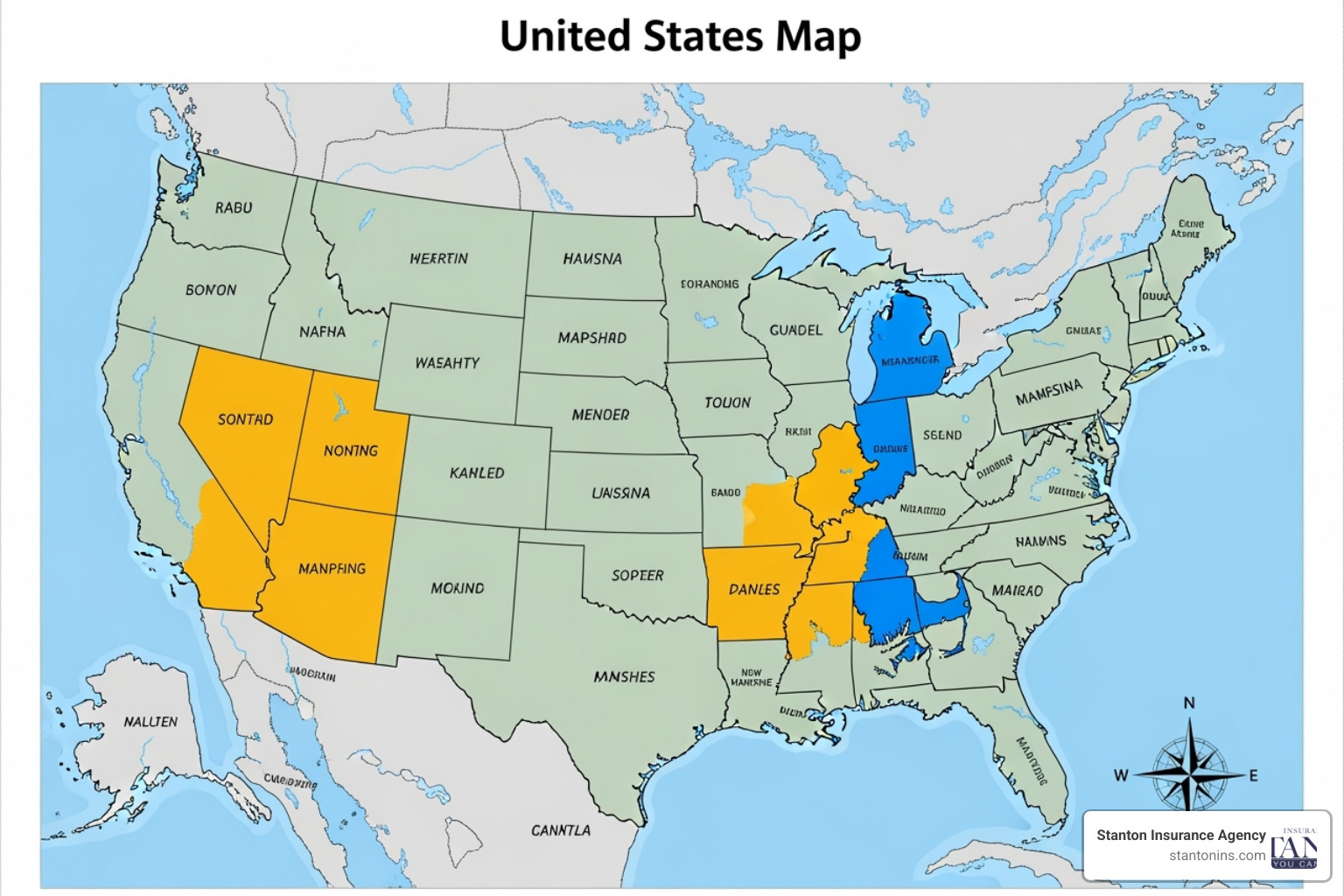
- Massachusetts: UMBI is mandatory. Minimum limits are $20,000 per person and $40,000 per accident. This means your policy would cover up to $20,000 for injuries to one person and a total of $40,000 for all injured parties in a single accident caused by an uninsured driver. While these are the minimums, we often recommend higher limits to truly protect yourself from the soaring costs of medical care.
- New Hampshire: UMBI is required if you purchase auto insurance. Minimum limits in New Hampshire match your liability coverage. So, if you choose $100,000/$300,000 for your bodily injury liability, your uninsured motorist bodily injury coverage would also be set at $100,000/$300,000. This ensures a consistent level of protection, whether the at-fault driver is insured or not.
These requirements are in place for a good reason: to shield innocent drivers and their families from devastating financial burdens. Given that roughly 1 in 8 drivers nationwide are uninsured, this coverage isn’t just a legal formality; it’s a practical necessity.
Learn more: What is the Minimum Car Insurance Coverage in Massachusetts?
Read more: Part II – What is in my insurance policy – Mass.gov
Understanding Coverage Limits and ‘Stacking’
When we talk about coverage limits for uninsured motorist bodily injury liability, there are a couple of key terms you’ll encounter:
- Per-Person Limit: This is the maximum amount your policy will pay for injuries sustained by any single person in an accident. For example, if your policy has a $50,000 per-person limit, that’s the most it will pay for one individual’s medical bills, lost wages, and pain and suffering.
- Per-Accident Limit: This is the total maximum amount your policy will pay for all injuries sustained by everyone involved in a single accident, regardless of how many people were hurt. If your policy has a $100,000 per-accident limit and three people are injured, the total payout for all three combined cannot exceed $100,000.
Now, let’s talk about a powerful feature called ‘stacking’. This can significantly increase your protection:
- Stacking: In some cases, you can combine coverage from multiple vehicles or policies to increase your overall protection. This is like adding layers to your financial shield. For instance, if you have two cars, each with a $50,000 per-person UMBI limit, and you choose to stack your coverage, you might effectively have $100,000 in coverage available per person. This option is particularly valuable for families with multiple vehicles, as it can provide a much higher level of financial security. We always recommend discussing stacking options with your insurance agent to see if it’s available and beneficial for your specific situation.
The cost of uninsured motorist bodily injury liability coverage is generally quite low, especially when compared to the immense financial protection it offers. It’s often less than half the cost of your liability coverage when purchased in similar amounts. This small investment can save you tens, or even hundreds, of thousands of dollars if you’re ever involved in an accident with an uninsured driver. It’s one of the most cost-effective ways to improve your auto insurance safety net.
Learn more: Why is Car Insurance So Expensive in Massachusetts?
After the Crash: How to Use Your UMBI Coverage
Nobody expects to be in a car accident, and finding the other driver doesn’t have insurance can turn a stressful situation into a financial nightmare. But here’s the good news: if you have uninsured motorist bodily injury liability coverage, you’re protected. The key is knowing exactly what steps to take in those crucial first moments after the crash.
I’ve guided countless clients through this process over the years, and I can tell you that being prepared makes all the difference. When emotions are running high and you’re dealing with potential injuries, having a clear action plan can help protect both your health and your financial future.
Learn more: Is Massachusetts a No-Fault Car Insurance State?
What to do immediately after an accident with an uninsured driver
The moments right after an accident can feel overwhelming, but your actions during this time can make or break your uninsured motorist bodily injury liability claim. Think of it as building your case from the very beginning.
First, prioritize safety. Make sure everyone is okay and call 911 immediately. Even if injuries seem minor, it’s better to have emergency responders assess the situation. Move to a safe location if you can do so without causing further harm.
Don’t take the other driver’s word about their insurance status. Even if they tell you they’re uninsured, collect every piece of information you can get. Write down their name, phone number, driver’s license number, and the make, model, and license plate of their vehicle. If they have an insurance card (even if it’s expired), get that information too. Sometimes drivers think they’re uninsured when they actually have coverage, or they might be lying to avoid complications.
Document everything like your financial future depends on it – because it does. Use your phone to take photos of both vehicles from multiple angles, the accident scene, street signs, traffic signals, road conditions, and any visible damage or injuries. Write down the exact time, date, and location of the accident. These details might seem unimportant now, but they become crucial evidence later.
Talk to witnesses and get their contact information. Independent witnesses can provide unbiased accounts of what happened, which can be invaluable if there are disputes about who was at fault. Ask for their names and phone numbers – most people are willing to help.
File a police report without exception. This step is absolutely critical for uninsured motorist bodily injury liability claims. The police report creates an official record of the accident and often includes the officer’s assessment of fault. For hit-and-run accidents, a police report is typically required for your UMBI coverage to apply.
Seek medical attention, even if you feel fine. Adrenaline can mask pain and injuries immediately after an accident. Some injuries, particularly soft tissue damage like whiplash, don’t show symptoms until hours or days later. Getting checked out by a medical professional creates a clear link between the accident and any injuries you might have sustained.
Contact us as soon as you’re safely able to do so. The sooner we know about the accident, the sooner we can start helping you steer the claims process and ensure you’re getting all the benefits you’re entitled to under your policy.
How to file an uninsured motorist bodily injury liability claim
Filing a uninsured motorist bodily injury liability claim is like asking your own insurance company to step into the shoes of the uninsured driver who hit you. Your insurer essentially becomes responsible for paying the damages that the at-fault driver should have covered – but only if that driver was legally responsible for the accident.
Start by contacting your insurance company immediately. When you call, have all your documentation ready: the police report number, photos from the scene, witness contact information, and details about any medical treatment you’ve received. The more organized you are, the smoother the process will go.
Gather and submit comprehensive documentation. Your insurance company will need proof of everything – your medical records, bills from doctors and hospitals, documentation of any physical therapy or rehabilitation, proof of lost wages from your employer, and receipts for any out-of-pocket expenses related to the accident. Think of it as telling the complete story of how this accident has impacted your life financially.
Cooperate fully with your insurer’s investigation, but understand what they’re looking for. Your insurance company needs to verify two main things: that the other driver was indeed uninsured (or underinsured), and that they were at fault for the accident. This investigation might include giving recorded statements, allowing them to inspect your vehicle, or even undergoing an independent medical examination to verify your injuries.
Your insurance company will only pay out if the other driver was legally responsible for the accident. If there’s a dispute about fault or the amount of damages, many policies include arbitration clauses – a way to resolve disagreements without going to court.
The claims process can take time, especially if your injuries are severe or if there are complications in determining fault. But having uninsured motorist bodily injury liability coverage means you have a path to recovery that doesn’t depend on the financial responsibility of someone who chose to drive without proper insurance.
Learn more: What to Do After a Car Accident
Frequently Asked Questions about Uninsured Motorist Bodily Injury Liability
Insurance questions keep you up at night? You’re not alone! We get calls every day from folks trying to wrap their heads around uninsured motorist bodily injury liability coverage. Let’s clear up the confusion with straight answers to the questions we hear most often.
Do I still need UMBI coverage if I have good health insurance?
Absolutely, yes! This is probably the biggest misconception we encounter. Your health insurance is fantastic for covering those doctor visits and hospital stays, but it’s only part of the puzzle when an uninsured driver turns your world upside down.
Think about it this way: health insurance won’t cover lost wages, pain and suffering, or other non-medical damages. If you’re laid up for three months because someone without insurance plowed into you, who’s going to replace your paycheck? Your health insurance company? Not a chance.
Here’s where uninsured motorist bodily injury liability coverage really shines. It can also help with your health insurance deductible and copays, providing a more complete financial recovery after an accident you didn’t cause. It’s like having a safety net under your safety net – because one layer of protection just isn’t enough when someone else’s irresponsibility threatens your financial stability.
Will filing a UMBI claim make my insurance rates go up?
This worry keeps a lot of people from filing legitimate claims, and honestly, it breaks our heart. The good news? Generally, a not-at-fault accident, including a UMBI claim, should not cause your rates to increase in states like Massachusetts. Since the accident was caused by the uninsured driver, your insurer typically cannot penalize you for using the coverage you’ve paid for.
Think of it this way – you’ve been paying your premiums faithfully, driving responsibly, and then some uninsured driver hits you. Why should you be punished for their mistake? Insurance companies understand this logic too. They’ll go after the at-fault driver (if they can find them) to recover costs, not take it out on you at renewal time.
Your rates are affected by things like your driving record, at-fault accidents, and the type of car you drive – not by using coverage that exists specifically to protect you from other people’s poor choices.
Can I reject UMBI coverage in Massachusetts or New Hampshire?
Here’s where Massachusetts and New Hampshire lawmakers put their foot down: In both Massachusetts and New Hampshire, Uninsured Motorist Bodily Injury (UMBI) coverage is mandatory and cannot be rejected. It is a required part of every standard auto insurance policy to protect drivers from the significant financial risks posed by uninsured motorists.
This isn’t some insurance company trying to pad your bill – it’s your state government recognizing that with roughly 1 in 8 drivers on the road being uninsured, leaving this coverage optional would be like playing financial Russian roulette. The legislators looked at the data, saw the devastation uninsured drivers cause to innocent families, and decided this protection needed to be non-negotiable.
So while you might not have a choice in carrying this coverage, you can take comfort knowing it’s there when you need it most. And trust us, if that day ever comes, you’ll be grateful for lawmakers who had your back.
Secure Your Drive with the Right Protection
Picture this: you’re cruising down the highway, music playing, everything perfect – until it’s not. In a split second, an uninsured driver changes your life. With roughly 1 in 8 drivers lacking proper insurance coverage, this scenario isn’t just possible; it’s probable enough that you need to be prepared.
Uninsured motorist bodily injury liability coverage isn’t just another line item on your insurance policy – it’s your financial lifeline when the unthinkable happens. While your health insurance might cover your medical bills, it won’t replace your lost wages when you can’t work for months. It won’t compensate you for the pain and suffering you endure. And it certainly won’t help with those hefty deductibles and copays that pile up faster than snow in a New England winter.
Think of UMBI as your personal financial bodyguard. It steps in when the other driver can’t – or won’t – take responsibility for the damage they’ve caused. Without it, you’re essentially gambling with your family’s financial future every single time you turn the key in your ignition.
At Stanton Insurance Agency, we’ve seen too many families struggle with the aftermath of accidents caused by uninsured drivers. The good news? This coverage is surprisingly affordable for the massive protection it provides. We’re talking about potentially saving tens of thousands of dollars for what often costs less than your monthly coffee budget.
Don’t wait for an accident to find gaps in your coverage. As a local business, we’re dedicated to providing trusted protection for your valuable assets, and that means making sure you understand exactly what you have – and what you might be missing. Our team is here to help you review your current policy and ensure you’re truly protected for whatever the road throws your way.
The peace of mind that comes with proper uninsured motorist bodily injury liability coverage? That’s priceless. But the coverage itself is surprisingly affordable, and we’re here to help you get it right.
Learn more: What You Need to Know About Auto Insurance
Ready to protect yourself? Get a comprehensive car insurance quote now.