
Why Property Owner Liability Matters for Every Property Owner
Property owner liability is the legal responsibility you have when someone is injured on your property due to unsafe conditions or your negligence. This responsibility applies whether you own a home, rental property, or commercial building.
Key aspects of property owner liability:
- Duty of Care: Property owners must maintain reasonably safe conditions for visitors.
- Visitor Status Matters: You owe different levels of responsibility to invited guests, social visitors, and trespassers.
- Common Hazards: Slip and falls, poor lighting, icy walkways, and inadequate security are frequent causes of claims.
- Financial Risk: Without proper insurance, you could face devastating out-of-pocket costs for medical bills, legal fees, and settlements.
- Prevention is Key: Regular inspections, prompt repairs, and adequate warnings can significantly reduce your liability risk.
As a property owner, you might think you’re protected simply because you didn’t intend for anyone to get hurt. Unfortunately, that’s not how the law works. The reality is that if someone slips on your icy sidewalk, trips over a broken step, or is injured by a hazard you knew about (or should have known about), you could be held financially responsible for their medical bills, lost wages, pain and suffering, and more. These claims can easily reach six or seven figures, putting your home, rental income, business assets, and personal savings at serious risk.
The legal foundation rests on a principle called “premises liability.” It’s rooted in negligence law, which says that property owners have a duty to maintain a safe environment and warn visitors of dangers they might not see. When you fail in this duty and someone gets hurt as a result, you can be sued. The level of care you owe depends on the visitor’s legal status—whether they’re a customer, a social guest, or even a trespasser—and the laws of your state.
My name is Geoff Stanton, and as President of Stanton Insurance Agency in Waltham, Massachusetts, I’ve spent over two decades helping property owners understand and protect themselves from property owner liability risks, particularly through comprehensive Commercial Property & Liability and Artisan Contractor programs. This guide will walk you through the legal framework, your specific duties, common hazards, and the insurance protections you need to safeguard your financial future.
Property owner liability further reading:
- Apartment Building Insurance
- Safeguarding Your Investment: A Landlord’s Guide to Building Insurance
- does apartment building insurance have dog bite
The Legal Foundation of Property Owner Liability

Property owner liability isn’t about being responsible for every accident; it’s rooted in the legal concept of negligence. Premises liability law dictates that owners have a duty to maintain a reasonably safe environment. When they fail in this duty and someone gets hurt as a result, they can be held financially responsible for the damages. Understanding the core components of a claim is the first step in mitigating your risk.
What is Premises Liability?
At its heart, premises liability is the legal principle that holds property owners accountable for injuries that occur on their property due to unsafe conditions or their negligence. As Merriam-Webster defines it, premises liability is “liability arising from injuries or losses occurring on one’s premises.” This broad definition covers a wide array of incidents, from a simple slip and fall to more complex cases involving inadequate security.
The essence of a premises liability claim hinges on negligence. This means the injured party must prove that the property owner failed to uphold their “duty of care” – a legal obligation to act reasonably to prevent harm to others. When this duty is breached, and that breach directly causes an injury resulting in damages, the property owner can be held liable. Premises liability claims account for a significant portion of personal injury lawsuits, with slip and fall accidents being the most common type.
Key Elements of a Negligence Claim
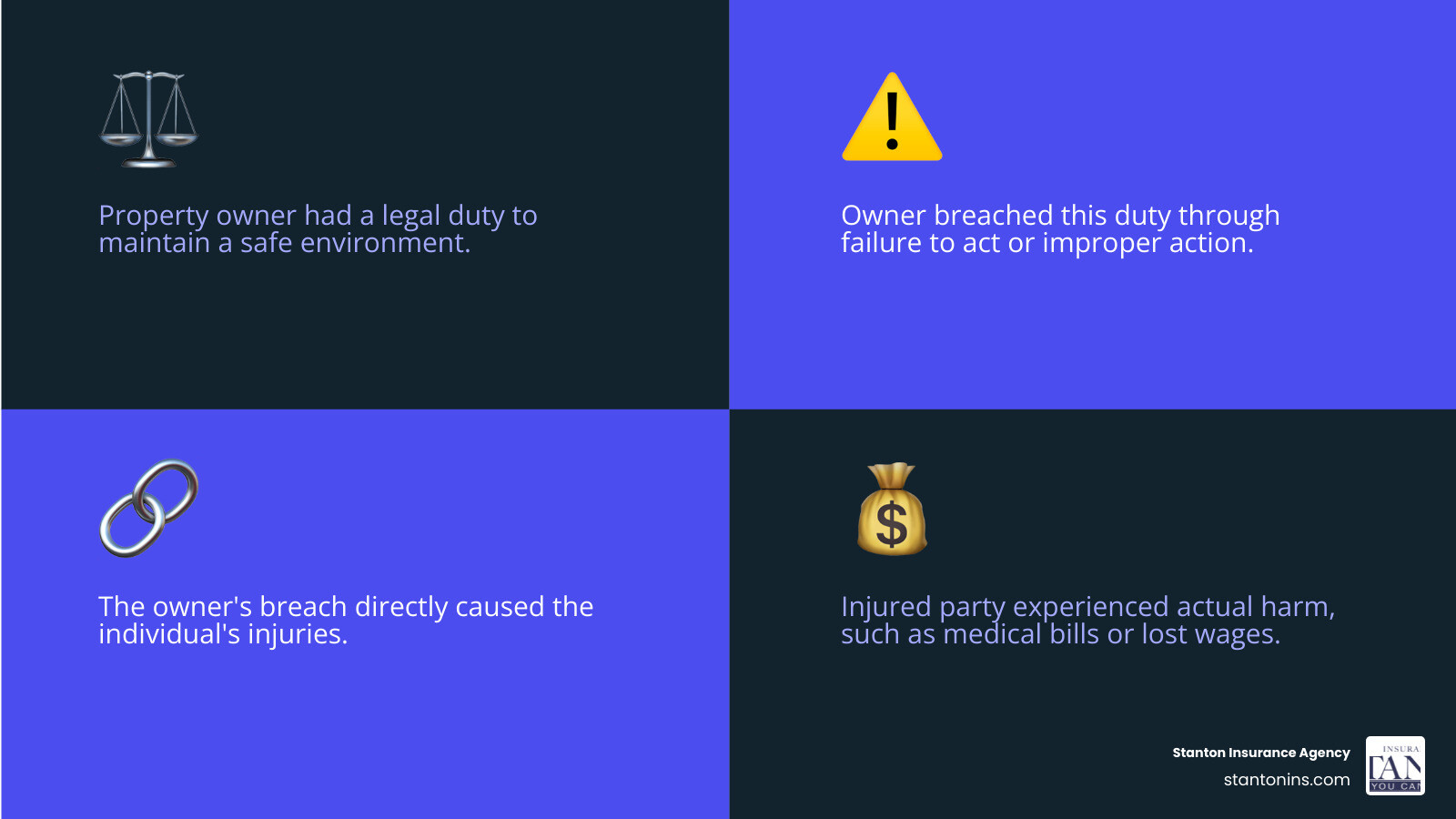
To successfully pursue a premises liability claim, the injured party (the plaintiff) typically needs to prove four key elements of negligence. Think of these as the four pillars holding up a legal case:
- Duty: The property owner had a legal duty to the injured person to maintain a safe property. This means they had an obligation to act reasonably to prevent harm.
- Breach: The owner breached that duty by failing to act or acting improperly. For example, they might have known about a broken step but failed to repair it, or they didn’t put up a “wet floor” sign after a spill.
- Causation: The owner’s breach of duty directly caused the person’s injuries. There must be a clear link between the owner’s negligence and the harm suffered. For instance, if someone slipped on a spill that had been there for hours, the owner’s failure to clean it or warn of it caused the fall.
- Damages: The injured person suffered actual harm, such as medical bills, lost wages, or pain and suffering. Without quantifiable damages, there is no basis for a claim.
The Role of State Law and Visitor Status
The specifics of property owner liability are heavily influenced by state laws. While the general principles of premises liability apply across the board, the exact “duty of care” owed can vary significantly from one jurisdiction to another. This is particularly true when it comes to how different types of visitors are treated under the law.
In Massachusetts and New Hampshire, for instance, the legal landscape for premises liability has evolved. While many states traditionally categorize visitors (invitees, licensees, trespassers) to determine the duty of care, both Massachusetts and New Hampshire have moved towards a more unified standard of “reasonable care under all circumstances.” This means that property owners generally owe a duty of reasonable care to all lawful visitors, requiring them to act as a reasonably prudent person would under similar circumstances. However, understanding the traditional classifications of visitors is still crucial, as they often inform what “reasonable care” entails in different situations.
For specific legal advice regarding your situation, always remember to consult an attorney in your area, as state laws differ.
Your Duty of Care: Responsibility Based on Visitor Type
The level of responsibility you have, or your “duty of care,” changes significantly depending on the legal status of the person on your property. Courts traditionally classify visitors into three categories, each with a different level of expected protection. Some states, like Massachusetts, have moved toward a general standard of “reasonable care under all circumstances,” but understanding these classic distinctions is still crucial.
| Visitor Type | Definition | Example | Duty of Care Owed by Property Owner |
|---|---|---|---|
| Invitee | A person on the property for the owner’s financial benefit. | Customer in a store; Repair technician. | Highest duty. Must inspect for, repair, and warn of known and hidden dangers. |
| Licensee | A person on the property with permission, but not for business purposes. | Social guest; Neighbor stopping by. | Mid-level duty. Must warn of known, non-obvious dangers. No duty to inspect for unknown hazards. |
| Trespasser | A person on the property without permission. | Someone taking a shortcut; Burglar. | Lowest duty. Must not intentionally or recklessly cause harm. |
Even with a unified standard of reasonable care, the context of a visitor’s presence—why they are on your property—still influences what a “reasonable” property owner would do. For example, a store owner (with invitees) is expected to conduct more frequent and thorough inspections than a homeowner expecting a social guest (a licensee). For a trespasser, the duty is generally much lower, primarily to avoid intentionally causing them harm.
Special Considerations for Children: The “Attractive Nuisance” Doctrine
Children, bless their curious hearts, don’t always understand danger. This is where the “attractive nuisance” doctrine comes into play, creating a special and significant layer of property owner liability. This doctrine holds that if something on your property is likely to attract children (even trespassers) who are too young to appreciate the danger, you have a higher duty to protect them from it.
Common examples of attractive nuisances include:
- Swimming pools: An unfenced or unsecured pool is a classic example.
- Trampolines: Fun for kids, but a serious liability if not properly secured.
- Unattended machinery or construction sites: Heavy equipment or ongoing projects can be irresistible to young adventurers.
- Piles of lumber or building materials: What looks like a fun climbing structure to a child can be a dangerous trap.
If you have an attractive nuisance on your property, especially in residential areas of Massachusetts or New Hampshire, you must take reasonable steps to prevent children from accessing it and getting injured. This could mean erecting sturdy fences, installing self-latching gates, using pool covers, or securing equipment. Failing to do so can lead to devastating consequences and substantial legal liability.
Common Hazards and Shared Responsibilities
Liability often arises from specific, preventable hazards on a property. Identifying and addressing these risks is a primary responsibility. Furthermore, in rental situations, liability isn’t always straightforward and can be divided between the landlord and the tenant, typically based on who has control over the area where the injury occurred.

Hazardous Conditions That Lead to Liability
Many property owner liability claims stem from common,, dangerous conditions. These aren’t always dramatic; sometimes, it’s the seemingly small things that lead to big problems. Here are some of the most frequent culprits:
- Wet or slippery floors: Spills, leaks, or recently mopped floors without warning signs are prime examples.
- Icy or snowy walkways: Failing to clear ice and snow promptly from sidewalks and entrances, especially in our Massachusetts and New Hampshire winters, is a significant risk.
- Cracked sidewalks and potholes: Uneven walking surfaces are tripping hazards, particularly in commercial parking lots or residential pathways.
- Poor lighting in stairwells, hallways, or parking lots: Inadequate illumination can conceal hazards and contribute to falls, or even make your property a target for criminal activity.
- Broken stairs or missing handrails: These are clear safety violations and major tripping or falling hazards.
- Improperly stacked merchandise or falling objects: In a retail or commercial setting, items falling from shelves can cause serious injury.
- Inadequate security (e.g., broken locks, poor lighting): If a property owner fails to implement reasonable security measures, they could be held liable for injuries resulting from criminal activity.
- Unrestrained pets or dog bites: If you own a pet, especially one with a known aggressive history, you have a responsibility to keep others safe.
Landlord vs. Tenant: Who is Liable?
Determining property owner liability in rental situations can be tricky, as responsibility often falls to whoever has “control” over the area where the injury occurred. This is a common point of confusion for both landlords and tenants in Massachusetts and New Hampshire.
Generally, a landlord is responsible for maintaining common areas (like lobbies, stairwells, hallways, parking lots, and shared laundry rooms). If a tenant or visitor is injured in one of these areas due to the landlord’s negligence (e.g., a broken step in a common stairwell, poor lighting in the parking lot), the landlord would typically be held liable. For more detailed insights, our Residential Landlord Insurance guide digs into these responsibilities.
Conversely, a tenant is generally responsible for conditions within their leased space—the apartment or commercial unit they exclusively control. If a guest is injured inside a tenant’s apartment due to a hazard created or ignored by the tenant, the tenant would likely be liable. Lease agreements are crucial here; they should clearly define maintenance duties and responsibilities for both parties. However, a landlord can still be held liable if they rented out a property with a dangerous condition they knew about and failed to warn the tenant, or if they promised to make repairs but failed to do so.
Understanding this distinction between a property owner’s and an occupier’s liability is essential for both parties.
Proactive Protection: Limiting Liability and Ensuring Coverage
The best defense against a lawsuit is preventing an accident from happening in the first place. A proactive approach to property maintenance, combined with a robust insurance portfolio, creates a powerful shield for your assets. Understanding your legal defenses and insurance options is not just good practice—it’s essential for any property owner.
Proactive Steps to Prevent Accidents
Taking proactive steps is not just about avoiding lawsuits; it’s about creating a safe environment for everyone who sets foot on your property. Here are some key actions you can take to limit your property owner liability:
- Regular Inspections: Conduct routine checks of your property, both inside and out. Look for potential hazards like loose railings, uneven pavement, or faulty lighting. Document these inspections with dates and notes.
- Maintenance Logs: Keep detailed records of all maintenance and repairs. This documentation can be invaluable if you ever need to prove that you acted responsibly.
- Prompt Repairs: Address any identified hazards immediately. A broken step today could be a lawsuit tomorrow. If a repair cannot be made immediately, block off the area or post clear warning signs.
- Warning Signs: For unavoidable or temporary hazards (like a wet floor), use clear and conspicuous warning signs.
- Adequate Lighting: Ensure all areas, especially stairwells, entrances, and parking lots, are well-lit to prevent accidents and deter crime.
- Snow and Ice Removal: In Massachusetts and New Hampshire, this is non-negotiable. Promptly clear snow and treat icy patches on all walkways, steps, and parking areas.
- Securing Attractive Nuisances: If you have a pool, trampoline, or other features that might attract children, ensure they are properly fenced, secured, and supervised.
- Pet Control: If you have pets, particularly dogs, ensure they are properly restrained and controlled, especially when visitors are present. Be aware of and comply with local leash laws.
- Record Keeping: Document everything – inspections, repairs, communications with tenants or guests about hazards, and insurance policies.
Legal Defenses Against a Liability Claim
While prevention is key, understanding potential legal defenses can also provide peace of mind. If a claim is brought against you in Massachusetts or New Hampshire, several defenses might be available:
- Comparative Negligence: This is a crucial defense in our states. If the injured party is found to be partially at fault for their own injury, their compensation can be reduced by their percentage of fault. For example, if a jury awards $10,000 but finds the injured person 25% responsible, they would only receive $7,500. Critically, in both Massachusetts and New Hampshire, if the injured party is found to be more than 50% at fault, they generally cannot recover any damages at all.
- Assumption of Risk: If the injured person knowingly and voluntarily exposed themselves to a specific, obvious risk, you might argue they assumed the risk.
- Open and Obvious Danger: If the hazard was so apparent that any reasonable person would have seen and avoided it, you might argue you had no duty to warn. However, this defense is often limited, especially if the owner could have easily removed the danger.
- Trespasser Status: As discussed, your duty of care to a trespasser is generally very low, unless the attractive nuisance doctrine applies.
The Critical Role of Insurance in Property Owner Liability
Insurance is your financial backstop. If a claim is filed against you, the right policy can cover legal defense costs, medical bills for the injured party, and settlement or judgment payouts up to your policy limits. Without it, you could be paying these astronomical costs out of pocket. Homeowner’s insurance and commercial general liability insurance typically cover premises liability claims, including medical bills, legal costs, and payouts.
Here at Stanton Insurance Agency, we understand the specific needs of property owners in Massachusetts and New Hampshire. We offer a range of policies designed to protect you:
- Homeowner’s & Landlord Policies: These provide essential liability coverage for residential properties, protecting you if someone is injured in your home or on your rental property. Our Insurance for Landlords Complete Guide offers in-depth information.
- Commercial General Liability (CGL): Absolutely essential for business properties, CGL covers claims of bodily injury or property damage that occur on your business premises or arise from your operations. For businesses, this is a foundational layer of protection.
- Apartment Building Insurance: If you own multi-family dwellings, specialized coverage is vital. This protects against common perils like fire and wind, but critically includes liability coverage custom for the unique risks of apartment complexes. You can learn more about this with our Apartment Building Insurance Complete Guide.
- Umbrella Insurance: This provides an extra layer of liability protection above your other policies, kicking in when the limits of your homeowner’s or CGL policy are exhausted. It’s a smart choice for any property owner looking for robust protection against catastrophic claims.
The importance of insurance cannot be overstated. It’s not just a piece of paper; it’s peace of mind, ensuring that one unforeseen accident doesn’t jeopardize your entire financial security.
After an Incident: Immediate Actions and Legal Deadlines
Even with the best precautions, accidents can happen. Your response in the moments, days, and weeks following an injury on your property is critical. Knowing what to do—and what not to do—can significantly impact the outcome of a potential claim. You must also be aware of strict legal deadlines that govern how long someone has to file a lawsuit.
What to Do Immediately After an Injury
If someone is injured on your property, acting calmly and methodically can make a significant difference. Here’s what we recommend:
- Prioritize Medical Help: The first step is always to ensure the injured person receives appropriate medical attention. Call 911 if the injury appears serious.
- Show Compassion, But Do Not Admit Fault: Express concern for their well-being, but avoid making any statements that could be construed as an admission of guilt or negligence. Simply say, “I’m so sorry this happened, let’s make sure you get the help you need.”
- Document the Scene: If possible and safe, take photos or videos of the accident scene from multiple angles. Note the date, time, weather conditions, and any potential hazards that contributed to the incident. Get contact information for any witnesses.
- Preserve Evidence: Do not immediately clean up or repair the area where the accident occurred. This might seem counterintuitive, but preserving the scene as it was immediately after the incident is crucial for investigation.
- Contact Your Insurer Immediately: As soon as possible, notify your insurance provider. They are your first line of defense and will guide you through the claims process.
- Consider Legal Counsel: If you’re unsure about your responsibilities or the potential implications, consulting with an attorney can provide valuable guidance.
Your insurance company is there to help manage the claim and provide a defense if a lawsuit is filed.
Understanding the Statute of Limitations
A statute of limitations is a law that sets a strict time limit on a person’s right to file a lawsuit. In Massachusetts and New Hampshire, the statute of limitations for most personal injury cases, including premises liability, is three years from the date of the injury. This means that an injured party typically has three years from the date of the accident to file a formal lawsuit.
Why is this important for property owners? If a claim is not filed within this specific time frame, the injured party generally loses their right to seek legal remedy, regardless of the merits of their case. While this deadline provides some protection, it doesn’t negate the need for thorough documentation and prompt action on your part immediately following an incident. We always advise clients not to assume a claim won’t be filed just because time has passed; always be prepared and keep records for at least the statute of limitations period.
Frequently Asked Questions about Property Owner Liability
We often get questions from property owners in Massachusetts and New Hampshire about various scenarios related to liability. Here are some common ones:
Can I be held liable if a trespasser is injured on my property?
Generally, your duty to a trespasser is only to avoid intentionally or recklessly harming them. You’re not typically expected to ensure a trespasser’s safety or warn them of non-obvious dangers. However, this changes significantly if the trespasser is a child injured by an “attractive nuisance” like an unfenced pool, an accessible trampoline, or unattended construction equipment. In that case, due to the attractive nuisance doctrine, your property owner liability can be significantly higher, as children are often presumed not to understand the inherent dangers.
What does “pain and suffering” mean in a liability claim?
Pain and suffering refers to the non-economic damages an injured person can claim for physical discomfort, emotional distress, mental anguish, and loss of enjoyment of life resulting from an injury. It is calculated separately from tangible costs like medical bills, lost wages, and property damage (which are considered economic damages) and is often a substantial part of a jury award, particularly in cases involving severe or long-term injuries.
How does a signed “waiver of liability” affect my responsibility?
A waiver can offer some protection, but it is not foolproof. While waivers are commonly used in activities like recreational sports or events, their enforceability varies greatly by state and specific circumstances in Massachusetts and New Hampshire. Courts may not enforce a waiver if it is poorly written, ambiguous, signed under duress, or if the injury resulted from gross negligence, recklessness, or intentional harm on the part of the property owner. A waiver might not protect you from all forms of property owner liability, especially if basic safety standards were ignored.
Secure Your Investment with the Right Protection
Understanding property owner liability is about more than just avoiding lawsuits; it’s about responsible ownership. By maintaining a safe environment, understanding your legal duties, and securing the right insurance, you protect your visitors, your tenants, and your financial future. The complexities of premises liability require a proactive and informed approach.
At Stanton Insurance Agency, we believe in providing trusted protection for your most valuable assets. Don’t leave your property exposed to the significant risks of a liability claim. Contact us today to review your coverage and ensure you have the peace of mind that comes with a comprehensive insurance plan.
Protect your property today. Explore our Apartment Building Insurance options and get a comprehensive quote.