Why New Hampshire Businesses Need Commercial Auto Insurance
Commercial auto insurance NH is essential protection for any business that uses vehicles for work purposes. Unlike personal auto policies, commercial coverage protects your business from liability claims, covers higher-risk business activities, and extends protection to multiple drivers and vehicle types. In New Hampshire, while the state doesn’t mandate insurance for all drivers, businesses must prove financial responsibility—and a commercial auto policy is the most practical and comprehensive way to do so.
Quick Overview: Commercial Auto Insurance in New Hampshire
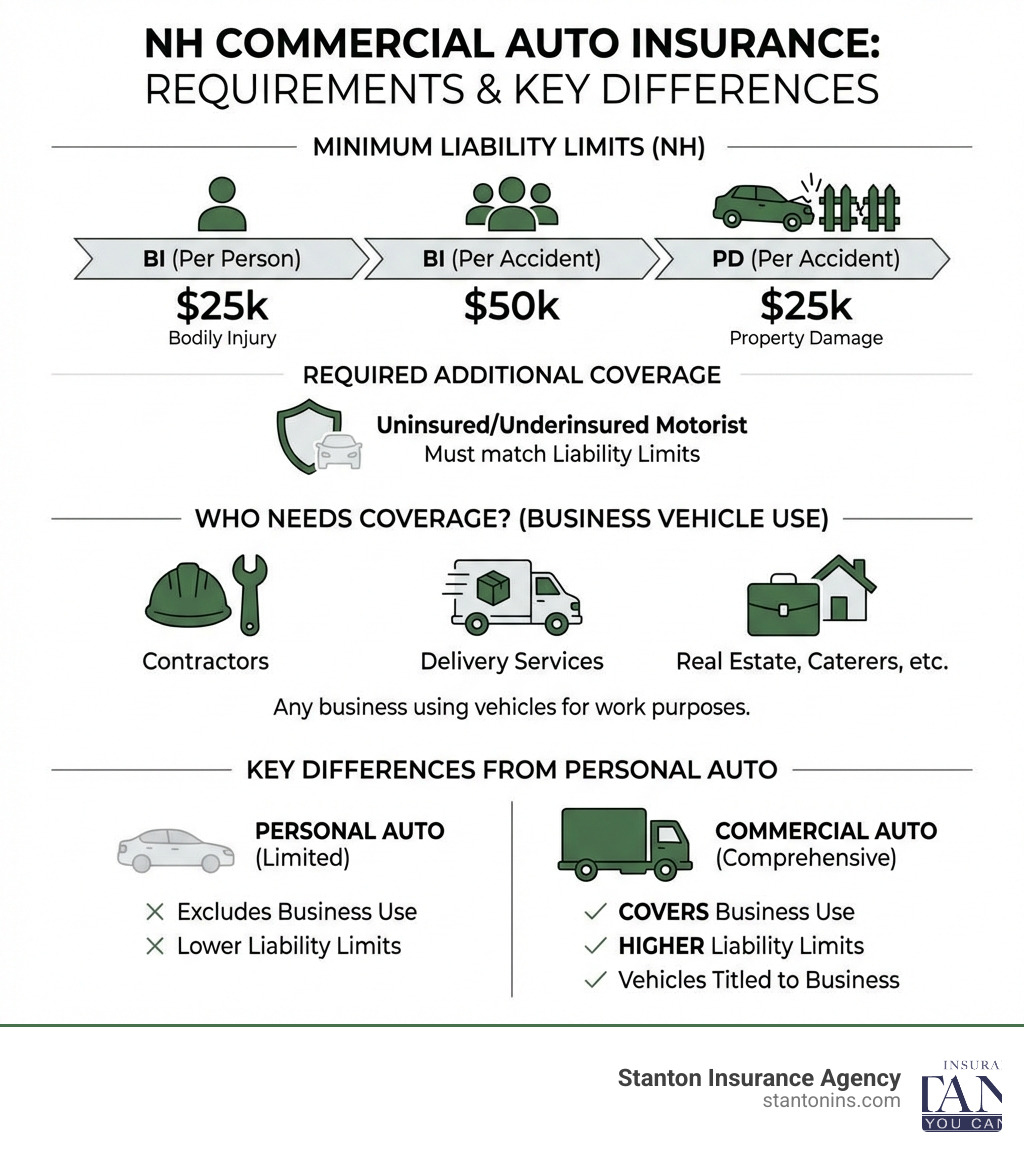
- Who Needs It: Contractors, landscapers, delivery services, real estate agents, caterers, and any business using vehicles for work
- Minimum State Requirements: $25,000/$50,000/$25,000 liability coverage (bodily injury per person/per accident, property damage per accident)
- Required Additional Coverage: Uninsured/underinsured motorist coverage at the same limits as liability
- Average Cost: Approximately $147 per month, though 37% of small businesses pay less than $100 monthly
- Key Difference from Personal Auto: Covers business use, higher liability limits, and vehicles titled to businesses
Why Personal Auto Insurance Won’t Cut It
Personal auto policies typically exclude business use. If you’re transporting tools, making deliveries, or visiting clients in your vehicle, you’re creating a coverage gap that could leave you personally liable for damages in an accident. Commercial auto insurance fills this gap with appropriate liability limits and specialized coverages designed for business operations.
I’m Geoff Stanton, President of Stanton Insurance Agency. For over two decades, I’ve helped New Hampshire businesses steer commercial auto insurance NH requirements and find the right protection. Whether you have one work truck or a fleet, understanding your coverage options is crucial for protecting your assets and operating with confidence.
What is Commercial Auto Insurance and Who Needs It?
At its core, commercial auto insurance is a business insurance policy designed to protect companies from financial losses arising from vehicle accidents. Unlike personal auto insurance, it’s customized for business vehicle use, acknowledging the higher risks involved. It covers vehicles owned by a business, partnership, or corporation, protecting against unique commercial risks—for example, a delivery driver spends more time on the road, increasing accident exposure. The policy typically includes liability coverage (for injuries or property damage you cause) and physical damage coverage (for your own vehicles). Understanding why Commercial Auto Insurance Why It Matters is the first step toward securing your business’s future.
Who Needs Commercial Auto Insurance in NH?
If your business in the Granite State uses vehicles for operations, you likely need commercial auto insurance NH. Many business owners underestimate their need for this specialized coverage.
You probably need a commercial policy if your vehicle is:
- Used to transport goods, equipment, or people for a fee.
- Owned by a corporation, partnership, or LLC.
- Used by employees.
- Heavier than a standard passenger vehicle (e.g., a large pickup truck or box truck).
- Equipped with work-related modifications (e.g., ladder racks, permanent toolboxes).
Common professions in New Hampshire that require commercial auto insurance NH include:
- Contractors: Plumbers, electricians, builders, roofers, and HVAC technicians.
- Landscapers and Snow Plow Operators: Using trucks for hauling equipment and clearing snow.
- Real Estate Agents: Transporting clients and visiting properties.
- Caterers and Food Trucks: Transporting food and equipment.
- Delivery Services: For packages, food, or floral arrangements.
- Non-Emergency Medical Transport: Transporting patients requires high liability limits.
- Consultants: Visiting clients as a core part of business.
- Cleaning Services: Carrying supplies and staff to job sites.
- Manufacturers: Delivering products or transporting equipment.
If a vehicle is integral to your business operations, a personal policy won’t provide adequate protection.
Commercial Auto Insurance NH: Requirements, Costs, and Penalties
Understanding New Hampshire’s unique approach to auto insurance is crucial for every business owner. While the state doesn’t mandate insurance for all drivers, it does require you to prove financial responsibility, making a commercial policy the most practical way to protect your business.
New Hampshire’s Financial Responsibility Law
New Hampshire’s “Live Free or Die” motto extends to its auto insurance laws; it’s one of the few states that doesn’t mandate coverage for all drivers. However, this freedom comes with a major caveat: you must prove you can meet the state’s Motor Vehicle Financial Responsibility Requirements if you cause an accident. If you can’t cover the costs, you face severe penalties like license and registration suspension. For a business, this can be catastrophic. A commercial auto insurance policy is the most reliable way for businesses to demonstrate financial responsibility and avoid operational shutdowns.
Minimum Coverage Requirements
While NH doesn’t mandate insurance, any policy must meet minimum financial responsibility requirements. We often recommend higher limits, as these minimums can be quickly exhausted in a serious accident.
Minimum liability limits in New Hampshire:
- Bodily Injury Liability: $25,000 per person / $50,000 per accident.
- Property Damage Liability: $25,000 per accident.
- Uninsured/Underinsured Motorist (UM/UIM): $25,000 per person / $50,000 per accident. This is required and must match your liability limits.
- Medical Payments: $1,000 per person.
For more details, consult the New Hampshire Auto Insurance Guide.
Factors Influencing Your Commercial Auto Insurance NH Premium

The cost of your commercial auto insurance NH policy is based on your business’s unique risk profile. Understanding these factors can help you manage costs.
Key factors influencing your premium:
- Profession & Vehicle Use: A contractor’s truck hauling heavy equipment poses a different risk than a real estate agent’s sedan.
- Vehicle Type: The make, model, age, and weight of your vehicles impact your premium. Heavier, more expensive vehicles cost more to insure.
- Driving Records: Insurers review the motor vehicle reports for all drivers, typically for the last three years. Clean records lead to lower rates.
- Travel Radius: Local operations are typically less risky than regional or multi-state travel.
- Coverage Limits & Deductibles: Higher liability limits increase your premium, while a higher deductible can lower it.
- Claims History: A record of frequent or costly claims will likely result in higher premiums.
- Location: Rates are affected by where vehicles are garaged and operated, considering factors like traffic density and claim frequency.
- Telematics: Some insurers offer discounts for using devices that monitor safe driving behavior.
On average, commercial auto insurance costs around $147 per month, but 37% of small business customers often pay less than $100 per month, showing how much rates can vary.
Penalties for Inadequate Coverage
The penalties for failing to meet New Hampshire’s financial responsibility requirements are severe:
- License and Registration Suspension: If you can’t pay for damages in an at-fault accident, your license and registration can be suspended, halting business operations.
- Personal Liability: Without insurance, your business and personal assets are exposed. You could be liable for all damages, potentially amounting to hundreds of thousands of dollars.
- Potential for an SR22 Insurance NH Filing Requirement: You may be required to file an SR-22 certificate, which often leads to higher insurance rates.
- Fines and Legal Fees: You could face state fines and significant legal fees if sued.
The financial risks of being uninsured far outweigh the cost of a proper commercial auto insurance NH policy. For more details, refer to the state’s information on penalties for not carrying auto insurance.
Decoding Your Policy: Coverages and Vehicle Types
A commercial auto insurance policy is more than just liability. It’s a suite of coverages you can tailor to fit your business’s specific needs, protecting your vehicles and your bottom line.
Standard Coverages Explained
When we help you set up your commercial auto insurance NH policy, we’ll ensure you have the foundational coverages that protect your business from the most common risks on the road:
- Liability Coverage: Covers costs if your business vehicle is at-fault in an accident that injures others or damages their property. It’s the most critical part of your policy. Learn more about Auto Insurance Liability Coverage.
- Collision Coverage: Pays to repair or replace your business vehicle if it’s damaged in a collision, regardless of fault.
- Comprehensive Coverage: Covers damage to your business vehicle from non-collision events like theft, vandalism, fire, or hitting an animal.
- Uninsured/Underinsured Motorist (UM/UIM) Coverage: Required in NH, this protects you if an at-fault driver has no insurance or not enough to cover the damages.
- Medical Payments Coverage: Also required in NH, this covers medical expenses for you and your passengers, regardless of fault.
Recommended Additional Coverages for NH Businesses
While standard coverages form a solid base, New Hampshire businesses often benefit from additional protections:
- Physical Damage Coverage: This term combines Collision and Comprehensive, ensuring your work vehicles are protected against a wide range of physical damage.
- Towing and Labor: Helps cover costs for towing and basic roadside assistance.
- Rental Reimbursement: Helps pay for a temporary rental vehicle if yours is being repaired after a covered claim, keeping your business running.
- Coverage for Permanently Attached Equipment: Protects valuable, permanently installed equipment like ladder racks, toolboxes, or plows.
- Business Auto Improvements: Some policies offer packages with features like lease gap coverage (important for leased vehicles) and increased medical payments.
What Types of Vehicles Are Covered?
Our commercial vehicle insurance can be customized to cover a wide array of vehicles used by New Hampshire businesses:
- Cars, SUVs, and Passenger Vans: Used by real estate agents, consultants, or for client transport.
- Pickup Trucks and Work Vans: The backbone of many businesses, from contractors to delivery companies.
- Box Trucks and Utility Trucks: Essential for moving goods, equipment, or providing specialized services.
- Insurance for commercial trucks: This includes heavy-duty vehicles like dump trucks, flatbeds, and tractor-trailers. Businesses operating these vehicles may have additional liability requirements.
We also insure specialized vehicles like food trucks and non-emergency medical transport vans.
Personal vs. Commercial and Specialized Policies
Using a personal vehicle for work can create dangerous coverage gaps. Understanding the distinction between policy types and knowing when you need specialized coverage is key to being fully protected.
Key Differences: Commercial vs. Personal Auto Insurance
Many business owners mistakenly believe a personal auto policy covers work use. The differences between personal and commercial policies are substantial:
| Feature | Personal Auto Insurance | Commercial Auto Insurance |
|---|---|---|
| Primary Use | Commuting, errands, pleasure | Business tasks, transporting goods/people |
| Covered Vehicles | Vehicles titled to an individual | Vehicles titled to a business; heavier vehicles |
| Liability Limits | Lower, suited for personal risk | Higher, to protect business assets |
| Covered Drivers | Policyholder and listed household members | Employees and other designated drivers |
| Exclusions | Typically excludes business use, especially delivery | Covers business use; personal use often allowed |
| Cost | Generally lower premiums | Generally higher premiums due to increased risk and liability |
| Claims Handling | Designed for individual incidents | Specialized for business-related incidents, potentially complex |
| Vehicle Modifications | Limited coverage for aftermarket modifications | Covers specialized equipment and permanent vehicle modifications |
Understanding Hired and Non-Owned Auto (HNOA) Insurance
What if an employee uses their personal car for an errand, or you rent a van for a delivery? This is where Hired and Non-Owned Auto (HNOA) insurance is crucial. It’s an endorsement for businesses that use vehicles they don’t own.
- Hired Auto: Covers liability for vehicles your business rents, leases, or borrows.
- Non-Owned Auto: Covers your business’s liability when employees use their personal vehicles for work. It protects the business, while the employee’s personal policy remains primary for their own vehicle.
HNOA is a smart addition for any business whose employees use their own cars for work and is often bundled with a Commercial General Liability policy.
When is a Garage Insurance Policy Needed?
Auto service businesses in New Hampshire need more than a standard commercial auto insurance NH policy. A specialized Garage Insurance policy is required to cover their unique risks.
- Who Needs It: Auto repair shops, body shops, tow truck operators, valet services, and car dealerships.
- What It Covers: A Garage policy combines commercial auto and general liability insurance.
- Garagekeepers Coverage: This is essential. It protects customers’ vehicles while in your care, custody, and control.
- Garage Liability: Covers your business operations, including premises liability (like slip-and-fall accidents) and liability from your work.
This comprehensive policy is essential for any business in the automotive sector.
How to Get the Right Coverage in New Hampshire
Securing the right protection starts with getting accurate quotes and expert advice. Knowing where to look and who to trust can save you time, money, and future headaches, especially when navigating the nuances of commercial auto insurance NH.
Where to Get Commercial Auto Insurance Quotes
You have a few options for getting commercial auto insurance NH quotes:
- Direct Insurers: Going directly to an insurance company’s website can be straightforward, but it limits your choices to one provider.
- Captive Agents: These agents represent a single insurance company and can only offer its products.
- Independent Insurance Agents: As an independent agency, Stanton Insurance represents multiple insurance companies. We shop the market for you, comparing policies and prices from various top-rated carriers to find the best fit for your business. We can help you Get a New Hampshire Car Insurance Quote from numerous providers.
The Advantage of Working with an Independent Agent
Working with a local, independent insurance agency offers significant advantages for your business. At Stanton Insurance Agency, we act as your advocate—we work for you, not an insurance company.
Key benefits of using an independent agent include:
- Unbiased Advice & Comparison Shopping: We offer objective advice and compare policies from multiple carriers to find the best balance of coverage and cost.
- Local Expertise: We understand the unique risks and regulations facing New Hampshire businesses.
- Customized Solutions: We tailor policies to your exact needs, ensuring you’re properly insured without overpaying.
- Claims Assistance: If you need to file a claim, we guide you through the process.
An independent agent saves you time and money, providing peace of mind so you can focus on running your business.
Frequently Asked Questions about Commercial Auto Insurance in NH
Does my personal auto policy cover business use in New Hampshire?
Generally, no. Personal auto policies contain a “business use” exclusion. While some minor use like commuting is fine, activities like making deliveries, hauling equipment, or transporting clients are typically not covered. Relying on a personal policy for business use can lead to a denied claim, leaving your business (and potentially your personal assets) exposed to significant financial liability. We strongly advise confirming with your insurer if you use your personal vehicle for any business purpose beyond a simple commute.
What are the federal requirements for commercial trucks in NH?
If your business operates heavy trucks involved in interstate commerce (crossing state lines), you may need a USDOT number and be subject to Federal Motor Carrier Safety Administration (FMCSA) regulations. These often require much higher liability limits than state minimums, ranging from $750,000 to over $1,000,000, depending on the type of vehicle and what you haul. You can check your USDOT number requirements with the FMCSA to determine if federal regulations apply to your operation.
Can I get a discount on my commercial auto policy?
Yes, many insurers offer discounts on commercial auto insurance NH policies. Common discounts include:
- Paid-in-Full Discount: Paying your annual premium upfront can often save you a percentage.
- Clean Driving Record Discount: For businesses whose drivers have excellent driving histories.
- Bundling Discounts: Combining your commercial auto policy with other business insurance policies (like a Business Owner’s Policy or general liability) from the same insurer often results in savings.
- Safety Features/Anti-Theft Devices: Vehicles equipped with advanced safety features or anti-theft systems may qualify for discounts.
- Low Annual Mileage: If your business vehicles don’t travel many miles per year, you might qualify for a lower rate.
- Driver Training: Some insurers offer discounts for professional driver training programs.
Always ask your independent agent about available discounts to ensure you’re getting the best possible rate.
Secure Your Business on the Road
Choosing the right commercial auto insurance NH is a critical step in building a resilient business. It’s not just about meeting legal requirements; it’s about creating a safety net that protects your financial future from the unpredictable nature of the road. By understanding your risks, coverages, and options, you can drive your New Hampshire business forward with confidence.
Ready to find the right protection for your business vehicles? Explore our New Hampshire Auto Insurance Complete Guide to learn more and get started.