
Why Commercial Property Owner Insurance Is Essential for Business Owners
Commercial property owner insurance protects the physical assets of your business — your building, equipment, inventory, and more — from losses caused by fire, theft, storms, vandalism, and other covered events.
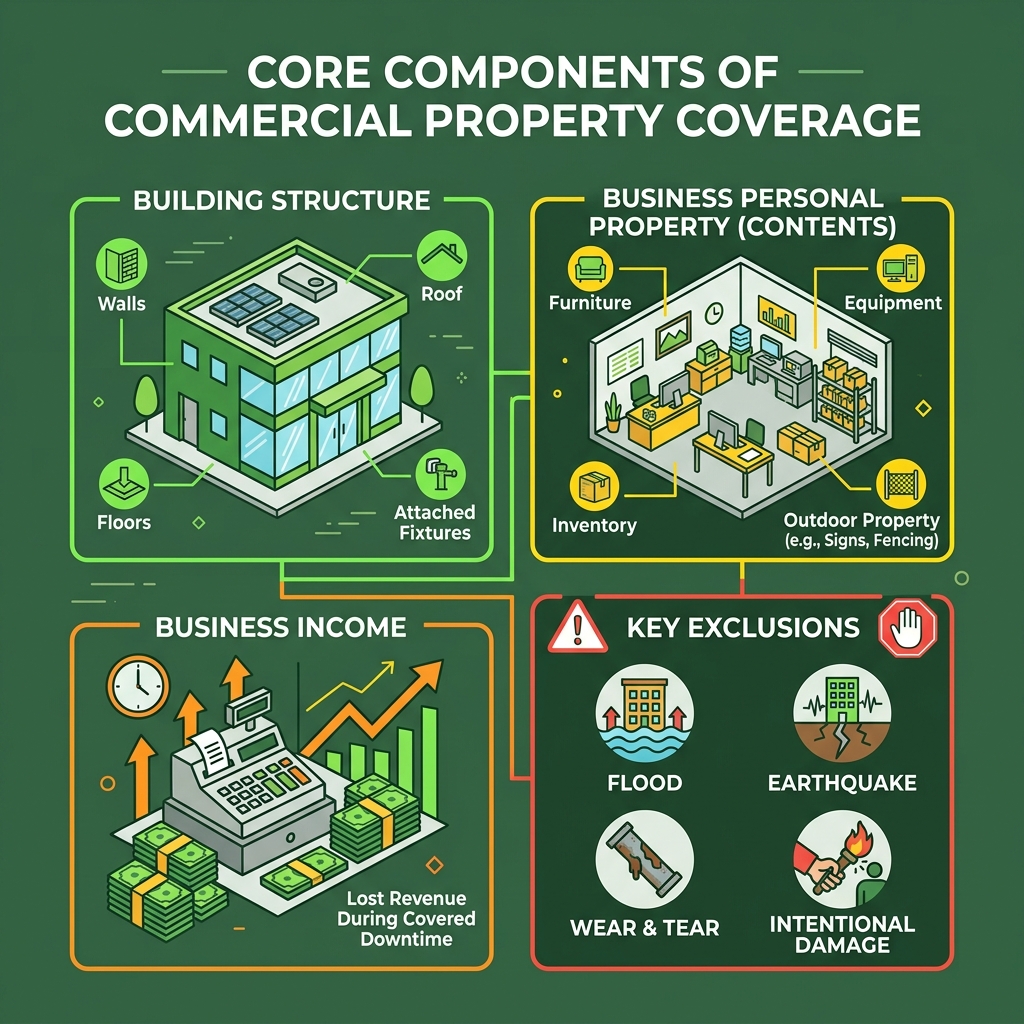
Here’s what it typically covers at a glance:
| Coverage Type | What It Protects |
|---|---|
| Building structure | Walls, roof, floors, attached fixtures |
| Business personal property | Furniture, equipment, inventory |
| Business income | Lost revenue during covered downtime |
| Outdoor property | Signs, fencing, storage sheds |
| Equipment breakdown | Mechanical or electrical failure |
The stakes are high. In 2023 alone, the U.S. experienced a record 28 separate billion-dollar weather disasters. Commercial property insurance premiums rose an average of 10.1% in the first quarter of 2024 — the steepest increase across all lines of business. And costs are projected to climb nearly 80% by 2030.
If you own or lease a commercial space, this coverage isn’t optional — it’s foundational.
I’m Geoff Stanton, President of Stanton Insurance Agency and a Certified Insurance Counselor (CIC) with over two decades of experience helping Massachusetts and New Hampshire business owners find the right commercial property owner insurance. In this guide, I’ll walk you through everything you need to know to protect your assets, avoid costly coverage gaps, and make smart decisions in a changing market.
Commercial property owner insurance resources:
- business insurance policy
- commercial property insurance rates
- is collapse covered by commercial property insurance
Understanding Commercial Property Owner Insurance and What It Covers
When we talk about commercial property owner insurance, we are looking at a safety net designed to catch your business if a disaster strikes. Whether you own a historic brick-and-mortar shop in downtown Portsmouth, NH, or a modern warehouse in Worcester, MA, your physical assets are the lifeblood of your operation.
Building Structures and Business Personal Property
At its core, this insurance covers the “bones” of your business. This includes the building itself—the walls, roof, and floors—along with permanently installed fixtures. But it doesn’t stop at the threshold. More info about commercial property insurance reveals that it also covers “Business Personal Property” (BPP).
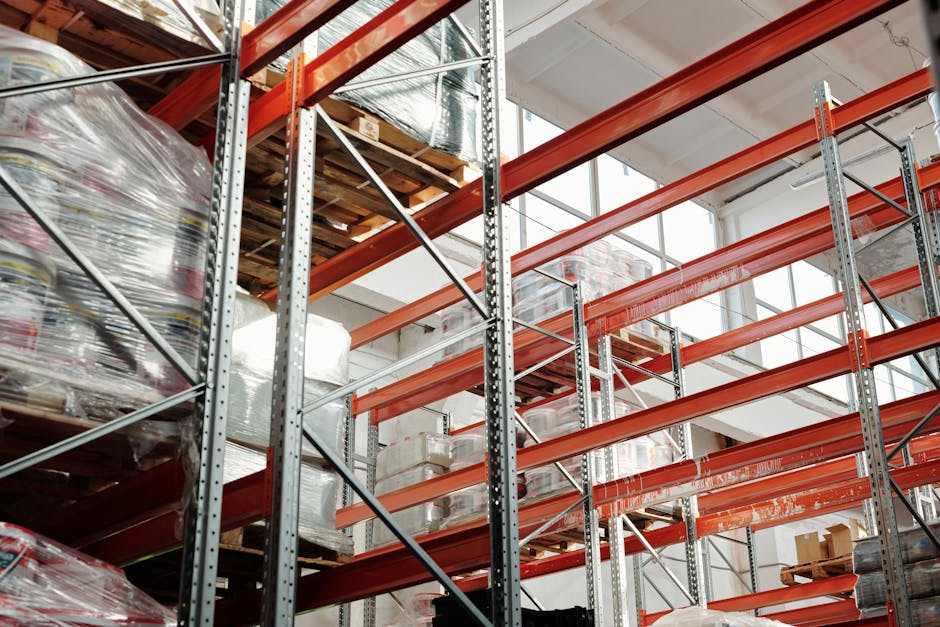
BPP includes everything you’d take with you if you moved: furniture, computers, specialized machinery, and your inventory. Even the outdoor signs that help customers find you and the fencing that secures your perimeter are included. For those operating Commercial Property Insurance in Massachusetts, ensuring these limits reflect today’s high replacement costs is vital.
Core Perils: Fire, Theft, and Vandalism
The most common “perils” (insurance-speak for things that cause damage) covered include fire, lightning, windstorms, and hail. Theft and vandalism are also major concerns for property owners. You might wonder, is vandalism covered? Generally, yes, but certain conditions—like a building being vacant for more than 60 days—can change that. Similarly, owners often ask is collapse covered? Standard policies usually cover collapse only if it’s caused by specific “hidden” factors like insect damage or the weight of snow on a roof—a very real concern for us in New England!
Specialized Endorsements: Spoilage and Equipment Breakdown
Standard policies are great, but they don’t cover everything. If you run a restaurant in Manchester or a medical lab in Boston, a power outage could lead to thousands of dollars in ruined stock. That’s where a spoilage endorsement comes in. Additionally, equipment breakdown coverage is essential. While standard property insurance covers external damage (like a tree falling on your HVAC), equipment breakdown covers internal issues, like a mechanical failure or a power surge that fries your server rack.
Navigating Costs and Market Trends
The insurance market is currently in what we call a “hard market.” This means premiums are rising, and insurance companies are being much pickier about who they insure.
In the first quarter of 2024, commercial property premiums rose an average of 10.1%. This isn’t just a random hike; it’s a response to a world that’s getting more expensive and more volatile. In 2023, the U.S. dealt with 28 separate billion-dollar weather events, totaling nearly $93 billion in recovery costs.
For business owners in Massachusetts and New Hampshire, these national trends are hitting home. Stricter underwriting means insurers want to see updated electrical systems, well-maintained roofs, and robust security before they offer their best rates.
How Your Property is Valued: RC vs. ACV
One of the biggest factors in your premium—and your payout—is how your property is valued. This is a choice you make when you sign the policy.
| Feature | Replacement Cost (RC) | Actual Cash Value (ACV) |
|---|---|---|
| Definition | Cost to buy new/rebuild today | RC minus depreciation (age/wear) |
| Premium | Higher | Lower |
| Payout | Covers full cost of new items | Payout is lower for older items |
| Best For | Most businesses wanting full recovery | Businesses on a very tight budget |
Most experts agree that Replacement Cost is the way to go. If a fire destroys your five-year-old computers, ACV will only give you what those used computers were worth. RC will give you the funds to buy brand-new ones so you can get back to work.
Factors Determining Your Commercial Property Owner Insurance Premiums
When we calculate your rates, we look at several “rating factors”:
- Location: Is the property in a high-crime area or a flood zone? How close is the nearest fire station?
- Construction Type: A wood-frame building is more expensive to insure than a fire-resistive steel and concrete structure.
- Occupancy: A dry cleaner (using chemicals and heat) is riskier to insure than an accounting firm.
- Fire Protection: Does the building have a sprinkler system and monitored fire alarms?
- Deductibles: Choosing a higher deductible (the amount you pay out of pocket) will lower your monthly premium.
Market Projections for Commercial Property Owner Insurance Through 2030
Looking ahead, the forecast suggests businesses should prepare for continued price pressure. Insurance costs are projected to increase significantly by 2030, driven by severe weather, rebuilding costs, and reinsurance trends.
However, there is a silver lining. What can be covered under Citizens commercial property insurance and other modern policies often includes “green” upgrades. Properties with sustainability features—like energy-efficient HVAC or LEED certification—may qualify for lower premiums as insurers recognize these buildings are often better maintained and more resilient.
Avoiding the Crisis of Underinsurance
Perhaps the most alarming statistic in our industry right now is this: 90% of buildings examined were underinsured. Even worse, 68% of them were underinsured by 25% or more.
Underinsurance happens when your policy limit is lower than the actual cost to rebuild your property. With the recent spike in construction costs and inflation, a policy written three years ago might only cover 70% of what it would cost to rebuild today.
The Coinsurance Penalty
If you are underinsured, you don’t just lose out on the “gap” at the top; you might be hit with a coinsurance penalty. Most policies require you to insure at least 80% or 90% of the building’s value. If you fall below that, the insurance company can reduce your claim payout proportionally—even for small losses!
To avoid this, we recommend:
- Professional Appraisals: Don’t guess. Get a professional to value the replacement cost of your building.
- Annual Policy Reviews: Your business changes, and so does the economy. We should chat every year to adjust your limits.
- Inflation Guards: These are policy features that automatically increase your limits slightly each year to keep pace with rising costs.
Whether you are safeguarding your investment as a retail owner or following an apartment building insurance guide, staying on top of valuations is the only way to ensure your business survives a total loss. This is especially true for insurance for multi-family properties, where the scale of a loss can be massive.
Frequently Asked Questions about Commercial Property Owner Insurance
Does commercial property insurance cover floods or earthquakes?
No. This is a common and dangerous misconception. Standard commercial property owner insurance almost always excludes earth movement (earthquakes) and floods (including surface water and sewer backups).
If your business is near the Merrimack River or along the coast, you need a separate flood policy. You can find more details on maximum flood insurance for multi-family buildings to see how these limits work. Earthquake coverage can usually be added as an endorsement for an additional fee.
What is the difference between a BOP and standalone property insurance?
Think of a Business Owner’s Policy (BOP) as a “value meal” for small businesses. It bundles property insurance, commercial-general-liability, and business income insurance into one convenient package. It’s usually much cheaper than buying them separately.
However, BOPs are designed for “low-risk” small to mid-sized businesses. If your business is very large, has high-risk operations (like manufacturing explosives), or needs very high limits, you will likely need a standalone property policy tailored to your specific needs.
How do I file a claim after a property loss?
Filing a claim effectively is all about speed and documentation.
- Notify us immediately: The sooner the insurance company knows, the sooner they can help.
- Document the scene: Take photos and videos of everything before you start cleaning up.
- Prevent further damage: If there’s a hole in the roof, tarp it. If a pipe burst, shut off the water. Insurance companies expect you to take reasonable steps to mitigate the loss.
- Keep records: Save every receipt for temporary repairs or lost inventory.
- Work with the adjuster: They will visit the site to assess the damage. Having your inventory lists ready will speed this up significantly.
For a deeper dive into managing these risks as a property owner, check out our landlord insurance complete guide.
Conclusion
At Stanton Insurance Agency, we know that your commercial property is more than just four walls and a roof—it’s the foundation of your hard work and your future. Protecting it requires more than just a “set it and forget it” policy.
In a market where costs are rising and weather events are becoming more severe, you need a partner who understands the local landscape of Massachusetts and New Hampshire. We can help you implement risk mitigation strategies—like installing smart water sensors or upgrading security systems—that not only protect your turf but can also lead to bundling discounts and lower premiums.
Don’t wait for a storm to find out you’re underinsured. Let’s work together to build a resilient insurance plan that keeps your business running, no matter what happens.
Protect your business with Stanton Insurance today. We are here to exceed your expectations and provide the trusted protection your valuable assets deserve.
