Storing Your Motorcycle for a Massachusetts Winter: Should You Cancel, Reduce, or Keep Your Insurance?
You'll learn what each off-season insurance option really protects, where the hidden risks are, and how to bring full coverage back before your first spring ride.
The short answer
- Canceling outright may save less than riders expect and leaves a stored bike unprotected against theft, fire and garage damage.
- A storage or comprehensive-only setup, where your carrier allows it, can trim the cost while still covering the bike as it sits.
- Your insurance and your plates may be connected, so talk to your agent and check with the RMV before canceling coverage on a registered bike.
- Whatever you choose, put full riding coverage back in place before the first ride of spring.
Your three options at a glance
When the riding season winds down and the bike rolls into the garage, owners usually weigh one of three paths for their insurance:
- Cancel the policy and buy a new one in spring.
- Reduce to storage-only coverage, usually by keeping comprehensive and removing the coverages that only matter while you're riding.
- Keep the full policy exactly as it is, all winter long.
The right answer depends on a handful of things: what the bike is worth, whether you still owe money on it, where it's stored, how your policy is priced across the year, and whether you're the type who rides on a surprise 55-degree day in January.
Stanton Insurance offers motorcycle insurance alongside home, auto, condo, renters and umbrella coverage, and works with Massachusetts customers in towns like Waltham, Newton, Lexington and Concord. The guidance below is general reasoning to help you sort through the decision.
If your bike is financed, read your loan agreement before reducing anything, since lenders may require certain coverages to stay in place while the loan is open.
Why canceling is usually the riskiest move
Canceling feels like the cleanest way to stop paying for something you aren't using, but it can create problems worth weighing first.
A parked bike can still be stolen or damaged
Motorcycles are light, valuable and easy to load into a van. Theft from garages, sheds and driveways happens in the off-season too. A garage fire, a roof that gives way under heavy snow, a falling shelf, or a car bumping the bike while someone parks can all cause real damage. With no policy in force, every one of those losses comes out of your pocket. If theft is your biggest worry, our post on whether motorcycle insurance covers theft explains which coverage responds.
Plates and registration are part of the picture
Your insurance and your registration can be connected, so canceling coverage without checking on your plates can lead to headaches. Before you cancel coverage on a bike that still has active plates, ask your agent and check with the Massachusetts RMV about what that means for your registration.
A gap can follow you
Some insurers consider whether you've carried continuous coverage when they price a policy. A lapse every winter can matter when you go to buy coverage again, depending on the carrier.
The savings may be smaller than you think
Some motorcycle policies are priced with the riding season in mind, so the winter months may not cost much. Some policies also apply a fee or a less favorable refund calculation when you cancel mid-term. Ask for real numbers before you decide.
How storage or comprehensive-only coverage works
The middle path is often the best fit for a bike that truly won't move until spring. The idea is to keep protection for the bike itself while removing coverage tied to riding it.
What it typically keeps
Comprehensive coverage generally responds to losses that don't involve a crash: theft, fire, vandalism, falling objects, certain weather events, depending on the policy. Those are many of the risks a stored motorcycle faces.
What it typically drops
Liability, collision and the other coverages that apply while you're on the road come off for the storage period. That's where any savings come from, and it's also the catch: once they're gone, the bike shouldn't be ridden anywhere, for any distance.
Availability varies
Not every carrier handles this the same way. Some offer a formal lay-up or storage option, some let you adjust individual coverages, and some have restrictions while the bike remains registered. Ask how the change works with your specific policy, what dates it takes effect, and what you'll need to do to reverse it. You can read more about our coverage on our motorcycle insurance page.
When keeping your full policy makes the most sense
Leaving everything in place all winter is a perfectly reasonable choice, and for some riders it's the smartest one. It tends to fit best when:
- You ride on warm winter days. New England winters bring the occasional dry, mild afternoon, and you'll want liability and collision in place if you take advantage of one.
- The bike is financed or leased. Your lender likely expects certain coverages to stay active.
- The difference is small. If your carrier already prices the policy seasonally, the savings from changes may not justify the paperwork.
- You don't want to manage two policy changes a year. Forgetting to restore coverage in spring is a real risk, and keeping the policy as-is removes it.
It's also worth thinking about how your motorcycle policy fits with the rest of your coverage. If you carry an umbrella policy, it generally sits on top of the liability limits on your other policies, so ask your agent how reducing liability on the bike might affect your umbrella before you make that change.
Prep the bike so a winter claim is less likely
Whichever coverage route you pick, a little care during storage lowers the odds you'll need it. Keep these steps simple and safe:
- Document the bike. Take photos from every side, write down the VIN, and keep receipts for aftermarket parts and accessories. Save copies somewhere other than the garage, such as a cloud folder.
- Handle fuel carefully. If you add fuel stabilizer, follow the product label and do it with the engine off and cool, outdoors or in a well-ventilated space.
- Never run the engine in a closed garage. Exhaust contains carbon monoxide, which builds up quickly in an enclosed space.
- Keep it away from ignition sources. Park the bike well away from furnaces, water heaters, space heaters, and anything with a pilot light or open flame, since fuel vapors can ignite.
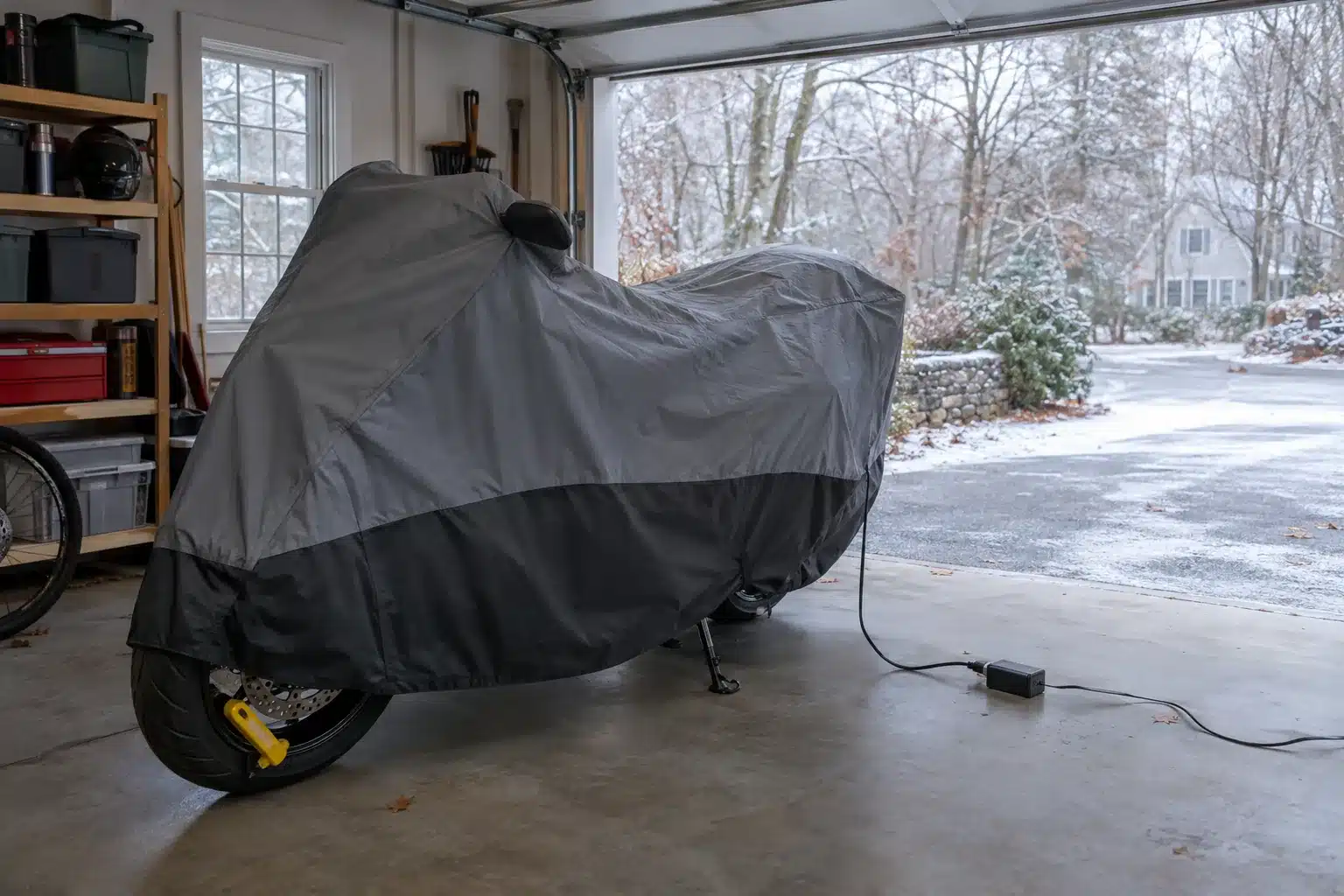
- Care for the battery. Use a maintainer designed for motorcycle batteries, or remove and store the battery as your owner's manual describes.
- Discourage pests and thieves. A breathable cover, an exhaust plug made for rodent prevention, a disc lock or a chain to a solid anchor, and a locked garage door all help. Hang a reminder tag on the handlebars to remove plugs and locks before riding.
For fluid changes or any mechanical work you're not comfortable doing, leave it to a qualified motorcycle shop.
One more point: many homeowners and renters policies limit or exclude coverage for motorized vehicles, so don't assume your house policy protects the bike just because it's parked in your garage.
Bringing coverage back in spring
A common off-season mistake is forgetting to undo a fall change before the first nice day in spring.
Restore coverage before you ride
If you reduced or canceled, call your agent ahead of the season and choose an effective date on or before the day you plan to ride. Ask for updated documents, such as a new declarations page or ID card, so you have proof the change went through.
Use the call to review your policy
Spring is a good time to mention anything that changed over the winter: new accessories, upgraded gear, a new rider in the household, or a different garage. Each of these can affect what your policy should cover.
Check the bike, too
Look over the tires, brakes, lights and battery before the first ride, and have a shop handle anything that seems off.
If your bike is already put away
If the bike is already stored and you haven't changed your policy, there's no emergency. If you're weighing a change, it's better to talk it through with your agent before making any change. You can reach Stanton Insurance here to go over your options for the rest of the off-season.
Put a calendar reminder a couple of weeks before you expect to ride so restoring full coverage never becomes a last-minute scramble.
Common questions
Will my homeowners insurance cover my motorcycle while it's stored in my garage?
Often it won't, or only in a limited way. Many homeowners and renters policies restrict or exclude coverage for motorized vehicles. Ask your agent to review both policies so you know exactly what protects the bike while it's parked.
Can I ride on a warm winter day if I've switched to storage-only coverage?
You shouldn't. Storage-only setups typically remove liability and collision, so riding would leave you without the protection you need on the road. Restore full coverage first, and confirm it's in effect before you head out.
If I cancel my motorcycle insurance, do I also have to deal with my plates?
Possibly. Before canceling coverage on a registered bike, ask your agent and check with the Massachusetts RMV about what happens to your plates and registration.
Is it worth keeping comprehensive on an older, lower-value bike?
It depends on what the bike is worth to you compared with the cost of the coverage. Comprehensive typically responds to theft, fire and many storage-related losses, so even an older bike may be worth protecting while it sits. An agent can help you compare the cost against the bike's value.