
Why Understanding Minimum Coverage Renters Insurance Matters
Minimum coverage renters insurance typically refers to the lowest policy limits offered by insurers or required by landlords—but understanding what “minimum” actually means can save you from serious financial trouble down the road.
Quick Answer: What You Need to Know About Minimum Coverage
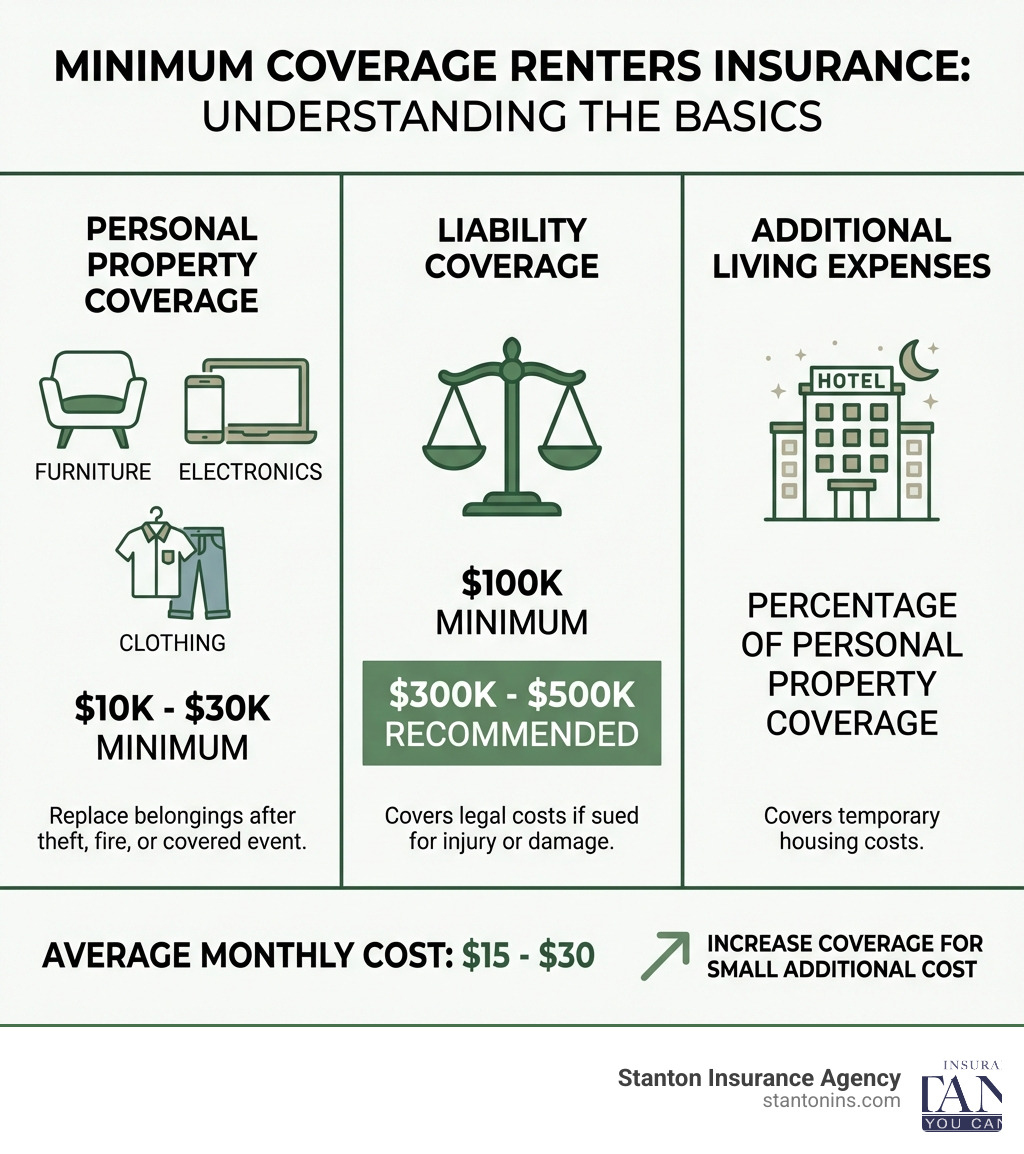
- Personal Property: Usually starts at $10,000-$30,000 to replace your belongings after theft, fire, or other covered events
- Liability Protection: Typically begins at $100,000 (though experts recommend $300,000-$500,000) to cover legal costs if you’re sued for injury or property damage
- Additional Living Expenses: Covers temporary housing costs if your rental becomes uninhabitable
- Average Cost: $15-$30 per month, making it one of the most affordable insurance products available
- Landlord Requirements: Most landlords in Massachusetts and New Hampshire require proof of coverage as a lease condition, even though state law doesn’t mandate it
If you’ve just signed a lease that requires renters insurance, you might be tempted to buy the absolute cheapest policy that meets your landlord’s minimum liability requirement—usually around $100,000. But here’s the reality: your landlord’s requirement protects their interests, not necessarily yours. News reports of apartment fires often include tragic stories of renters who lost everything because they weren’t insured or were severely underinsured.
The gap between what your landlord requires and what you actually need can be enormous. A single lawsuit from a guest injury can quickly exceed a basic $100,000 liability limit, leaving you personally responsible for hundreds of thousands in medical bills and legal costs. Meanwhile, that $10,000 in personal property coverage might barely cover your laptop, phone, furniture, and clothes—let alone everything else you own.
I’m Geoff Stanton, President of Stanton Insurance Agency, and I’ve spent over two decades helping renters in Massachusetts and New Hampshire understand their coverage needs. Through my experience, I’ve seen too many people find their minimum coverage renters insurance wasn’t enough only after filing a claim—which is exactly why this guide exists.
What Does Minimum Coverage Renters Insurance Actually Include?
When people talk about “minimum coverage,” they’re usually referring to the lowest limits an insurance company offers or the base amount required by a landlord. While policies vary, a basic plan typically provides a safety net for three critical areas. It’s essential to understand that this is a starting point, not always the final destination for adequate protection.
Personal Property Protection: Covering Your “Stuff”
This is the part of your policy that helps you repair or replace your belongings after a covered event like a fire, theft, or windstorm. A minimum policy might offer between $10,000 and $30,000 in coverage. To see if that’s enough, take a quick mental inventory: your laptop, phone, TV, furniture, clothes, kitchenware, and bike. The total value adds up faster than you think. Most experts recommend creating a home inventory to get an accurate number.
Many home insurance companies, including those that offer renters policies, often recommend a minimum of $30,000 to $40,000 for contents coverage. However, the exact amount you need depends entirely on the value of your personal possessions. This is where a home inventory becomes invaluable. It’s a detailed list of all your belongings, their estimated value, and ideally, photos or videos. This not only helps you choose the right coverage amount but also speeds up the claims process if you ever need to file one.
When considering personal property coverage, you’ll typically encounter two types of valuation: Actual Cash Value (ACV) and Replacement Cost (RC). An ACV policy will pay you the depreciated value of your items, meaning what they’re worth today. For example, if your five-year-old TV is stolen, an ACV policy will pay you only a fraction of what you originally paid for it. Replacement Cost coverage, on the other hand, pays to replace your damaged or stolen items with new ones of similar quality, without factoring in depreciation. While RC coverage is usually a bit pricier, many find it well worth the extra expense, especially when facing the daunting task of replacing everything after a major loss.
For more detailed information on what’s covered, check out our guide on More info about Renters Insurance Coverage.

Personal Liability: Your Financial Shield
This is arguably the most crucial part of your renters policy and often the focus of a landlord’s requirements. Personal Liability Coverage protects you financially if you’re found responsible for injuring someone or damaging their property. This could be a guest slipping in your kitchen, your dog biting a neighbor, or an overflowing bathtub that damages the unit below you. Standard policies often start with a minimum of $100,000 in liability coverage.
This coverage extends beyond just your rental unit. If your child accidentally breaks an expensive vase at a relative’s home, or your pet causes damage to a neighbor’s property, your personal liability coverage can kick in. It typically covers medical payments to others if they’re injured on your property, legal fees if you’re sued, and the cost of repairing or replacing property that you accidentally damage. While many policies start at $100,000, insurance experts often recommend increasing this to at least $300,000, and some even suggest $1 million, especially if you have significant assets to protect. The good news? The cost to increase your liability limit is typically very small compared to the added protection it provides.
For more insights into this critical protection, take a look at Your renters insurance guide.
Additional Living Expenses (ALE): A Place to Stay
If a covered disaster, like a major fire, makes your apartment uninhabitable, Additional Living Expenses (ALE) coverage helps pay for the increased costs of temporary living. This can include hotel bills, restaurant meals, and laundry services while your home is being repaired. Minimum policies include this, but the coverage limit (e.g., a percentage of your personal property coverage) might only last for a short period.
Imagine a scenario where a burst pipe in your building forces you out of your apartment for weeks. Where do you go? What do you eat? ALE coverage, sometimes referred to as “Loss of Use” coverage, steps in to cover the difference between your normal living expenses and the increased costs you incur while displaced. This doesn’t mean it covers your entire hotel bill and every meal out, but it reimburses you for the extra expenses. For example, if your rent is $1,500 but your hotel and increased food costs total $2,500, ALE would cover the $1,000 difference (up to your policy limits). It’s a lifesaver when you’re already dealing with the stress of a damaged home.

Landlord Requirements vs. Your Actual Needs
It’s a common scenario: your lease says you need renters insurance with $100,000 in liability. You buy a policy that meets this exact requirement and think you’re all set. While this satisfies your landlord, it’s crucial to understand their motive. They require this coverage primarily to protect themselves and their property from your potential negligence. Your landlord’s insurance covers the building, but not your liability or your belongings.
Decoding Landlord Requirements for Minimum Coverage Renters Insurance
In Massachusetts and New Hampshire, there are no state laws that legally require tenants to carry renters insurance. However, landlords can—and frequently do—make it a mandatory condition of your lease agreement. If you refuse to get it, they might reject your rental application.
Why do they do this? A landlord mandates liability coverage to ensure that if you accidentally cause a fire, a flood, or any other damage that impacts the building structure or other units, there’s an insurance policy to cover those costs. This protects them from having to sue you directly for damages that could be substantial. Your landlord’s insurance policy protects the building itself, including its structure and any fixtures or furnishings they own. It does not cover your personal belongings, nor does it cover your personal liability for incidents that occur within your rented space. So, while you might satisfy the lease with minimum coverage renters insurance, it’s primarily a safeguard for your landlord, not a comprehensive shield for you.
To understand more about this, check out our detailed article on Can a Landlord Require Renters Insurance in Massachusetts.
The Financial Risks of Sticking to Minimum Coverage Renters Insurance
A $100,000 liability limit might seem like a lot, but it can be exhausted quickly in a serious lawsuit. If a guest suffers a permanent injury in your apartment, medical bills and legal settlements can easily soar into the hundreds of thousands. For instance, if a guest slips on a rug, breaks a leg, and requires extensive surgery and rehabilitation, the medical bills alone could exceed $100,000. If you are found liable, and your liability limit is only $100,000, you are personally responsible for paying the rest. This could lead to wage garnishment, liens on future property, and financial ruin for years.
This is why many insurance professionals and consumer advocates recommend a minimum of $300,000 to $500,000 in liability protection. Some even suggest increasing it to $1 million if you have significant assets to protect, such as savings, investments, or future earnings. The peace of mind that comes with adequate liability coverage is invaluable, especially when you consider the relatively low cost of increasing your limits. We dig deeper into this topic in our Personal Liability Insurance Guide 2025.
When to Get More Than Minimum Coverage
Your life isn’t “minimum,” so your insurance probably shouldn’t be either. The right amount of coverage depends entirely on your unique circumstances. Opting for more than the bare minimum is a smart financial decision that often costs only a few extra dollars per month.
Factors That Increase Your Liability Risk
Certain lifestyle factors significantly increase your risk of a liability claim. If any of these apply to you, you should strongly consider higher liability limits:
- You own a pet: We love our furry friends, but dog bites are a leading cause of liability claims. Even the friendliest dog can have an off day, or be startled, leading to an unfortunate incident. A tenant with pets should absolutely consider potential damage or injuries caused by their animals when determining liability coverage.
- You host guests frequently: The more people you invite into your home, the higher the chance of an accidental injury. A spilled drink leading to a slip and fall, or even a simple trip over a misplaced item, could result in a liability claim against you.
- You have a pool or trampoline: While less common in typical rental units, if your rental property includes “attractive nuisances” like a swimming pool or trampoline, these carry a high risk of injury. Such features significantly increase your exposure to liability lawsuits.
- You have significant assets: If you’ve worked hard to build up savings, investments, or own other valuable property, higher liability limits help protect these assets from being seized in a lawsuit. An umbrella liability policy can also provide an additional layer of protection beyond your renters insurance limits.
Valuing Your Possessions Accurately
Don’t just guess how much your belongings are worth. We’ve all done that mental tally where we think “it’s not that much,” but then a real-world scenario hits, and the true cost of replacement becomes painfully clear. Use a home inventory app or a simple spreadsheet to list your items and their estimated replacement cost. Be thorough! Go room by room, open every drawer, and list everything from your socks to your silverware.
Pay special attention to high-value categories like electronics, jewelry, and collectibles. A standard policy has sub-limits for these items (e.g., a maximum of $1,500 for jewelry). If your collection is worth more, you may need to schedule these items separately through an endorsement or “floater” policy. For example, if you have an engagement ring worth $10,000, your standard renters policy might only cover $1,500 of that value. A floater ensures the full value is protected.
Here’s a list of common items with surprisingly high replacement costs that often get underestimated:
- Mattress and Bedding: $1,000 – $3,000+ (A good quality mattress, frame, and linens add up!)
- Professional Wardrobe: $2,000 – $5,000+ (Think about all your suits, dresses, shoes, and outerwear.)
- Laptop & Desk Setup: $1,500 – $4,000+ (Laptop, monitor, keyboard, mouse, printer, external drives, software.)
- Kitchen Appliances & Cookware: $1,000 – $2,500+ (Stand mixer, espresso machine, quality pots and pans, dinnerware sets.)
- Bicycles and Sporting Equipment: $500 – $3,000+ (A decent road bike, ski equipment, golf clubs.)
Understanding Common Exclusions
It’s just as important to know what your policy doesn’t cover. Standard renters insurance policies almost never cover damage from floods or earthquakes. If you live in an area prone to these events, you will need to purchase separate coverage. In Massachusetts and New Hampshire, while major earthquakes are rare, localized flooding can be a significant concern.
If your rental is in a flood zone, or even just susceptible to heavy rains, flood insurance is a crucial consideration. Flood coverage is available from the National Flood Insurance Program and some private insurers. You can often obtain this coverage through the same agent or company representative who sold you your renters insurance policy. Earthquake coverage can also be purchased as a separate policy or added as an endorsement to your existing renters policy. Always review your policy details or speak with your insurance provider to understand specific exclusions and ensure you have comprehensive protection against all potential risks. For a deeper dive into what’s typically covered and excluded, consult our guide on What Does Renters Insurance Cover.
How Much Does Renters Insurance Cost?
One of the biggest myths about renters insurance is that it’s expensive. In reality, it’s one of the most affordable insurance products available. The average cost of renters insurance in the U.S. is about $15 to $30 per month. This means many policies cost less than a dollar a day! The small cost of a premium far outweighs the potential for a catastrophic financial loss. We’ve seen average costs for tenant insurance in Massachusetts and New Hampshire typically fall within this range, making it incredibly accessible.
What Influences Your Premium?
Several factors determine your final price when you’re looking for minimum coverage renters insurance:
- Location: Rates vary by state, city, and even ZIP code. For instance, an apartment in downtown Boston might have a different rate than a rental in rural New Hampshire, based on local risks like crime rates, population density, and proximity to fire departments.
- Coverage Amounts: As expected, higher limits for personal property and liability will increase the premium. If you opt for $50,000 in personal property coverage instead of $20,000, your premium will be slightly higher.
- Deductible: This is the amount you pay out-of-pocket on a claim before your insurance kicks in. A higher deductible will generally lower your premium. For example, opting for a $1,000 deductible instead of a $500 one could reduce your monthly cost.
- Claims History: A history of filing claims, especially frequent ones, can lead to higher rates. Insurers see this as an indicator of higher future risk.
- Safety Features: Discounts are often available for safety features in your rental unit, such as working smoke detectors, fire extinguishers, deadbolt locks, and security systems.
- Credit Score: In many states, including Massachusetts and New Hampshire, your credit score can influence your insurance rates. A higher credit score often indicates a lower risk to insurers.
For more specifics on costs in our area, check out How Much is Renters Insurance in Massachusetts.
How to Get Cheap Renters Insurance
While you don’t want to skimp on necessary coverage, especially when it comes to liability, there are smart ways to save money on your minimum coverage renters insurance. The best strategy is always to shop around for the best deal. Don’t settle for the first quote you receive. We recommend getting quotes from multiple insurance providers to compare prices and coverage options.
One of the most effective ways to get a significant discount is by bundling your renters policy with your auto insurance. Many insurance companies offer a multi-policy discount that can save you a substantial amount on both premiums.
Here’s a quick comparison to illustrate the potential savings with bundling:
| Coverage Type | Annual Premium (Without Bundling) | Annual Premium (With Bundling) | Potential Annual Savings |
|---|---|---|---|
| Renters Insurance | $300 | $240 | $60 |
| Auto Insurance | $1200 | $1080 | $120 |
| Total Annual Cost | $1500 | $1320 | $180 |
Beyond bundling, always ask about other available discounts. These can include:
- Discounts for installing protective devices like smoke alarms, carbon monoxide detectors, and deadbolt locks.
- Discounts for being claims-free for a certain period.
- Discounts for setting up automatic payments or going paperless.
- Discounts for a good credit score.
- Discounts for being a non-smoker.
Raising your deductible is another way to lower your premium, but remember, you’ll pay that amount out-of-pocket for each claim. Consider what you can comfortably afford in an emergency. Paying your annual premium in full, rather than in monthly installments, can also sometimes result in a small discount.
By being proactive and asking the right questions, you can find affordable Cheap Renters Insurance that provides robust protection without breaking the bank.
Frequently Asked Questions about Minimum Coverage Renters Insurance
We often hear similar questions from renters in Massachusetts and New Hampshire navigating their insurance options. Here are some of the most common ones:
What is the minimum recommended liability coverage for a renter?
While many landlords only require $100,000 in liability coverage, most insurance professionals recommend a minimum of $300,000 to $500,000. This provides a much stronger buffer against serious legal and medical claims that could otherwise jeopardize your financial future. As we discussed, a major accident could lead to medical bills and legal settlements far exceeding $100,000. The good news is that the cost to increase your liability limit from $100,000 to $300,000 or even $500,000 is typically very small—often just a few extra dollars per month—making it an incredibly cost-effective way to protect your assets and future earnings.
Does minimum coverage renters insurance cover my roommate?
No. A standard renters insurance policy only covers the person named on the policy and their resident relatives. Your roommate is not covered for their personal belongings or their personal liability under your policy. If your roommate wants their possessions protected and needs liability coverage, they will need to purchase their own separate policy. This is a common misconception, and it’s crucial for each individual living in a rental unit to secure their own coverage for adequate protection.
If I don’t own much, do I still need more than the minimum?
Even if you believe your belongings aren’t worth much, the liability portion of your policy is essential. We often hear people say, “I don’t own anything valuable,” but that overlooks the significant risk of personal liability. A single accident—a guest tripping, your pet biting someone, or an accidental fire—can lead to a lawsuit that costs far more than the value of all your possessions combined. The liability protection in a renters policy is an inexpensive shield against potentially life-altering financial loss, regardless of how many valuable items you own. It protects your future income and assets from being used to pay for a judgment against you.
Secure Your Peace of Mind Today
Choosing the right renters insurance is about more than just checking a box on your landlord’s list. It’s about a realistic assessment of your risks and a smart investment in your financial security. While minimum coverage renters insurance satisfies your lease, it may not satisfy the costs of a real-world disaster. By understanding the true value of your belongings and the potential for liability, you can choose a policy that provides true peace of mind.
We know that navigating insurance options can sometimes feel like trying to solve a puzzle blindfolded. That’s where we come in. The experts at Stanton Insurance Agency are here to help you steer your options, answer your questions, and find a policy that fits your life and your budget here in Massachusetts or New Hampshire. Don’t wait for an emergency to find out you’re underinsured.
Reach out to us today for expert advice, a thorough policy review, and the financial security you deserve. Let us help you protect what matters most.
