
Why NH Auto Insurance Matters Even When It’s Not Required
NH auto insurance stands out as unique in the United States—New Hampshire is one of only two states that doesn’t require drivers to carry auto insurance. However, this doesn’t mean you can simply skip coverage. Here’s what you need to know:
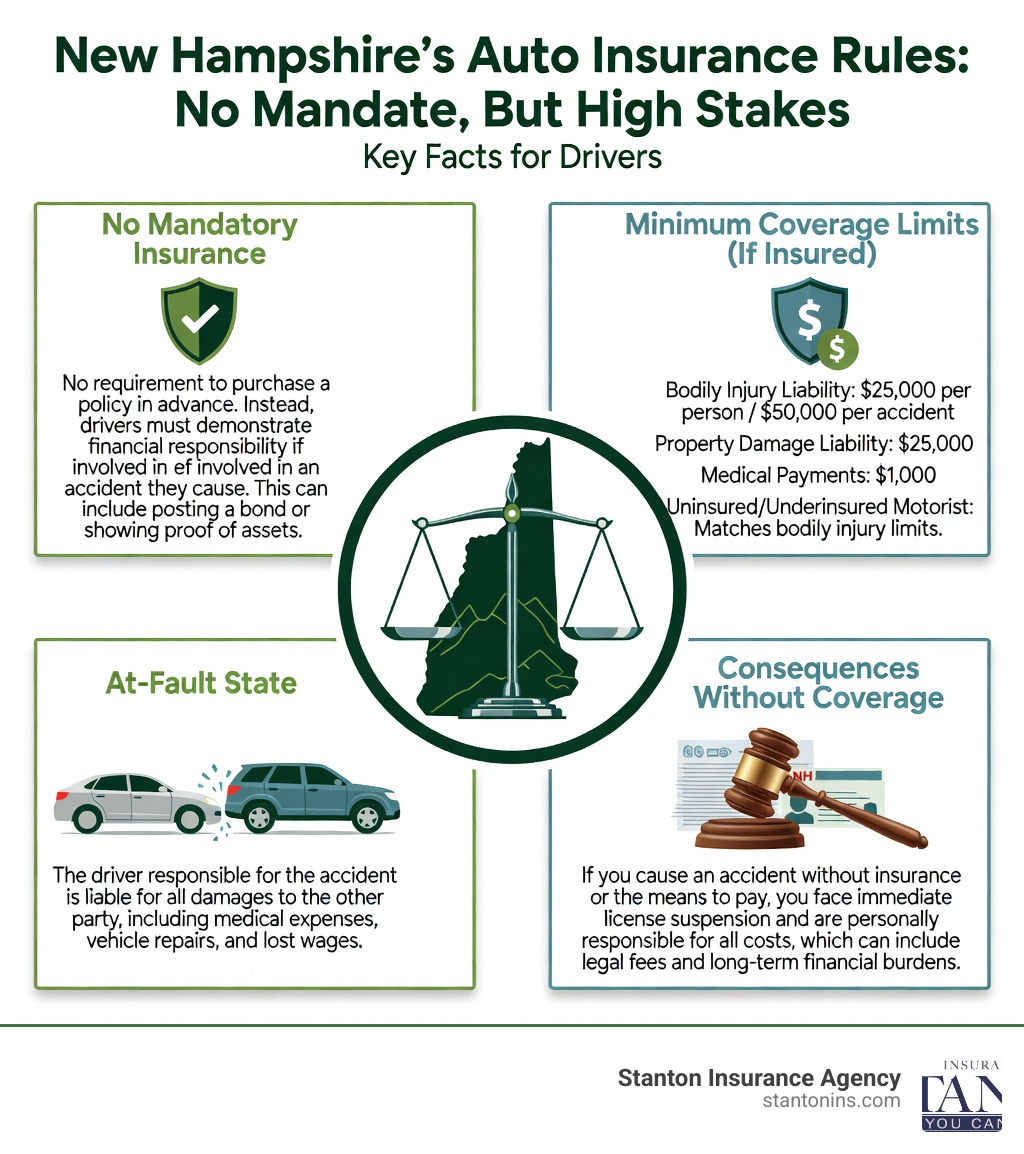
Quick Facts About NH Auto Insurance:
- No Mandatory Insurance – You’re not required to buy a policy upfront
- Financial Responsibility Required – You must prove you can pay for damages if you cause an accident
- Minimum Limits (if insured) – $25,000/$50,000 bodily injury, $25,000 property damage, $1,000 medical payments, plus uninsured motorist coverage
- At-Fault State – The driver responsible for an accident pays for the other party’s injuries and damages
- License at Risk – If you cause an accident and can’t pay, you’ll lose your license
Average Cost: Around $91 per month for liability-only coverage in 2023, though rates vary widely by location, driving history, and credit score.
The reality is simple: while you can drive without insurance in New Hampshire, you’re personally liable for every dollar of damage if you cause an accident. A single crash can cost tens of thousands—or even hundreds of thousands—in medical bills, property damage, and legal fees. Without insurance, your personal assets, savings, and wages are all at risk.
I’m Geoff Stanton, President at Stanton Insurance in Waltham, Massachusetts, and I’ve spent over two decades helping families and businesses protect themselves with smart insurance solutions, including NH auto insurance for our New Hampshire clients. Let me walk you through how to compare carriers and find the right coverage for your needs.
NH auto insurance terms made easy:
Understanding NH Auto Insurance Requirements
In the Granite State, the philosophy of “Live Free or Die” extends to the road. New Hampshire is one of only two states in the country that does not mandate every driver to purchase a car insurance policy. However, this freedom comes with a significant caveat: the law requires “Financial Responsibility.”
If you are involved in an accident and found to be at fault, you must be able to prove you have the funds to pay for the resulting damages. Most people choose to meet this requirement by purchasing NH auto insurance. Without it, you are essentially “self-insuring,” which means your house, your savings, and your future earnings are on the line if you cause a collision.
Furthermore, New Hampshire is an at-fault state. This means the person responsible for the accident is legally obligated to cover the costs of the other driver’s injuries and property damage. If you don’t have insurance and can’t pay these costs out of pocket, the state can suspend your driver’s license and vehicle registration until you’ve settled the claims.
For a deeper dive into the legal nuances, you can check out these resources:
- Auto Insurance Requirements in New Hampshire
- New Hampshire Insurance Department Automobile Insurance Guide
Minimum Coverage Limits for NH Auto Insurance
If you do decide to purchase a policy—which we strongly recommend for your financial security—the state mandates that the policy must meet specific minimum limits. You can’t just buy a “tiny” policy; it has to provide a baseline level of protection.
The minimum required limits for NH auto insurance are:
- Bodily Injury Liability: $25,000 per person and $50,000 per accident.
- Property Damage Liability: $25,000 per accident.
- Medical Payments (MedPay): $1,000 per accident (this is required on all NH policies).
- Uninsured Motorist (UM): Limits must at least equal your Bodily Injury limits.
While these are the minimums, many drivers find that $25,000 doesn’t go very far in a serious medical emergency or if you total a modern SUV. Many Granite Staters opt for higher limits, such as $100,000/$300,000, to ensure they aren’t left paying the difference out of pocket.
Learn more about your options here: NH Auto Insurance
Proving Financial Responsibility Without Insurance
What happens if you choose not to carry insurance? You still have to prove you are “financially responsible” if an accident occurs. If you are at fault in an accident and don’t have insurance, the New Hampshire Department of Safety may require you to file an SR-22.
An SR-22 is not insurance itself, but rather a certificate filed by an insurance company with the state to prove that you have purchased the required liability coverage. This is often required for drivers who have had their license suspended due to an uninsured accident, a DUI, or multiple traffic violations.
If you’re in a position where the state is demanding proof of future financial responsibility, you’ll need to work with an agency that understands these filings. Failing to maintain an SR-22 when required will lead to an immediate license suspension.
For more information on high-risk filings, see: SR22 Insurance NH
Factors Influencing NH Auto Insurance Rates
When you look for NH auto insurance, you’ll notice that prices aren’t the same for everyone. Insurance companies use two main processes to determine what you pay: underwriting and rating.
Underwriting is the process where the company evaluates how “risky” you are. Rating is the math that turns that risk into a dollar amount. In New Hampshire, several factors weigh heavily on your premium:
- Driving History: Tickets and accidents will naturally drive up costs.
- Credit Score: In NH, insurers often use credit-based insurance scores. High credit scores generally lead to lower premiums.
- Location: Where you park your car matters. Drivers in Manchester or Nashua typically pay more than those in the North Country due to traffic density and higher theft rates.
- Age and Experience: Teen drivers are statistically more likely to be in accidents, leading to higher rates for households with young operators.
To see how location and driver profiles change the numbers, look at the table below based on state premium comparison data:
| Driver Profile | Location | Estimated Annual Premium |
|---|---|---|
| Married Couple (Age 44) + Teen | Nashua (03063) | $1,054 – $7,069 |
| Married Couple (Age 44) + Teen | Rural South (03070) | $950 – $6,200 |
| Single Male (Age 23) | Manchester (03102) | $1,200 – $4,500 |
| Senior Couple (Pleasure Use) | Concord (03301) | $600 – $1,800 |
As you can see, the range is massive. This is why shopping around is critical. For more details on pricing, visit: Auto Insurance Rates in New Hampshire
Maximizing Discounts on NH Auto Insurance
The good news is that there are plenty of ways to trim down those premiums. We always encourage our clients to ask about every possible discount. Some of the most effective include:
- Bundling: This is the “king” of discounts. When you combine your auto insurance with NH homeowners insurance or NH renters insurance, you can often save 25% or more across both policies.
- Multi-Car: Insuring more than one vehicle on the same policy usually triggers a significant price break.
- Good Student: If you have a teen driver on your policy with a “B” average or better, most insurers will offer a discount.
- Paid in Full: Paying your annual premium in one lump sum rather than monthly installments often removes service fees and lowers the base rate.
Ready to see what you could save? New Hampshire Car Insurance Quote
Essential Coverage Types for Granite State Drivers
While liability is the “base” of your policy, it only pays for the other person. To protect your own car, you need to look at physical damage coverages:
- Collision Coverage: This pays for damage to your car if you hit another vehicle or an object (like a tree or a guardrail), regardless of who is at fault.
- Comprehensive Coverage: This covers “acts of God” or things out of your control—think deer hits, falling branches in a storm, fire, theft, or a cracked windshield.
- Medical Payments: Required at a $1,000 minimum, but many NH drivers increase this to $5,000 or $10,000 to cover health insurance deductibles after an injury.
Optional Add-ons to Consider:
- Towing and Labor: Covers the cost of a tow truck if you’re stranded.
- Rental Reimbursement: Pays for a rental car while yours is in the shop for a covered claim.
- Gap Insurance: If you owe more on your car loan than the car is worth, this covers the “gap” if the vehicle is totaled.
Navigating Claims and Total Loss in New Hampshire
Accidents are stressful, but knowing the rules of the road for claims can make the process smoother. In New Hampshire, the Insurance Department has strict rules to protect consumers. For instance, per NH rule INS 1002.04(b), insurers must respond to your claim within 10 working days.

When it comes to repairs, you have the right to choose your repair shop. An insurance company cannot force you to go to a specific “preferred” shop, though they will only pay the amount of their own estimate. If your chosen shop charges significantly more, you might have to pay the difference.
The 75% Total Loss Threshold
One of the most common questions we get is: “When is my car considered totaled?” In New Hampshire, a motor vehicle is generally deemed a total loss when the cost of repairs exceeds 75% of its Fair Market Value.
To determine this value, insurers must use statistically valid methods, such as averaging the retail value from accepted industry databases or looking at the sales of at least two comparable vehicles sold in your local market within the last 90 days.
If your car is totaled, the insurer pays you the Fair Market Value (minus your deductible). You then have the option to let the insurance company take the car, or you can “buy it back” for its salvage value if you want to try and fix it yourself—though this will result in a “salvage title.”
For more on finding the right partners for these situations, see: Best Car Insurance in NH
Filing an Auto Insurance Claim
If you’re involved in an accident, follow these steps to ensure your claim is handled correctly:
- Safety First: Move to a safe location and check for injuries.
- Call the Police: Even for minor accidents, a police report is vital for the insurance company to determine fault.
- Document Everything: Take photos of the damage to all vehicles and the surrounding scene.
- Exchange Info: Get names, phone numbers, and insurance details from the other driver.
- Report the Loss: Contact your agency or company immediately.
You are only responsible for the cost of one repair estimate. If the insurance company wants more estimates, they are the ones who have to pay for them.
Learn more about local support: NH Insurance Agencies
Specialized Driving Laws and Teen Requirements
Teaching a teenager to drive in New Hampshire is a rite of passage. The state has specific rules for “Youth Operators.”
- Practice Driving: Teens can start practicing at age 15 ½, provided they are accompanied by a licensed adult aged 25 or older.
- Supervised Hours: To get a license, a teen must log at least 40 hours of supervised driving, with at least 10 of those hours being at night.
- Youth Operator License: These licenses are for drivers under 21. They are vertically oriented and come with restrictions. For the first six months, a driver under 18 cannot have more than one passenger under 25 (unless they are family) and cannot drive between 1 AM and 4 AM.
Adding a teen to your NH auto insurance can be expensive, but it’s much cheaper than the alternative if they are involved in an accident without coverage. For more local tips, see our Car Insurance Manchester NH Guide.
Commercial and Business Auto Needs
If you use your vehicle for work—especially if you’re a contractor—a personal auto policy might not be enough. In fact, most personal policies specifically exclude coverage if you’re hauling tools, visiting job sites, or transporting goods for profit.
For contractors in New Hampshire, Commercial Auto Insurance is essential. Most General Contractors will require you to carry a $1,000,000 Combined Single Limit (CSL) for liability. This protects your business if one of your work trucks causes a major accident.
We also help businesses with ACORD certificates, which are the standard industry forms used to prove you have the right insurance to your clients or project managers.
Get the details on business coverage: Commercial Auto Insurance in New Hampshire
Frequently Asked Questions about NH Auto Insurance
Is auto insurance mandatory in New Hampshire?
No. New Hampshire is one of the only states that does not mandate auto insurance for all drivers. However, you must be able to demonstrate financial responsibility if you are at fault in an accident. If you cannot pay for the damages you cause, you face the loss of your license and personal lawsuits.
What are the minimum liability limits in NH?
If you choose to carry insurance (or are required to due to a previous violation), the minimum limits are $25,000 per person and $50,000 per accident for bodily injury, and $25,000 for property damage. You must also carry $1,000 in medical payments coverage and uninsured motorist coverage.
How does New Hampshire determine a total loss?
A vehicle is generally considered a total loss in New Hampshire when the cost of repairs exceeds 75% of its fair market value. The insurer must use documented sales of comparable vehicles or statistically valid retail values to determine this amount.
What happens if I drive without insurance and get in an accident?
If you are at fault and cannot pay for the other party’s damages, the state can suspend your license and registration. You may also be required to file an SR-22 for several years, which will make your future insurance premiums much more expensive.
Can I choose my own repair shop in NH?
Yes. New Hampshire law protects your right to choose any repair shop you prefer. While the insurance company will provide an estimate based on their assessment, you are not obligated to use their “preferred” facilities.
Conclusion
Navigating NH auto insurance can feel a bit like driving through the White Mountains in a fog—it’s beautiful, but you need to know where the turns are. Whether you’re looking for the most affordable liability policy to meet financial responsibility requirements or a comprehensive package to protect your family’s assets, we’re here to help.
At Stanton Insurance Agency, we believe in “Live Free or Die,” but we also believe in “Live Protected.” You’ve worked hard for your car, your home, and your savings. Don’t let one bad second on the Everett Turnpike take it all away.
Ready to find the best rate for your Granite State ride? Get a New Hampshire car insurance quote today and let us help you secure your peace of mind.