
Why Liability and Uninsured Motorist Coverage Matter for Every Driver

Liability and uninsured motorist coverage are two essential types of auto insurance that protect you from different financial risks on the road. Here’s how they differ:
Liability Coverage:
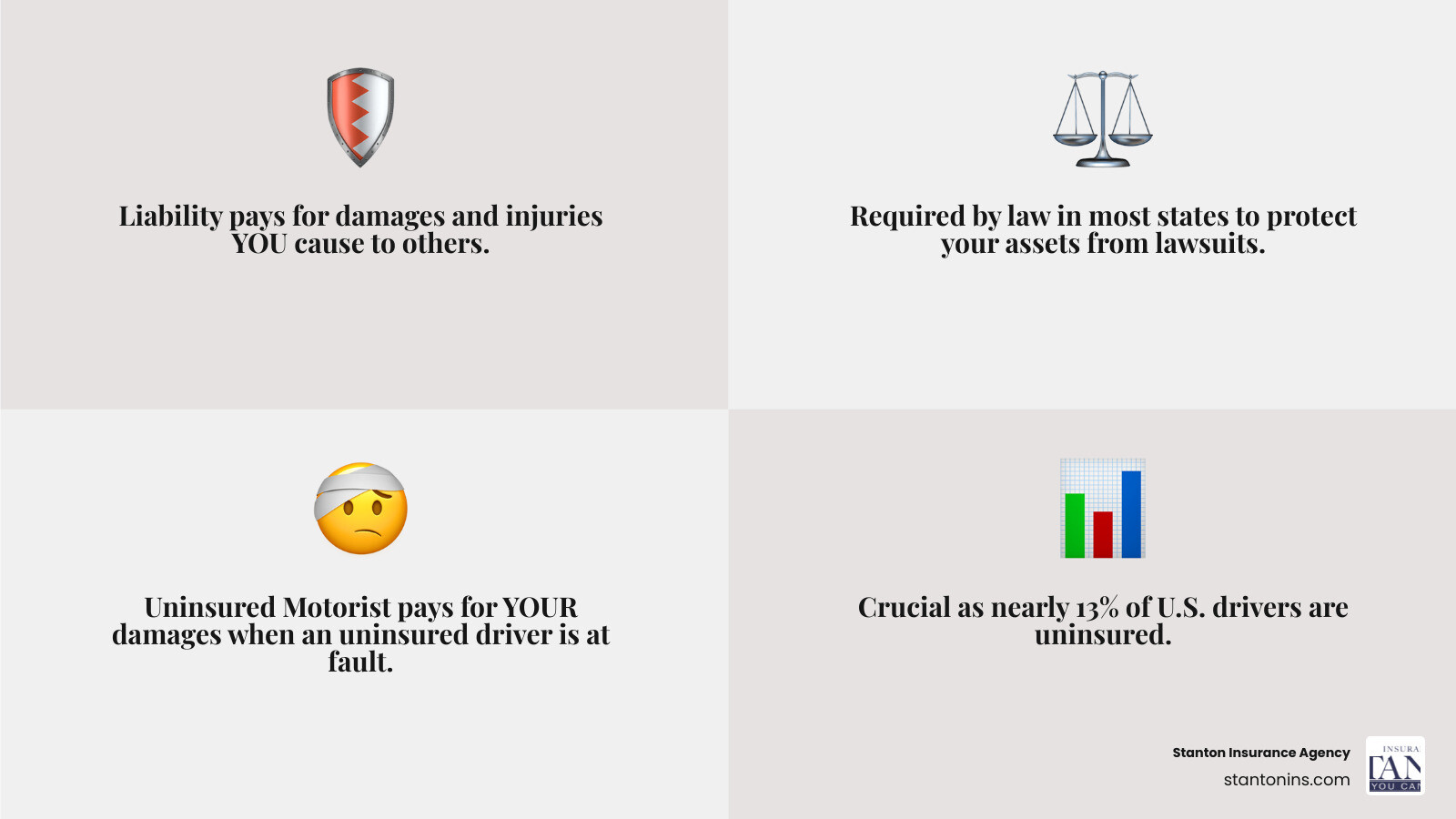
- Pays for damages and injuries you cause to others
- Required by law in most states
- Protects your personal assets from lawsuits
Uninsured Motorist Coverage:
- Pays for your damages when hit by an uninsured driver
- Covers medical bills, lost wages, and pain and suffering
- Essential protection since nearly 13% of drivers are uninsured
Every time you drive, you face risks beyond your control. While you may be a careful driver, you share the road with many who are not properly insured. Although Massachusetts has one of the lowest rates of uninsured drivers in the country, New Hampshire’s rate is much closer to the national average. This means responsible drivers in both states remain vulnerable to serious financial consequences if they are hit by someone without coverage.
The consequences of being unprepared can be devastating. Without proper coverage, a single accident could result in thousands of dollars in medical bills, vehicle repairs, and lost income. Understanding these two critical coverages helps ensure you’re protected whether you cause an accident or become the victim of one.
I’m Geoff Stanton, President of Stanton Insurance Agency, and I’ve spent over two decades helping Massachusetts and New Hampshire drivers steer the complexities of auto insurance, including the critical relationship between liability and uninsured motorist coverage. My experience has shown me how proper coverage can mean the difference between a manageable claim and financial hardship.
The Foundation: What is Liability Coverage and Why is it Required?

Think of Auto Liability Insurance as your financial safety net when things go wrong on the road. When you’re at fault in an accident, this coverage steps up to pay for the damages and injuries you cause to other people. Here’s the key point: liability coverage protects others, not you. It won’t pay for your own medical bills or fix your car, but it will prevent you from facing a potentially devastating lawsuit.
Without liability coverage, you could find yourself personally responsible for hundreds of thousands of dollars in damages. Imagine hitting a luxury car or, worse, seriously injuring someone who needs extensive medical care. The financial consequences could follow you for decades. This is exactly why nearly every state requires drivers to carry at least some liability and uninsured motorist protection.
The legal requirement isn’t just bureaucratic red tape—it’s based on a simple principle of fairness. If you cause harm while driving, you should be financially responsible for fixing it. Your liability coverage makes this possible without destroying your personal finances in the process.
Bodily Injury and Property Damage Liability
Liability Car Insurance Coverage comes in two distinct parts, each serving a specific purpose:
Bodily Injury Liability covers the human cost of accidents you cause. This includes medical expenses, lost wages, and pain and suffering for injured people. You’ll see this coverage displayed as two numbers, like $20,000/$40,000. The first number represents the maximum your policy will pay for one person’s injuries, while the second is the total amount available for all injuries in a single accident.
Property Damage Liability handles the physical damage you cause to other people’s belongings. While this is usually another person’s vehicle, it also covers damage to fences, buildings, mailboxes, or any other property you might hit.
In Massachusetts, the minimum required coverage is 20/40/5—meaning $20,000 per person for bodily injury, $40,000 total per accident for bodily injury, and $5,000 for property damage. New Hampshire takes a different approach, not requiring insurance but setting minimum financial responsibility limits of 25/50/25 if you choose to buy coverage or are required to after certain violations.
Here’s the reality check: these state minimums are dangerously low in today’s world. A single emergency room visit can easily exceed $20,000, and modern vehicles often cost more than $5,000 just to repair minor damage. Many drivers find too late that minimum coverage leaves them exposed to significant personal liability.
Consequences of Driving Without Insurance
The penalties for driving without insurance extend far beyond just getting a ticket. In Massachusetts, you’re looking at license suspension, registration suspension, hefty fines, and possible vehicle impoundment. New Hampshire may not require insurance, but if you cause an accident without coverage, you could lose your driving privileges for up to a year and face personal liability for all damages.
The financial consequences can be even more severe than the legal ones. Without insurance, you’re personally responsible for every dollar of damage you cause. This can lead to wage garnishment, liens on your property, and years of financial hardship. Some states may also require you to file an SR-22 form, proving you carry insurance for several years after a violation.
These harsh consequences aren’t meant to be punitive—they exist because uninsured drivers create financial risks for everyone else on the road. When someone without insurance causes an accident, the costs often fall on other drivers, insurance companies, and ultimately, all of us through higher premiums.
Your Financial Shield: Understanding Uninsured & Underinsured Motorist Coverage
Picture this: you’re driving home from work when suddenly, an uninsured driver runs a red light and crashes into your car. You’re injured, your vehicle is totaled, and you’re facing thousands in medical bills. This is exactly when uninsured motorist coverage becomes your financial lifeline.
While liability coverage protects you when you’re at fault, what happens when someone else causes an accident and they have no insurance—or not enough to cover your bills? This is where uninsured motorist (UM) and underinsured motorist (UIM) coverage becomes your financial shield. It’s a first-party coverage, meaning you’re making a claim with your own insurance company.
The statistics are eye-opening. According to the Insurance Information Institute, while Massachusetts has one of the lowest rates of uninsured drivers in the nation at just 3.5%, the rate in New Hampshire is 9.3%. These aren’t just numbers on a page—they represent real drivers on the same roads you travel every day in New England.
Here’s what makes liability and uninsured motorist coverage so different in purpose: liability protects others from your actions, while UM/UIM protects you and your passengers from drivers who are financially irresponsible or lack sufficient insurance. Think of it as your personal safety net in a world where not everyone plays by the rules.
What Does UM/UIM Cover?
When an uninsured or underinsured driver causes an accident, your UM/UIM coverage steps in to pay for expenses they can’t cover. This protection extends far beyond what many people realize.
Medical bills are the most obvious expense, covering everything from emergency room visits to ongoing rehabilitation costs. This protection is particularly vital because your health insurance may not cover all auto accident injuries, might have high deductibles, or may not cover passengers in your vehicle. UM/UIM coverage fills these potentially devastating gaps.
Lost wages become crucial when injuries prevent you from working. Your coverage reimburses the income you lose during recovery, helping you maintain financial stability when you need it most. Pain and suffering compensation addresses the physical and emotional distress caused by the accident—something that’s impossible to quantify but very real for accident victims.
Vehicle damage through Uninsured Motorist Property Damage (UMPD) can cover repairs to your car, though this coverage has specific rules and may not be necessary if you have Collision coverage. UMPD typically has lower limits and may not cover hit-and-run incidents without physical contact with the other vehicle.
This coverage proves crucial in several scenarios: hit-and-run accidents where the at-fault driver flees the scene, accidents with drivers who illegally have no insurance, or situations where the at-fault driver’s insurance company denies coverage or becomes insolvent.
In Massachusetts, UM coverage of $20,000/$40,000 is mandatory and includes both bodily injury and property damage protection. New Hampshire requires that UM/UIM coverage be offered to all policyholders, and if you purchase it, the limits must match your liability coverage. This means choosing 25/50/25 liability coverage automatically means your UM/UIM limits would also be 25/50/25.
UM/UIM Coverage Limits and Considerations
Understanding how UM/UIM limits work is straightforward once you grasp the numbers. Coverage like $100,000/$300,000 UM/UIM bodily injury means your policy pays up to $100,000 for one person’s injuries and a total of $300,000 for all injuries in a single accident caused by an uninsured or underinsured driver.
We strongly recommend matching your UM/UIM bodily injury limits to your liability coverage limits. If you carry $250,000/$500,000 in liability, consider the same for your UM/UIM. This approach ensures you’re as protected from others as they are from you—a balanced and sensible strategy.
The reality of modern medical costs makes state minimums woefully inadequate. The average emergency room visit costs around $3,300, while inpatient hospitalization averages $57,000. A serious accident can easily generate bills exceeding $100,000, making higher coverage limits not just smart but essential for your financial security.
Stacked vs. Non-Stacked UM/UIM Coverage
This distinction significantly impacts your protection level and deserves careful consideration when selecting your uninsured motorist coverage.
Stacked coverage allows you to combine UM/UIM limits across multiple vehicles on your policy. With $50,000 in UM/UIM coverage per vehicle and two cars on your policy, stacked coverage effectively provides $100,000 in total coverage ($50,000 x 2). This improved protection applies whether you’re in one of your insured vehicles, driving someone else’s car, or even injured as a pedestrian.
Non-stacked coverage provides a single limit per accident, regardless of how many vehicles you insure. Using the same example, non-stacked coverage would only provide $50,000 in UM/UIM protection, even with two cars on your policy. While non-stacked coverage costs less, it offers significantly less protection when you need it most.
For a relatively small increase in premium, stacked coverage delivers substantially more financial protection and peace of mind. We almost always recommend stacking your UM/UIM coverage when it’s available in your state—it’s one of the best insurance values you can buy.
Navigating the Complexities of Liability and Uninsured Motorist Claims

When an accident happens, understanding how liability and uninsured motorist coverage work in practice becomes crucial. The claims process isn’t just paperwork—it’s your pathway to financial recovery. Let me walk you through what actually happens when you need to use these coverages.
How Liability and Uninsured Motorist Coverage Differ in a Claim
The key difference lies in who you’re dealing with and who pays the bills. When you cause an accident, your liability coverage springs into action to protect you from the other party’s claims. Their insurance company will contact your insurer directly, and your liability coverage handles their medical bills, lost wages, and vehicle repairs. You’re essentially in the background while your insurance company manages the situation.
The scenario flips completely when you’re hit by an uninsured driver. Now you become the claimant with your own insurance company, filing under your uninsured motorist coverage. Your insurer steps into the shoes of the missing insurance company and pays for your damages up to your policy limits.
In both situations, insurance adjusters play a critical role. These professionals investigate the claim by reviewing police reports, medical records, and repair estimates. They determine fault, assess damages, and negotiate settlements. Think of them as financial detectives who piece together what happened and what it’s worth.
What Types of Damages Can Be Recovered?
Understanding what you can recover helps you appreciate why adequate coverage limits matter so much. Medical costs form the foundation of most claims, covering everything from emergency room visits to ongoing rehabilitation. The average emergency room visit costs around $3,300, while inpatient hospitalization averages $57,000—numbers that quickly highlight why state minimums fall short.
Lost wages compensation goes beyond just your missed paychecks. If your injuries permanently affect your earning capacity, you can claim for future lost income too. A carpenter who loses the use of their dominant hand faces a lifetime of reduced earnings, not just a few weeks off work.
Pain and suffering compensation acknowledges that some damages can’t be measured in receipts and paychecks. This covers the physical discomfort, emotional distress, and mental anguish that accidents cause. While harder to quantify, it’s often a significant portion of serious injury claims.
Don’t overlook property damage either. Modern vehicles are expensive, and even minor accidents can result in repair bills exceeding $10,000. Your coverage should reflect today’s vehicle values, not what cars cost when state minimums were set decades ago.
How Contributory Negligence Affects Claims
Here’s where state laws can dramatically impact your recovery. Massachusetts and New Hampshire follow comparative negligence rules, which are much more forgiving than some other states. If you’re partially at fault for an accident, your recovery gets reduced by your percentage of fault, but you can still collect damages.
For example, if you’re 20% at fault in a $50,000 accident, you’d still recover $40,000. This system recognizes that accidents often involve shared responsibility and allows injured parties to recover proportionally.
Some states follow much harsher rules where even 1% fault bars any recovery. Fortunately, our region’s laws are more reasonable, but they still emphasize why understanding fault determination matters for your claim.
What to Do After an Accident with an Uninsured Driver
Finding the other driver has no insurance can feel overwhelming, but taking the right steps protects your ability to recover under your uninsured motorist coverage. Stay calm and ensure safety first—move to a safe location and check for injuries before anything else.
Call 911 immediately to report the accident. The police report becomes crucial evidence for your uninsured motorist claim, officially documenting both the incident and the other driver’s lack of coverage. Gather comprehensive information including the other driver’s name, contact details, and license plate number, even if they claim they’re uninsured. Take photos of the scene, all vehicle damage, and any visible injuries.
Avoid admitting fault or making statements about what happened beyond basic facts. Even innocent comments like “I’m sorry” can be misconstrued later. Seek medical attention promptly, even if you feel fine initially. Adrenaline masks many injuries, and conditions like whiplash or concussions may not show symptoms for hours or days.
Most importantly, contact your insurance agent immediately to report the accident and begin your uninsured motorist claim. Your agent will guide you through the process and help coordinate how your various coverages work together. Time matters in insurance claims, so don’t delay this crucial step.
Your uninsured motorist coverage exists precisely for these situations. While it’s frustrating to deal with irresponsible drivers, having proper coverage means their poor choices don’t become your financial disaster.
Frequently Asked Questions about Liability and Uninsured Motorist Insurance
Do I need uninsured motorist coverage if I have health insurance and collision coverage?
This is one of the most common questions I hear, and the answer is a resounding yes! While it might seem like you’re covered with health insurance and collision, there are important gaps that liability and uninsured motorist coverage fill.
Your health insurance will handle your medical bills, but it won’t cover lost wages while you’re recovering from injuries. It also won’t compensate you for pain and suffering – the physical discomfort and emotional distress that comes with being injured in an accident. These costs can add up quickly, especially if you’re unable to work for weeks or months.
Think about your passengers too. If you’re carrying friends or family members who don’t have adequate health insurance, your uninsured motorist coverage protects them as well. Your health insurance only covers you, but UM coverage extends to everyone in your vehicle.
From a financial standpoint, there’s another practical benefit. Your collision coverage comes with a deductible – often $500 or $1,000 that you pay out of pocket. Uninsured motorist property damage coverage may have a lower deductible or no deductible at all, saving you money when your car needs repairs.
What is the difference between stacked and non-stacked UM/UIM coverage?
Stacking is like getting a volume discount on protection. When you have stacked coverage, you can multiply your uninsured motorist limits by the number of vehicles on your policy. So if you carry $50,000 in UM coverage and insure two cars, stacked coverage gives you $100,000 in total protection.
Non-stacked coverage gives you a single limit regardless of how many vehicles you insure. Using the same example, you’d only have $50,000 in coverage even with multiple cars on your policy.
The beauty of stacked coverage is that it follows you everywhere. Whether you’re driving your own car, borrowing a friend’s vehicle, or even walking as a pedestrian, you have that higher level of protection. For most families, the small additional cost for stacked coverage is well worth the significantly increased protection it provides.
How much does uninsured motorist coverage cost?
Here’s some good news – uninsured motorist coverage is one of the most affordable types of insurance you can buy relative to the protection it offers. The exact cost varies based on your coverage limits, driving record, and where you live, but it typically adds only a modest amount to your overall premium.
To put this in perspective, the cost of being hit by an uninsured driver without this coverage can be devastating. Medical bills alone from a serious accident can easily reach tens of thousands of dollars. Add lost wages, vehicle repairs, and other expenses, and you’re looking at potentially life-changing financial consequences.
When you compare the relatively small annual cost of UM coverage to the massive financial protection it provides, it’s one of the smartest insurance investments you can make. Most of our clients are surprised by how affordable it is once they see the actual numbers.
How can a driver save money on auto insurance premiums?
Saving money on insurance doesn’t mean you have to sacrifice essential protection like liability and uninsured motorist coverage. There are smart ways to reduce your premiums while keeping the coverage you need.
Shopping around is your most powerful tool. Insurance rates can vary significantly between companies for identical coverage, so getting quotes from multiple providers often reveals substantial savings opportunities.
Raising your deductibles on comprehensive and collision coverage can lower your premiums considerably. Just make sure you can comfortably afford the higher deductible if you need to file a claim.
Don’t overlook available discounts. Many insurers offer savings for good driving records, bundling your auto and home insurance, good student grades, anti-theft devices, low annual mileage, or paying your premium in full rather than monthly installments.
Maintaining a clean driving record is crucial for long-term savings. Accidents and traffic violations can increase your premiums for years, so defensive driving pays off in multiple ways.
Finally, review your coverage annually. Your insurance needs change as your life changes. Maybe you’ve paid off your car loan, moved to a safer neighborhood, or your teenage driver has graduated college. Regular reviews help ensure you’re not paying for coverage you no longer need while making sure you have adequate protection where it matters most.
Secure Your Future on the Road

Picture this: you’re driving down a beautiful New Hampshire mountain road or navigating through downtown Boston when suddenly, your world changes in an instant. An uninsured driver runs a red light and slams into your car. Without the right coverage, this moment could haunt your finances for years to come.
This is exactly why understanding liability and uninsured motorist insurance isn’t just smart – it’s essential for every driver who values their financial security and peace of mind.
Liability insurance acts as your financial bodyguard when you’re responsible for an accident. It steps up to cover the other person’s medical bills, lost wages, and property damage, protecting your savings account, your home, and your future earnings from potentially devastating lawsuits. Without it, a single mistake behind the wheel could cost you everything you’ve worked so hard to build.
Uninsured motorist coverage flips the script entirely. When someone else’s poor decisions leave you injured and facing mounting bills, this coverage becomes your lifeline. It ensures that your recovery isn’t derailed by an irresponsible driver’s lack of insurance.
Here’s the uncomfortable truth: state minimum coverage limits are dangerously inadequate in today’s world. With the average new car costing over $40,000 and emergency room visits easily exceeding $10,000, those minimum limits can disappear faster than you’d think possible. A serious accident involving multiple injuries could result in hundreds of thousands of dollars in damages.
The good news? You don’t have to steer these decisions alone. At Stanton Insurance Agency, we’ve spent over two decades helping Massachusetts and New Hampshire families find the right balance between comprehensive protection and affordable premiums. We believe insurance should give you confidence, not confusion.
Your next step is simple but crucial: take a close look at your current policy. Do your liability limits truly protect your assets? Do you have adequate uninsured motorist coverage to protect your family? If you’re not sure, or if it’s been more than a year since your last review, it’s time for a conversation with someone who understands the local risks and requirements.
Ready to ensure you’re fully protected? Contact us today for a comprehensive car insurance review!