
Do you need uninsured motorist coverage: 1 Vital Insight
Why Uninsured Motorist Coverage Matters for Your Financial Protection
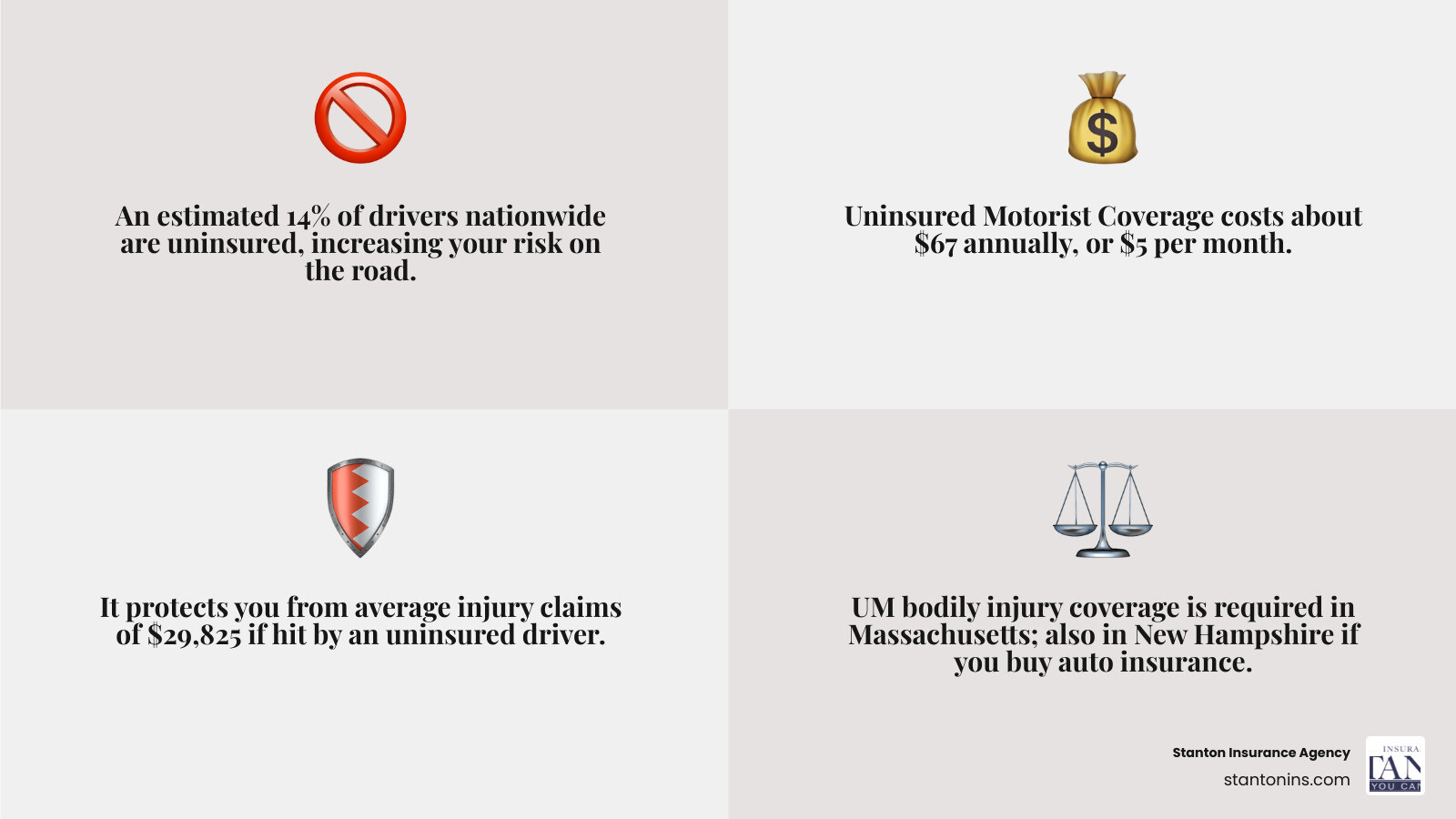
Do you need uninsured motorist coverage? The short answer is yes. With nearly 14% of drivers nationwide lacking auto insurance, this coverage is a critical part of any policy.
Quick Answer:
- Required in Massachusetts: Yes, for bodily injury coverage
- Required in New Hampshire: Yes, if you buy auto insurance
- Recommended everywhere: Protects against $29,825 average injury claims
- Cost: About $5 per month or $67 per year nationally
Being in a car wreck is bad enough, but it’s worse if the at-fault driver has no insurance or not enough to cover your costs. The risk is real everywhere, from Washington, D.C., with the highest rate of uninsured motorists at 25.2%, to low-risk states like Wyoming at 5.09%.
Uninsured motorist (UM) coverage protects you when the at-fault driver can’t pay for your injuries or vehicle damage. Underinsured motorist (UIM) coverage applies when their insurance isn’t enough. Together, they form a safety net that collision and comprehensive insurance don’t provide.
I’m Geoff Stanton, President of Stanton Insurance Agency. With 25 years in the industry, I’ve seen how essential UM/UIM coverage is for true financial security. It protects you when the at-fault driver can’t pay, filling a critical gap in your protection.
Understanding Uninsured and Underinsured Motorist Coverage
Imagine being in an accident where the at-fault driver has no insurance or flees the scene. This is where Uninsured Motorist (UM) coverage and Underinsured Motorist (UIM) coverage become your financial lifeline.
These protections are your safety net when the at-fault driver either has no insurance or not enough to pay for your losses. Both coverages can include Bodily Injury (UMBI) for medical expenses and lost wages, and Property Damage (UMPD) to repair your vehicle. They are your personal insurance against other people’s poor decisions. Learn more about how liability car insurance works.
There are three types of drivers on the road: uninsured drivers (no insurance, about 14% nationwide), underinsured drivers (carry only minimum required coverage), and fully insured drivers (carry sufficient coverage). You can’t control which type of driver hits you.
What is the difference between uninsured and underinsured motorist coverage?
The distinction between these coverages is straightforward.
Uninsured Motorist (UM) coverage protects you when you’re hit by someone with no liability insurance. This includes hit-and-run situations where the other driver can’t be found. Since you can’t collect from them, your UM coverage pays for your medical bills, lost wages, and other covered expenses.
Underinsured Motorist (UIM) coverage applies when the at-fault driver has insurance, but their policy limits are too low to cover your damages. For example, if a driver with a $25,000 limit causes $75,000 in medical bills, their insurance pays $25,000. Your UIM coverage can then cover the remaining $50,000 gap.
The key difference is that UM handles drivers with no insurance, while UIM deals with drivers who have some insurance but not enough. Hit-and-run scenarios typically fall under UM coverage, as the fleeing driver is treated as uninsured.
What does this coverage typically pay for?
When asking “do you need uninsured motorist coverage,” it’s helpful to know what it covers. This protection is designed to pay for costs the at-fault driver should have covered.
- Medical bills for you and your passengers: This includes ambulance rides, emergency room treatment, physical therapy, and prescriptions. The average UM injury claim is $29,825, so these costs can add up quickly.
- Lost wages due to injury: UM/UIM can replace your current lost income and future earnings if your injuries cause long-term disability.
- Pain and suffering: This compensates for the physical discomfort, emotional trauma, and reduced quality of life resulting from an accident.
- Funeral expenses: In the event of a fatal accident caused by an uninsured or underinsured driver, this coverage can help your family with burial costs.
- Vehicle repairs: Uninsured Motorist Property Damage (UMPD) coverage, where available, can pay to repair or replace your car. Learn more about collision insurance. Damage to other personal property in your vehicle may also be covered.
So, Do You Need Uninsured Motorist Coverage?
With an estimated 14% of drivers nationwide uninsured, according to the Insurance Information Institute, the risk of being hit by an uninsured or underinsured driver is real. That’s roughly one in seven drivers who can’t pay for the damage they cause.
Do you need uninsured motorist coverage? The answer is almost always yes. UM/UIM coverage protects you from significant out-of-pocket expenses and provides the peace of mind that comes from knowing you’re truly protected.
The statistics are concerning. In New Hampshire, the uninsured driver rate is 9.4%, while in Massachusetts it’s 6.2%. While these rates are lower than the national average, it still means thousands of drivers on local roads can’t pay for the damage they cause. When the average UM claim for injuries is $29,825, the financial risk becomes crystal clear.
UM/UIM coverage is about protecting your family’s financial future when someone else’s poor decision affects you. It’s a proactive step responsible drivers take to shield themselves from the consequences of others’ negligence.
Is uninsured motorist coverage required in Massachusetts and New Hampshire?
As a local agency serving both Massachusetts and New Hampshire, we guide families through the specific requirements in each state.
Massachusetts takes a firm stance. Uninsured Motorist Bodily Injury (UMBI) coverage is required by law. If you buy auto insurance in Massachusetts, your policy must include UMBI coverage. It’s a mandatory part of your coverage package, reflecting the state’s recognition of the serious financial risk posed by uninsured drivers. See minimum car insurance requirements in Massachusetts.
New Hampshire’s approach is different. The state doesn’t legally require all drivers to carry auto insurance. However, if you choose to buy a policy, it must include UM coverage. This means that while insurance isn’t mandatory, UM coverage is a built-in safeguard if you opt for a policy. New Hampshire allows you to reject Underinsured Motorist (UIM) coverage in writing, but we strongly advise against this, as many drivers carry only minimum liability limits. Do you need car insurance in NH? For more details, see the New Hampshire Insurance Department 2022 Automobile Guide.
Even where optional, we always recommend UM/UIM coverage. Only 22 states and D.C. have UM/UIM requirements, making this protection voluntary in over half the country. Its financial security far outweighs its low cost—typically around $60-$140 per year in our region.
What happens if you don’t have uninsured motorist coverage?
Without UM/UIM coverage, getting hit by an uninsured driver means you are personally liable for everything: medical bills, lost wages, and vehicle repairs. We’ve seen families face tens of thousands in medical bills from what seemed like a minor accident.
While you can sue the at-fault driver, this path is often frustrating. If someone can’t afford insurance, they likely don’t have significant assets. Winning a lawsuit against someone with no money provides a legal victory but no practical way to collect what you’re owed.
Meanwhile, the bills keep coming. Out-of-pocket costs can quickly drain savings and create lasting medical debt, forcing families to dip into college funds, delay retirement, or even face bankruptcy.
UM/UIM coverage is your insurance policy’s own insurance. It’s the safety net that catches you when the system fails, ensuring one person’s poor choices don’t derail your financial future.
How UM Coverage Compares to Your Other Insurance
It’s common to wonder if you need UM coverage when you already have collision, comprehensive, and health insurance. While there can be some policy overlap, there are also significant coverage gaps that only UM/UIM can fill. Understanding these deductibles and policy limits is crucial to building a safety net that works.
Each type of insurance serves a specific purpose, and an accident with an uninsured driver will quickly reveal any gaps in your protection. For a broader understanding of your options, explore full coverage vs. liability car insurance.
Do you need uninsured motorist coverage if you have collision and comprehensive?
Yes, you absolutely need UM coverage even with collision and comprehensive. These coverages work together rather than replacing each other.
Collision coverage pays to repair your vehicle after an accident, regardless of who is at fault (minus your deductible). What does collision insurance cover? However, it does not pay for your medical bills, lost wages, or pain and suffering.
Comprehensive coverage protects your vehicle from non-collision events like theft or hail damage. It is essential protection but is not related to accidents caused by other drivers. What does comprehensive insurance cover?
UM/UIM coverage steps in where the others leave off. It pays for your medical expenses, lost wages, and pain and suffering for you and your passengers when the at-fault driver is uninsured or underinsured—costs that collision and comprehensive do not address.
For example, if you’re hit by an uninsured driver and suffer injuries that keep you out of work, your collision coverage fixes your car, but you’re still facing thousands in medical bills and lost wages. Without UM coverage, that money comes out of your pocket.
The key difference is scope: collision fixes your car, but neither it nor comprehensive addresses the human cost of an accident with an uninsured driver. For a deeper dive, read our article on Uninsured Motorist Coverage vs. Collision.
Do you need uninsured motorist coverage if you have health insurance?
While valuable, relying solely on health insurance after an accident with an uninsured driver can leave you financially vulnerable.
- Health insurance may not cover your passengers. Your health plan covers you and enrolled family members, but it won’t help a coworker or your child’s friend injured in your car. Your UM coverage will protect anyone in your vehicle.
- Health insurance doesn’t cover lost wages or pain and suffering. It focuses only on medical treatment and won’t replace lost income, compensate for emotional trauma, or help repair your vehicle. UM/UIM addresses all these areas.
- High deductibles and copays can lead to significant out-of-pocket costs. Even with good health insurance, deductibles can be $5,000 or more. Many UM policies have no deductible for bodily injury claims, providing immediate financial relief.
Health insurance and UM coverage work as a team. Health insurance handles medical treatment, while UM coverage provides comprehensive financial protection that extends far beyond hospital bills.
How Uninsured Motorist Coverage Works in Practice

Understanding how UM/UIM coverage works can make a stressful situation more manageable. This protection acts as your financial safety net when the person who caused your accident can’t pay for the damage they’ve caused. Here’s a look at how it works in the real world.
How do you file a UM/UIM claim?
Filing a UM/UIM claim is a straightforward process, and your insurance agent can guide you through each step.
- Contact your insurance company immediately after the accident. Reporting the incident right away starts the claim process and ensures you don’t miss important deadlines.
- File a police report, especially for hit-and-run accidents. An official report creates a paper trail your insurer will need. For hit-and-runs, a police report is critical proof that the accident occurred and the other driver fled.
- Provide documentation of your injuries and damages. This includes medical records, hospital bills, photos of vehicle damage, and proof of any time missed from work. Thorough documentation helps streamline the claim.
- Cooperate with your insurer’s investigation. Your insurance company will need to verify the accident details and confirm the other driver is uninsured or underinsured. This may involve giving statements or providing additional documents.
When you file a UM/UIM claim, you’re dealing with your own insurance company for the protection you’ve paid for. What you need to know about auto insurance.
What is the difference between stacked and non-stacked coverage?
Stacking is a feature that can significantly impact how much protection you have, especially if you own multiple vehicles.
Stacked UM coverage lets you combine the coverage limits from multiple vehicles on your policy, multiplying your protection. If you have two cars with $50,000 each in UM coverage, stacking gives you up to $100,000 in total protection.
Non-stacked UM coverage means you can only access the coverage limit from one vehicle, regardless of how many cars you insure. In the same example, you’d have only $50,000 in protection.
| Feature | Stacked UM Coverage | Non-Stacked UM Coverage |
|---|---|---|
| Definition | Combines coverage limits across multiple vehicles | Uses the limit from a single policy/vehicle |
| How it Works | Increases payout potential if you own multiple cars | Only one policy’s limit applies |
| Cost | Typically higher premium | Lower premium |
| Availability | Not available in all states; check your policy | Standard in most policies |
The choice depends on your budget and desired level of protection. Stacking is permitted in New Hampshire but not in Massachusetts. We can help you steer these state-specific rules to ensure you have the right level of protection.
How much coverage should you get and what does it cost?
A good rule of thumb is to match your UM/UIM limits to your liability limits. If you think $100,000 is enough to protect others from your mistakes, you should have at least that much to protect yourself.
Also, consider your vehicle’s value and personal assets when setting limits. Ensure your Uninsured Motorist Property Damage coverage (where available) can handle repairs or replacement.
The cost is surprisingly affordable. UM/UIM coverage typically costs between $60 and $140 per year for our clients in Massachusetts and New Hampshire. That’s about $5 to $12 per month.
Considering the average UM injury claim is $29,825, this protection is one of the smartest financial decisions you can make. For personalized pricing, please reach out for a quote:
Frequently Asked Questions about Uninsured Motorist Coverage
Here are answers to the most common questions we receive about uninsured and underinsured motorist coverage.
How does uninsured motorist coverage work in a hit-and-run accident?
In a hit-and-run, your Uninsured Motorist coverage treats the fleeing driver as if they were uninsured. Your UM coverage can pay for your injuries and, depending on your policy, your vehicle damage up to your policy limits.
To use this coverage, you must file a police report promptly. This is typically required by insurance companies as official documentation that the incident occurred. Your insurer may also require proof of physical contact between your vehicle and the hit-and-run driver’s car. Claims involving a “phantom vehicle” that causes you to crash without contact can be more complex.
Can I be a passenger in a car and still be covered by my own UM policy?
Yes. Your UM coverage typically follows you, not just your car. If you’re injured as a passenger in a friend’s car by an uninsured driver, your own UM policy can cover your medical expenses and other damages. This is valuable if your friend has inadequate coverage.
This protection also extends to situations where you are a pedestrian or cyclist. If you’re hit by an uninsured driver while walking or biking, your UM coverage can protect you. This “follows the person” feature is important for families, as it can protect a child riding with friends.
What are the main benefits of having uninsured motorist coverage?
When we discuss do you need uninsured motorist coverage, the comprehensive nature of this protection becomes clear. It’s a financial safety net that prevents a bad accident from becoming a financial catastrophe.
- Financial Security: It covers thousands of dollars in medical bills, lost wages, and repair costs that you would otherwise have to pay out-of-pocket.
- Peace of Mind: Knowing you’re protected against the 14% of uninsured drivers lets you focus on recovery instead of financial stress.
- Protection for Passengers: It covers everyone in your vehicle, unlike health insurance, which may only cover you.
- Broader Compensation: Unlike health insurance, UM/UIM can compensate you for pain and suffering and other non-economic damages.
- Affordability: At an average cost of just $60-$140 per year in our area, it’s one of the best values in insurance. Considering the average UM injury claim is nearly $30,000, the cost is minimal for the protection it provides.
Secure Your Financial Future on the Road
With 14% of drivers nationwide lacking coverage, the risk of an accident with an uninsured driver is a valid concern. After reviewing the scenarios and statistics, the answer to “do you need uninsured motorist coverage?” is clear: absolutely. This isn’t just an add-on; it’s a fundamental shield for your family’s financial future.
Think of it as the financial equivalent of buckling up. It ensures that one accident doesn’t derail your family’s financial stability just because someone else drove without proper insurance.
UM/UIM coverage fills crucial gaps left by other policies. While health insurance may cover your medical bills, it won’t replace lost wages, compensate for pain and suffering, or help passengers not on your health plan. UM/UIM coverage acts as your personal safety net when the at-fault driver can’t pay.
At Stanton Insurance Agency, we’ve seen the financial hardship that accidents with uninsured drivers can cause. That’s why we’re passionate about helping our Massachusetts and New Hampshire neighbors understand their options. Our team knows the unique insurance landscape in our region, from Massachusetts’ mandatory UMBI requirements to New Hampshire’s distinct laws.
We provide straightforward advice, reviewing your policy to build protection that fits your life. Whether you’re a new driver in Concord or a family in Springfield, we’re here to ensure you have the trusted protection your valuable assets deserve.
Don’t leave your financial future to chance. The roads are unpredictable. Get a personalized car insurance review today. Let’s make sure you and your family can drive with confidence, knowing you’re covered no matter what comes your way.
