
Top 1 difference between pip and uninsured motorist coverage
Understanding Your Auto Insurance Safety Net
Navigating your auto insurance policy can feel like learning a new language, with a host of acronyms and clauses. Two of the most important, yet often confused, types of coverage are Personal Injury Protection (PIP) and Uninsured/Underinsured Motorist (UM/UIM) coverage. Both are designed to protect you financially after an accident, but they apply in very different situations. Understanding this distinction is crucial for building a policy that truly safeguards you and your family on the road. This guide will break down exactly what each coverage does, when it applies, and why having both is your strongest defense against unexpected costs.
The difference between pip and uninsured motorist coverage is one of the most important distinctions to understand when building your auto insurance policy. Both coverages protect you after an accident, but they work in completely different ways:
| Coverage Type | When It Applies | What It Covers | Fault Required |
|---|---|---|---|
| PIP (Personal Injury Protection) | Any accident involving your vehicle | Medical bills, lost wages (75%), essential services | No – pays regardless of fault |
| Uninsured Motorist (UM/UIM) | When at-fault driver has no/insufficient insurance | Medical bills, lost wages, pain & suffering, property damage | Yes – other driver must be at fault |
Nearly 13% of drivers nationwide don’t have auto insurance, and in some states that number exceeds 20%. This means you’re statistically likely to encounter an uninsured driver during your time behind the wheel. Meanwhile, even if you’re the one who causes an accident, you still need medical care – and that’s where these two coverages become your financial lifeline.
The key difference lies in timing and triggers: PIP acts as your immediate safety net regardless of who’s at fault, while UM/UIM coverage protects you specifically when another driver’s negligence leaves you facing bills they can’t pay. Understanding this distinction helps you see why both coverages work together rather than compete with each other.
I’m Geoff Stanton, President of Stanton Insurance Agency, and I’ve spent over two decades helping Massachusetts and New Hampshire families steer the difference between pip and uninsured motorist coverage to build policies that truly protect them. My experience in the claims department has shown me how these coverages can mean the difference between financial recovery and devastating out-of-pocket expenses after an accident.
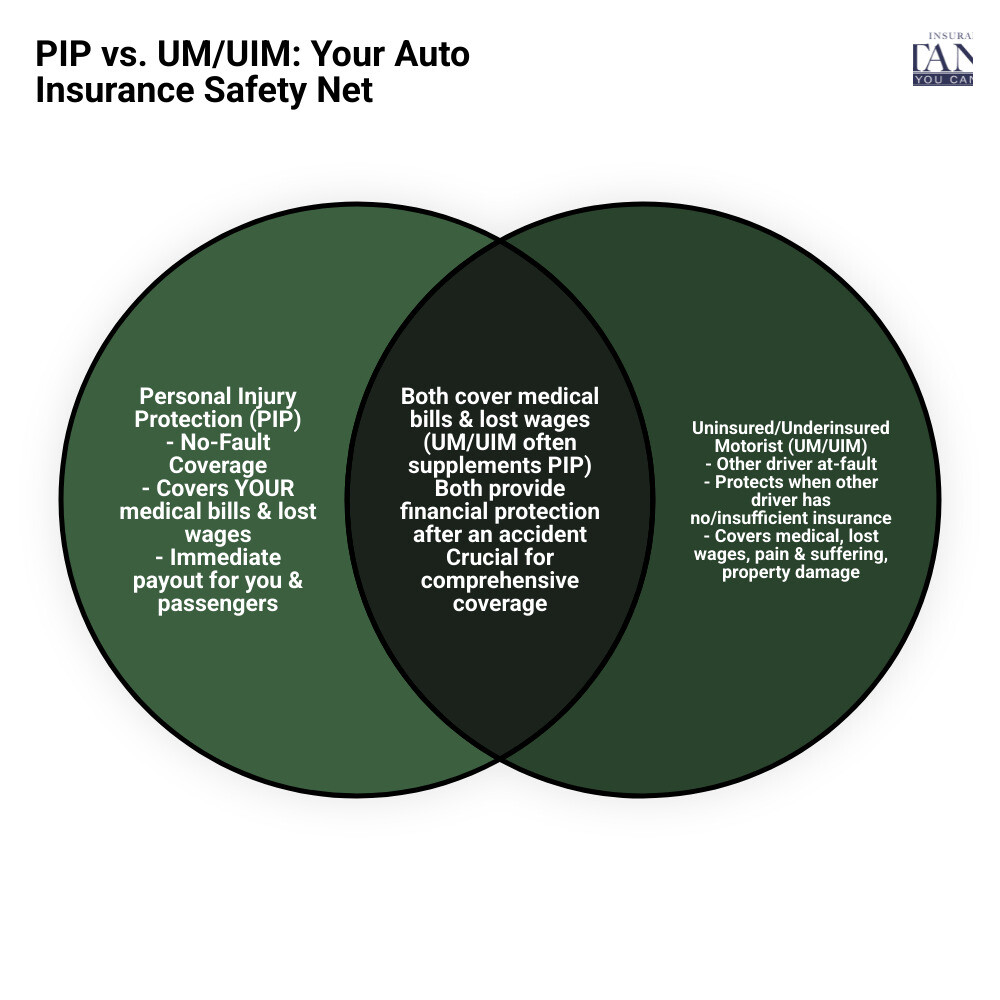
What is Personal Injury Protection (PIP)? Your First Line of Defense

Think of Personal Injury Protection as your insurance policy’s emergency response team. When an accident happens, PIP springs into action immediately – no questions asked, no blame game required. It’s there to make sure you get the medical care you need and keep food on the table while you recover.
The beauty of PIP lies in its simplicity. Whether you caused the accident, the other driver did, or nobody really knows what happened, PIP covers you and your passengers. This “no-fault” approach means you won’t be sitting in a hospital bed worrying about who’s going to pay for your treatment while lawyers sort out the details.
How PIP Works
PIP operates on a refreshingly straightforward principle: when you’re hurt, you get help. Period. Your own insurance company pays your bills up to your policy limits, regardless of who was at fault for the accident. This is a crucial part of understanding the difference between PIP and uninsured motorist coverage – PIP doesn’t care about fault at all.
In Massachusetts, this no-fault system is mandatory because it works. Instead of waiting weeks or months for fault determination, you can start physical therapy next week. Instead of battling with another driver’s insurance company, you’re dealing with your own insurer who has a contractual obligation to pay your covered expenses quickly.
The process is designed to get you back on your feet as fast as possible. You submit your medical bills and wage statements to your insurance company, and they handle the payments directly with your healthcare providers in most cases.
What PIP Covers
PIP coverage goes well beyond just paying your doctor bills, though that’s certainly its most important function. Medical expenses form the foundation – everything from emergency room visits and surgery to prescription medications and rehabilitation services. If you need an ambulance, PIP covers it. If you need months of physical therapy, PIP covers it.
But here’s where PIP really shines: it recognizes that injuries affect your entire life, not just your health. Lost wages become a major concern when you can’t work, so PIP typically reimburses up to 75% of your lost income. This isn’t charity – it’s practical protection that keeps your mortgage paid while you heal.
Replacement services might sound fancy, but it’s really about the everyday stuff you can’t do while recovering. If you normally clean your own house but can’t lift a vacuum cleaner with a back injury, PIP can pay for housekeeping services. If you usually watch your kids after school but you’re stuck in bed, PIP can help cover childcare costs.
The coverage extends to everyone in your vehicle too – your family members and any passengers are protected under your PIP coverage. In some situations, it even covers you if you’re hit by a car while walking or biking.
This immediate, comprehensive approach to covering your accident-related expenses is what makes PIP such a vital safety net. To learn more about how this coverage works in practice, check out our detailed guide on What is PIP Insurance? or find more about Is Massachusetts a No-Fault Car Insurance State?.
What is Uninsured/Underinsured Motorist (UM/UIM) Coverage? Protection from Others’ Lapses

Here’s a sobering reality: According to the Insurance Information Institute, nearly 13% of drivers countrywide don’t have auto insurance. In some states, that number climbs even higher, exceeding 20%. This means that roughly one in eight drivers you encounter on your daily commute is breaking the law by driving without coverage.
Now imagine this scenario: You’re stopped at a red light when an uninsured driver rear-ends you, causing serious injuries and thousands of dollars in medical bills. Their lack of insurance doesn’t make your pain any less real or your bills any smaller. This is exactly where Uninsured/Underinsured Motorist (UM/UIM) coverage becomes your financial lifeline.
While PIP steps in regardless of who caused the accident, the difference between PIP and uninsured motorist coverage becomes crystal clear in fault-based situations. UM/UIM coverage specifically protects you when someone else’s negligence—combined with their lack of adequate insurance—threatens to leave you holding the bag for expenses that should rightfully be their responsibility.
How UM/UIM Works
Uninsured/Underinsured Motorist coverage acts as a substitute for the coverage the at-fault driver should have had. Think of it as your insurance company stepping into the shoes of the responsible party and paying what they can’t or won’t pay.
Uninsured Motorist (UM) coverage kicks in when the at-fault driver has no insurance whatsoever. These drivers are essentially gambling with other people’s financial well-being every time they get behind the wheel.
Underinsured Motorist (UIM) coverage addresses a different but equally frustrating situation. The at-fault driver does have insurance, but their liability limits are woefully inadequate to cover your actual damages. For example, if they carry only the minimum $20,000 in bodily injury coverage but your medical bills alone total $75,000, UIM coverage can help bridge that devastating gap.
Unlike PIP’s no-fault approach, UM/UIM is fault-based coverage. You must establish that the other driver was legally responsible for the accident before these benefits become available. This usually involves the same investigation process that would occur with any liability claim—the key difference is that your own insurance company becomes the payer when the at-fault driver’s coverage falls short.
What UM/UIM Covers
UM/UIM coverage provides comprehensive protection that goes well beyond what PIP offers. Medical bills are covered, particularly those expenses that exceed your PIP limits or continue long after your PIP benefits are exhausted. Lost wages are also included, covering income loss that extends beyond what your PIP policy provides.
But here’s where UM/UIM coverage truly shines: it includes pain and suffering compensation. This covers the physical discomfort, emotional distress, and reduced quality of life that serious accidents often cause—damages that PIP simply doesn’t address but can represent the largest portion of your total losses.
Property damage protection may also be available through Uninsured Motorist Property Damage (UMPD) coverage, which can repair or replace your vehicle when an uninsured driver damages it. This becomes particularly valuable if you don’t carry collision coverage on your own policy.
The beauty of UM/UIM coverage lies in its comprehensive approach. While PIP gets you back on your feet immediately, UM/UIM ensures you’re fully compensated for the long-term impact of someone else’s poor decisions and inadequate preparation.
For more detailed information about this essential protection, visit our comprehensive guide on What is Uninsured Motorist Coverage?.
The Core Difference Between PIP and Uninsured Motorist Coverage: A Head-to-Head Comparison
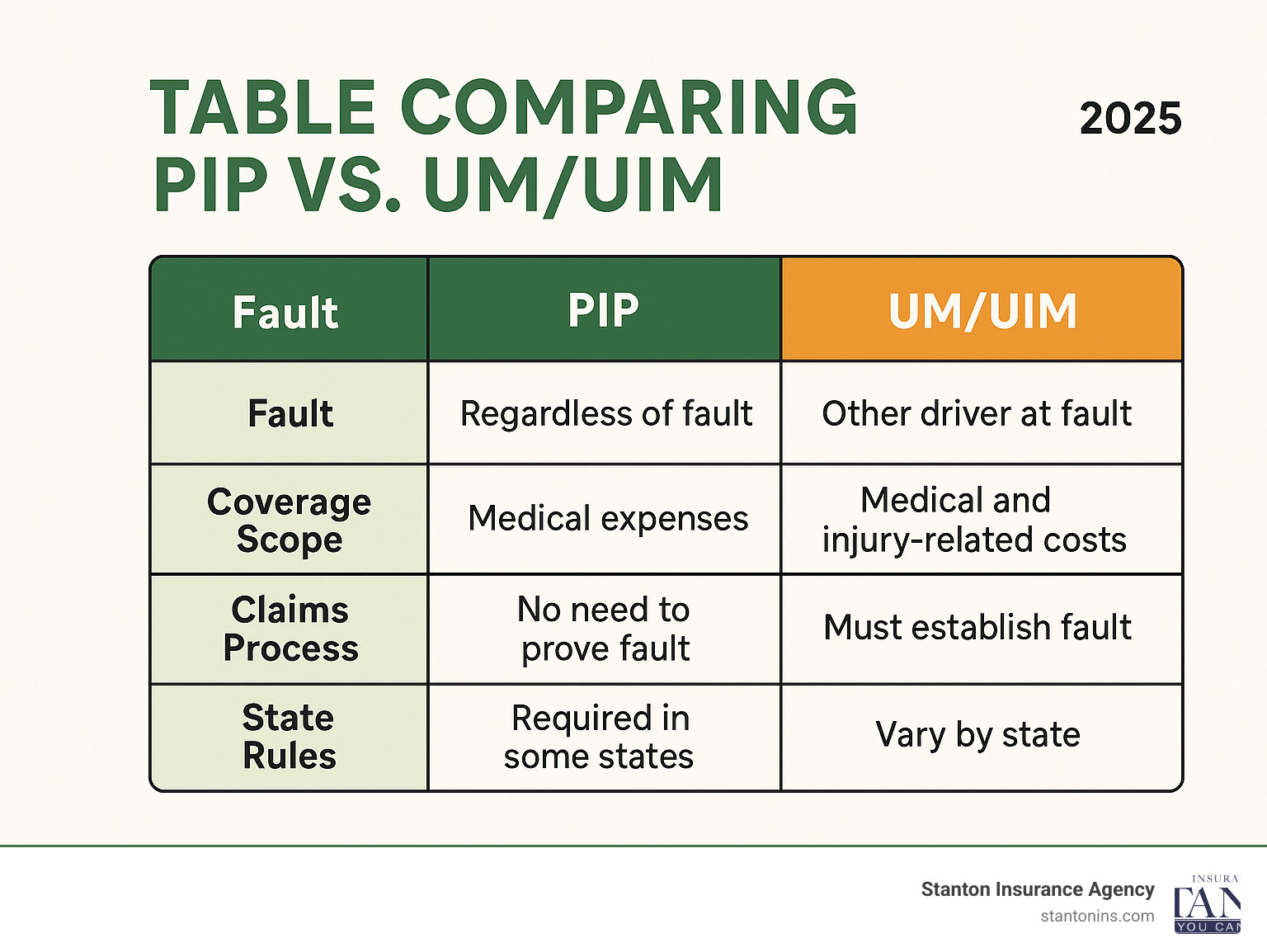
Now that we’ve explored what each coverage does, let’s dive into the heart of the matter. The difference between PIP and uninsured motorist coverage isn’t just academic—it’s the key to understanding when you’ll have financial protection and when you might be left scrambling to cover massive bills.
Think of it this way: if auto insurance were a restaurant, PIP would be the reliable house salad that comes with every meal, while UM/UIM would be the premium insurance policy you buy to protect against the chef having a really bad day. Both serve important purposes, but they work in completely different situations.
The Role of Fault: Who Caused the Accident?
Here’s where things get interesting, and where the difference between PIP and uninsured motorist coverage becomes crystal clear. These two coverages live in completely different worlds when it comes to fault.
PIP operates in a blame-free zone. Whether you rear-ended someone while checking your phone, got hit by a driver running a red light, or slid into a tree during an ice storm, your PIP coverage kicks in immediately. It doesn’t care who messed up—it just pays. This no-fault approach means you can get medical treatment right away without waiting for insurance investigators to play detective and figure out what happened.
UM/UIM coverage, on the other hand, is all about pointing fingers. It only springs into action when another driver is legally at fault for the accident and that driver either has no insurance or not enough to cover your damages. If you caused the accident, your UM/UIM sits on the sidelines. It’s essentially your insurance company stepping in to pay what the irresponsible at-fault driver should have paid but can’t.
This fundamental difference means that while PIP acts as your universal safety net, UM/UIM specifically protects you from other people’s poor choices and financial shortcomings.
Scope of Coverage: What Expenses Are Paid?
Both coverages can help with medical bills and lost wages, but that’s where the similarities end. The scope of what they cover reveals another crucial aspect of the difference between PIP and uninsured motorist coverage.
PIP focuses on getting you back on your feet financially. It covers your immediate economic damages—medical bills, about 75% of your lost wages, and essential services you can’t perform while recovering. Think of it as covering the practical, measurable costs of an accident. But here’s what PIP doesn’t do: it won’t compensate you for the sleepless nights, the chronic pain, or the anxiety about driving again.
UM/UIM coverage takes a much broader view. Yes, it covers medical expenses and lost income (typically after your PIP limits are used up), but it also addresses the non-economic damages that can be life-altering. This includes compensation for pain and suffering, emotional distress, permanent disability, and loss of enjoyment of life. These damages can be substantial—sometimes even more than the medical bills themselves—especially in serious accidents.
This is why having both coverages is so powerful. PIP handles your immediate needs while UM/UIM ensures you’re fully compensated for the total impact an irresponsible driver has had on your life.
State Requirements: Is It Mandatory in MA and NH?
The legal landscape adds another layer to understanding the difference between PIP and uninsured motorist coverage. Your state’s requirements reflect different philosophies about how to handle auto accidents.
In Massachusetts, the law treats both coverages as essential protection. As a no-fault state, PIP is mandatory with a minimum of $8,000 in coverage—the state wants to ensure everyone has immediate access to medical care regardless of fault. Uninsured Motorist coverage is also required, recognizing the real threat posed by drivers who break the law by driving without insurance. You can learn more about these requirements on our Auto Insurance in MA page.
In New Hampshire, the approach is quite different. As a traditional tort state, PIP isn’t required. Instead, any auto insurance policy sold in the state must include Medical Payments coverage. Insurers must also offer you UM/UIM coverage—and while you can reject it in writing, doing so leaves you financially vulnerable to the nearly 13% of drivers who have no insurance at all. Our Auto Insurance Requirements in New Hampshire page has all the details.
Understanding these state-specific rules helps explain why the coverages work differently and why both are crucial components of a well-rounded policy, regardless of what your state requires as a minimum.
Why Having Both PIP and UM/UIM is Your Best Strategy

Here’s the truth about the difference between pip and uninsured motorist coverage: they’re not competing against each other for your premium dollars. Instead, they work together like a tag team, each stepping in when the other reaches its limits. Think of it as having both a seat belt and an airbag in your car—you wouldn’t choose just one when you could have both protecting you.
PIP acts as your financial first responder. The moment an accident happens, it springs into action without asking questions about who was at fault. Need immediate medical care? PIP has you covered. Can’t work for a few weeks while you recover? PIP will help replace a portion of your lost income. It’s designed to get you the care you need right now, not after months of legal wrangling.
But here’s where things get interesting. UM/UIM coverage fills the gaps that PIP simply can’t touch. When an uninsured driver rear-ends you and your medical bills exceed your PIP limits, that’s when UM coverage becomes your financial lifeline. More importantly, if you’re dealing with chronic pain, emotional trauma, or permanent injuries from the accident, UM/UIM can compensate you for pain and suffering—something PIP never covers.
Let me paint you a real-world picture. Imagine you’re hit by an uninsured driver and face $25,000 in medical bills plus six months off work. Your PIP immediately pays the first $8,000 in medical expenses and covers 75% of your lost wages up to its limit. But what about the remaining $17,000 in medical bills? What about the ongoing physical therapy? What about compensation for the chronic back pain that may never fully heal?
This is where UM coverage saves the day. It steps in to cover those additional medical expenses, compensates you for the full extent of your lost wages, and—crucially—provides financial recognition for the pain and suffering you’ve endured. Without UM coverage, you’d be left hoping to collect money from someone who couldn’t even afford basic car insurance.
The statistics make this strategy even more compelling. With nearly one in eight drivers lacking insurance entirely, and many others carrying only minimum coverage that might not be enough for serious injuries, having both coverages isn’t just smart—it’s essential. Your comprehensive protection strategy means you’re covered whether the other driver has no insurance, too little insurance, or even if you can’t identify them after a hit-and-run.
At Stanton Insurance Agency, we’ve seen too many families struggle financially after accidents because they thought basic coverage was enough. The small additional cost of robust PIP and UM/UIM coverage pales in comparison to the financial devastation of being underprotected when you need it most. This layered approach to protection ensures you can focus on healing, not on how you’ll pay the bills.
For a deeper understanding of why comprehensive coverage matters so much, explore our guide on Why Auto Insurance Is Important: Protecting Yourself and Others on the Road.
Frequently Asked Questions about PIP and UM/UIM Coverage
When it comes to understanding the difference between PIP and uninsured motorist coverage, we hear the same thoughtful questions from clients time and time again. These are smart questions that show you’re thinking carefully about how these coverages work together to protect you. Let me address the most common concerns we encounter.
Can I use PIP and UM coverage for the same accident?
Absolutely, and this is exactly how these coverages are designed to work as a team. Think of it like having multiple safety nets stacked beneath a tightrope walker – each one catches you at a different level.
Here’s how it typically plays out: Let’s say an uninsured driver runs a red light and hits you. Your PIP coverage immediately springs into action, paying for your emergency room visit, initial medical treatment, and covering 75% of your lost wages while you recover. No waiting, no fault investigation needed – just immediate financial relief when you need it most.
But what happens if your injuries are more serious than initially thought? Once your PIP benefits reach their limit, your Uninsured Motorist coverage steps up to the plate. It can cover additional medical expenses that exceed your PIP limit, compensate you for ongoing lost wages, and – crucially – provide compensation for pain and suffering, which PIP doesn’t cover at all.
This layered approach means you’re not left scrambling to cover gaps in your protection. The coverages complement each other beautifully, ensuring comprehensive coverage for your injuries and losses.
Does PIP or UM coverage have a deductible?
The deductible situation varies between these two coverages, and understanding this helps you plan for potential out-of-pocket costs.
For PIP coverage in Massachusetts, you’ll typically encounter a deductible if you have health insurance. This deductible can be up to the first $2,000 of your medical bills that you’d be responsible for before PIP kicks in. However, you have options here – you can choose to reduce or even eliminate this deductible by paying a higher premium. It’s a trade-off between upfront premium costs and potential out-of-pocket expenses later.
Uninsured Motorist Bodily Injury (UMBI) coverage generally comes without a deductible, which is great news. Once it’s established that the other driver was at fault and lacks adequate insurance, your UMBI coverage pays from the first dollar up to your policy limits. No deductible to worry about during an already stressful time.
If you carry Uninsured Motorist Property Damage (UMPD) coverage, you might see a small deductible – often around $250 – but this is typically much lower than collision coverage deductibles.
What happens if I reject UM/UIM coverage where it’s optional?
This is one of those decisions that can haunt you later, and I’ve seen the devastating financial consequences firsthand. When you reject UM/UIM coverage in states like New Hampshire where it’s optional, you’re essentially betting that you’ll never encounter an uninsured or underinsured driver who causes you serious harm.
Unfortunately, this is a risky bet. Without UM/UIM coverage, your options become severely limited if an uninsured driver injures you. You’d have to rely entirely on your PIP (if available) and personal health insurance for medical bills. More importantly, you’d receive zero compensation for pain and suffering, which can represent the largest portion of damages in serious injury cases.
Your only remaining option would be to sue the at-fault driver personally. This sounds reasonable in theory, but the reality is often disappointing. These lawsuits are expensive, time-consuming, and frequently result in empty victories. You might win in court, but collecting money from someone who couldn’t afford insurance in the first place is like trying to squeeze water from a stone.
The peace of mind that comes with UM/UIM coverage far outweighs the modest additional premium cost. It’s protection against other people’s poor decisions – and unfortunately, you can’t control how responsibly other drivers handle their insurance obligations.
Secure Your Peace of Mind on the Road
Understanding the difference between PIP and uninsured motorist coverage is your gateway to building an auto insurance policy that truly has your back when life takes an unexpected turn. These two coverages work hand-in-hand to create a comprehensive safety net that protects you from multiple angles.
Think of PIP as your immediate response team—it springs into action the moment an accident happens, covering your medical bills and lost wages without anyone having to point fingers or determine fault. Meanwhile, UM/UIM acts as your financial bodyguard against the one-in-seven drivers who either have no insurance or carry bare-minimum coverage that won’t come close to covering serious injuries.
Here’s the thing: having both coverages isn’t about being overly cautious or paying for duplicate protection. It’s about being smart. PIP gets you the care you need right away, while UM/UIM ensures you’re fully compensated for both your tangible losses and the pain and suffering that can follow a serious accident. Together, they create a layered defense system that works no matter who caused the accident or how well-insured the other driver happens to be.
At Stanton Insurance Agency, we’ve seen how this combination of coverages can mean the difference between a manageable recovery and a financial nightmare. Our team understands the unique insurance landscape in Massachusetts and New Hampshire, and we’re committed to helping you build a policy that provides genuine peace of mind.
Your family’s financial security shouldn’t be left to chance, especially when protection is so accessible. The roads are full of uncertainties, but your insurance coverage doesn’t have to be one of them.
Ready to review your coverage and ensure you’re fully protected? Contact us for a personalized car insurance quote today and drive with confidence knowing you’ve made the smart choice for comprehensive protection.
