
Commercial Property Insurance Rates: 5 Smart Ways
Introduction: Protecting Your Business’s Physical Foundation
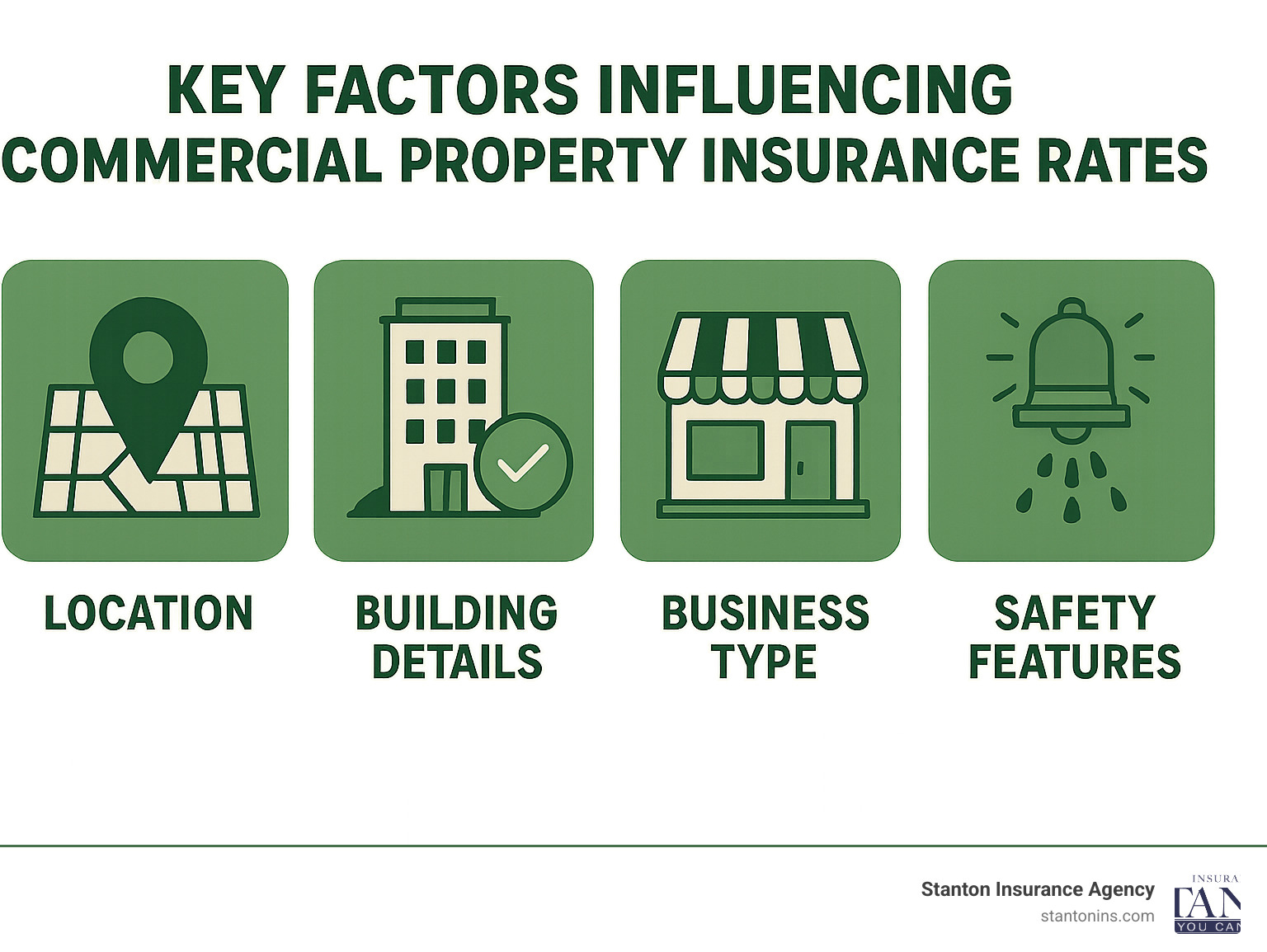
Understanding commercial property insurance rates is a core challenge for any business owner. While costs vary widely, many small businesses typically pay between $60 and $150 per month. This rate depends on several key factors:
- Location: Your business’s address and local risks.
- Building Details: Its age, construction materials, and value.
- Business Type: What your company does and its unique risks.
- Safety Features: Alarms, sprinklers, and other protections.
- Claims History: Your business’s past insurance claims.
For any business owner, your physical assets—from the building you operate in to the equipment and inventory inside—are the bedrock of your livelihood. An unexpected event like a fire, storm, or theft can be financially devastating without the right protection. This is where commercial property insurance steps in, acting as a critical safety net. This guide will break down the costs, explain the factors that insurers evaluate, and provide smart ways to help you get the best coverage at a fair price.
I’m Geoff Stanton, a Certified Insurance Counselor (CIC) and a fourth-generation owner at Stanton Insurance. I specialize in commercial property & liability, particularly for small and medium-sized portfolios, helping businesses steer complex commercial property insurance rates.
What is the Average Cost of Commercial Property Insurance?
Ever wonder what your neighbor pays for their business insurance? When it comes to commercial property insurance rates, pinning down a single “average” cost is a bit like trying to catch smoke! That’s because premiums are wonderfully (and sometimes frustratingly) customized for each unique business. No two businesses are exactly alike, and neither are their risks or insurance needs.
However, we can certainly give you a helpful ballpark figure based on industry data. Many small businesses often find themselves paying between $65 and $140 per month for commercial property coverage. That shakes out to roughly $800 to $1,700 over a year.
Now, here’s a smart move many businesses make: bundling! For those who combine their property coverage into a Business Owner’s Policy (BOP), which typically wraps in general liability too, the median cost can be even more appealing, often around $63 per month.
It’s truly amazing how much these costs can swing based on your business type and the risks involved. While many small businesses fall into the $65-$140 monthly range, some might pay as little as $45 per month (around $538 annually), and others up to $134 per month (about $1,605 annually), depending on their specific profile and provider. A tiny startup might even pay just $500 per year, while a massive corporation could see premiums upwards of $500,000 annually!
Think about it: A busy restaurant with sizzling kitchens, expensive equipment, and lots of foot traffic faces different challenges than a quiet home-based consultant with just a laptop. Each of these scenarios carries its own unique set of risks, which directly influences your commercial property insurance rates. In fact, almost two-thirds (62%) of small businesses might spend $100 or less per month, with a good chunk (35%) even paying under $50!
Average Commercial Property Insurance Costs by Profession
Just how much your profession influences your rates might surprise you! The type of business you run is a huge piece of the puzzle when insurers calculate your commercial property insurance rates. Take a peek at how median monthly premiums stack up for various professions:
| Profession | Median Monthly Premium |
|---|---|
| Accountant | $28 |
| Architect | $28 |
| General Contractor | $61 |
| Landscaper | $60 |
| Photographer | $32 |
| Real Estate Agent | $32 |
| Restaurant | $107 |
| Retail Store | $41 |
Note: These figures are based on national industry data and are for illustrative purposes. Your specific rate will depend on the unique factors of your business.
How Insurers Calculate Commercial Property Insurance Rates
Ever wondered how insurance companies figure out your premium? It’s not just a random number! They use a very detailed process to understand the unique risks your business property faces. Think of it like a puzzle, where each piece tells them something important about your potential for claims. They often use a helpful framework called “COPE” – which stands for Construction, Occupancy, Protection, and Exposure. Along with other factors like your claims history, these elements are the key to understanding your commercial property insurance rates.
Factor 1: Construction and Building Characteristics
The very bones of your building play a huge role in your insurance cost. Insurers look closely at what your property is made of, how old it is, and its overall condition.
- Construction Materials: What’s your building built from? If it’s made of fire-resistant materials like brick, masonry, or concrete (often called “Joisted Masonry” or “Non-Combustible”), you’re generally in luck. These materials hold up better against fire, meaning less risk for insurers and often lower premiums for you. On the flip side, wood-frame buildings are more susceptible to fire damage, which can mean higher commercial property insurance rates.
- Building Age and Condition: Newer buildings, especially those built to today’s codes, often get more favorable rates. They tend to have modern electrical, plumbing, and heating systems, which reduces the chance of problems like fires or water leaks. Older properties, however, might have outdated systems that pose a higher risk. But don’t despair if you’re in an older building! Keeping it well-maintained and upgrading key systems can really help lower that risk in the eyes of an insurer.
- Building Size & Value: This one’s pretty straightforward. The bigger your commercial property and the more it would cost to rebuild it from scratch (that’s called “replacement cost”), the more coverage you’ll need. And more coverage usually means a higher premium.
Factor 2: Occupancy (Your Industry and Operations)
It’s not just about the building; it’s also about what you do inside it! Your business operations and the value of your stuff are just as important.
- Industry Risk: Some businesses naturally come with more risk than others. Think about it: a busy restaurant with open flames and deep fryers, or a woodworking shop full of combustible dust, will likely have higher commercial property insurance rates than, say, a quiet accounting firm. Insurers see more potential for accidents and damage in those higher-risk operations.
- Equipment & Inventory Value: What’s inside your business? This includes all your “business personal property” – your computers, furniture, specialized machinery, tools, and all your inventory. If you’re a jewelry store with high-value stock, you’ll have a higher theft risk than a bookstore. The more valuable your contents, the higher your premium will be because there’s more for the insurer to potentially replace.
- Shared Spaces and Neighbors: If your business shares a building with others, your neighbors can actually impact your rates. If a neighboring business has a high fire risk – like a welding shop right next to your retail store – it could increase the perceived risk for your unit, even if your own operations are very safe. Insurers look at the whole picture!
Factor 3: Protection and Safety Measures
Good news! Insurers love businesses that take safety seriously. The more proactive you are about preventing losses, the more you can often save on your commercial property insurance rates.
- Fire Protection: This is a big one. Insurers really care about how well your property is protected from fire. They’ll check your proximity to a fire hydrant and even grade your local fire department’s response time using something called a Protection classification system. On-site systems like automatic sprinkler systems, fire alarms, and smoke detectors are gold! They can lead to significant discounts because they greatly reduce the potential for widespread fire damage.
- Security Systems: Beyond fire, strong security measures against theft and vandalism are also highly valued. Monitored burglar alarms, security cameras, reinforced doors, and strong locks can all help lower your rate. For larger, more valuable properties, even having security guards can make a difference.
- Maintenance and Upgrades: Keeping your property in tip-top shape shows insurers you’re responsible. A well-maintained roof, updated electrical wiring, and regularly serviced plumbing and HVAC systems all demonstrate lower risk. If you’ve recently made safety improvements or renovations, be sure to tell your insurer – it could earn you a discount!
Factor 4: Exposure (Location and External Risks)
Where your business is located plays a truly massive role in determining your commercial property insurance rates. This factor accounts for environmental risks, local crime rates, and even hazards posed by nearby properties.
- Geographic Hazards: Properties in areas prone to specific natural disasters will face higher rates. Here in Massachusetts and New Hampshire, this means thinking about risks like severe winter storms, nor’easters, heavy snow accumulation that could cause a roof collapse, and coastal flooding. The increasing frequency of severe weather events globally is a major reason why commercial property insurance rates are rising. Insurers have to pay out more for catastrophic events, and those costs get spread across policies. For example, while property rate increases are stabilizing, broader U.S. commercial insurance rates still saw growth partly due to these trends.
- Crime Rates: If your business is in an area with a higher crime rate, you’ll likely see a higher premium. This is simply because there’s an increased risk of theft, vandalism, or even arson. Insurers routinely check crime statistics for your specific location during their review.
- Proximity to Other Hazards: Being located near facilities that pose an liftd risk, like an oil refinery, a chemical plant, or even a fireworks factory, can also lead to higher commercial property insurance rates. This is due to the increased potential for an incident at that nearby location impacting your property.
Understanding Your Coverage: What’s Included and What’s Not
A standard Commercial Property Insurance policy is designed to cover damage to your physical assets from a wide range of perils. It’s the shield that protects your business’s physical foundation. However, just as important as knowing what’s covered is understanding what is typically excluded, as these often require separate, specialized policies.
What’s Typically Covered:
So, what exactly does this protective shield cover? A standard commercial property insurance policy is designed to step in when unforeseen events threaten your physical assets. It typically safeguards your building itself – the walls, roof, floors, and anything permanently attached like heating and AC systems. If you’re leasing your space, it often includes coverage for any valuable improvements you’ve made that become part of the property.
But it’s not just the structure; it also protects your Business Personal Property (BPP), which is essentially all the ‘stuff’ inside your business. Think office furniture, computers, specialized machinery, tools, and even equipment temporarily within 100 feet of your premises. Your inventory – the products you sell or materials you use – is also covered against damage or loss.
Beyond the main walls, things like exterior fixtures such as outdoor signs, fencing, and even landscaping can be included. And for those times you have property of others in your care (like a customer’s computer you’re repairing), your policy can extend protection to these items too. Most importantly, it covers losses from a wide range of common perils like fire, lightning, windstorms, hail, theft, and vandalism, offering a broad spectrum of security.
Common Exclusions:
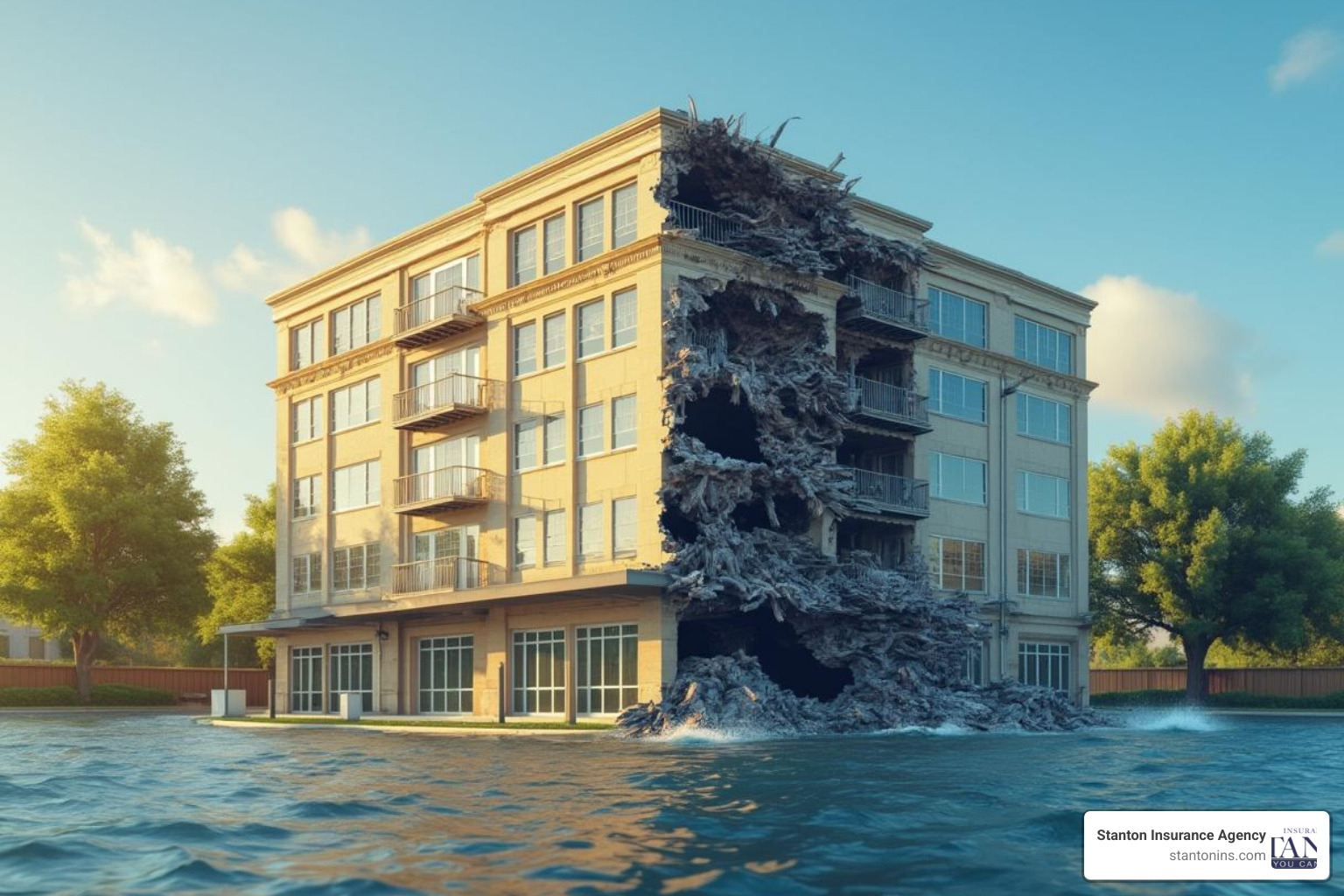
Now, just as important as knowing what’s covered is understanding what isn’t. While commercial property insurance is incredibly comprehensive, it does have some common limitations. For instance, flood damage is almost universally excluded. Living in Massachusetts or New Hampshire, you know severe weather can bring unexpected downpours, so if your business is in an area prone to flooding, or even if it’s not, you’ll need a separate flood insurance policy to protect against water rising from the ground up.
Similarly, earthquake damage also requires its own separate policy or an endorsement added to your existing one. Your policy won’t cover wear and tear – that’s the gradual deterioration of property over time, like an aging roof or old wiring. Insurance is for sudden, accidental events, not for maintenance you need to do anyway!
And while theft by outsiders is covered, employee theft is typically excluded and usually falls under a separate Crime Insurance policy. Also, your vehicles (cars, trucks, vans) aren’t covered here; they need a separate Commercial Auto Insurance policy. Lastly, in our digital age, it’s crucial to know that loss or corruption of data and digital assets isn’t covered; that’s where a Cyber Liability policy steps in. While some terrorism coverage might be available, acts of war or terrorism are standard exclusions. And though fire is generally covered, some policies might have specific exclusions for fires caused by certain prohibited activities or types of smoke damage not related to a sudden fire.
5 Actionable Strategies to Lower Your Insurance Premiums
It’s true that some things about your commercial property insurance rates are beyond your control, like your business’s location. But here’s the good news: there are many smart, proactive steps you can take to actively manage and reduce what you pay. We’re here to help you explore these options and find the best fit for your business.
First, consider bundling your policies. One of the most effective ways to save money is often by purchasing a Business Owner’s Policy (BOP). Think of a BOP as an insurance package deal. It conveniently combines commercial property insurance, general liability, and often business interruption coverage into one policy. Buying these coverages together typically costs less than getting them separately, and it makes managing your insurance much simpler. Many insurers offer savings of 10% or more when you bundle!
Next, you can often save by choosing to increase your deductible. Your deductible is the amount you agree to pay out-of-pocket before your insurance coverage kicks in for a claim. By opting for a higher deductible – for example, $2,500 instead of $1,000 – you’re telling insurers you’re willing to take on a bit more of the initial risk. This willingness usually leads to a lower premium for you. Just be sure to pick a deductible amount that your business can comfortably afford if you ever need to make a claim.
A big one is to invest in risk management. Insurers truly appreciate businesses that take steps to prevent losses in the first place. Installing or upgrading your fire and security systems is a direct way to earn discounts. This includes things like monitored alarm systems, automatic sprinkler systems, smoke detectors, and security cameras. Beyond security, keeping your building well-maintained is key. Regularly inspecting and updating your roof, electrical wiring, and plumbing systems shows you’re proactive. Newer, well-maintained systems significantly reduce the chance of costly claims like water damage or electrical fires.
It also really helps to maintain a good claims history. Your business’s past claims play a significant role in determining your commercial property insurance rates. If you have a history of frequent or large claims, your premiums will almost certainly be higher. By putting strong safety protocols in place, doing regular risk assessments, and handling small repairs yourself (instead of filing minor claims), you can keep your claims history clean. Insurers often look back at your claims over the past three to five years when they calculate your rates.
Finally, make it a habit to review your policy annually. Your business isn’t a static thing; it’s always growing and changing! As your operations expand, your inventory levels shift, or you acquire new equipment, your coverage needs may change too. An annual check-in with your insurance agent ensures that you aren’t paying for coverage you don’t need (over-insured) or, even worse, lacking enough protection when a loss occurs (under-insured). This yearly review is also the perfect time to discuss any new potential discounts you might qualify for, such as recent safety upgrades or changes in your business operations.
Frequently Asked Questions about Commercial Property Insurance Rates
We understand that navigating commercial insurance can bring up a lot of questions. Here are some of the most common ones we hear regarding commercial property insurance rates, answered in a straightforward way to help you feel more confident about your coverage.
How does property valuation (Actual Cash Value vs. Replacement Cost) affect my rate?
When it comes to insuring your business property, how your items are valued after a loss makes a big difference – both in your premium and in your financial recovery. Your commercial property insurance policy will clearly state which valuation method it uses.
There are two main ways property can be valued:
- Actual Cash Value (ACV): Think of ACV as getting what your old property was worth right before it was damaged, taking into account its age and wear and tear. It’s like selling a used car – you get the depreciated value, not the original sticker price. Policies based on ACV typically have lower premiums. However, the payout might not be enough to buy a brand new replacement, leaving you to cover the difference.
- Replacement Cost (RC): This method is designed to get you back to where you were before the loss. It pays to replace your damaged property with a brand new one of similar kind and quality, without any deduction for depreciation. While RC coverage does cost a bit more in premiums, it provides a significantly better payout. This means you can fully rebuild and replace your assets without having to dip into your own pocket for the cost of depreciation. We almost always recommend Replacement Cost coverage for most businesses. It truly helps ensure a full and faster recovery after a loss.
Do I need commercial property insurance if I rent my space?
Yes, you almost certainly do! This is a common misconception. While your landlord’s insurance policy covers the physical building itself, it generally does not extend to your business’s personal property.
Think about all the valuable items you’ve invested in: your computers, office furniture, specialized equipment, tools, and inventory. If a fire or theft occurs, your landlord’s policy won’t replace these. Without your own commercial property policy, you would be entirely responsible for replacing everything. This could be a huge financial burden, potentially even forcing your business to close.
What’s more, most commercial leases specifically require tenants to carry their own commercial property and liability insurance. It’s a standard clause designed to protect both you and the property owner. Having your own policy ensures your operations can get back up and running smoothly after an unexpected event.
Why are my commercial property insurance rates going up even if I haven’t had a claim?
It’s completely understandable to feel frustrated when your commercial property insurance rates increase, especially if you have a spotless claims history. You’re not alone in asking this question! Several larger trends beyond your individual business can influence rates across the entire industry:
- Mother Nature’s Impact: We’re seeing an unfortunate increase in the frequency and severity of natural disasters across the U.S. and globally. From more intense hurricanes and wildfires to heavy snow and coastal flooding, these widespread events lead to a significant rise in claims for insurers. To cover these increased payouts, insurance companies must adjust their premiums across the board, even for businesses that haven’t experienced a loss.
- The Rising Cost of Everything: Just like your daily expenses, the cost of labor, building materials, and equipment has increased significantly due to inflation. This means it simply costs more for insurers to repair or rebuild properties after a loss. These rising repair costs directly impact their pricing models, leading to higher premiums for everyone.
- Behind the Scenes – Reinsurance: Insurers themselves buy insurance (it’s called reinsurance!) to protect against massive losses from widespread events. When the cost of this reinsurance goes up, or if there’s less of it available, those increased costs get passed down to policyholders.
- Market Shifts: The insurance market itself goes through cycles. Sometimes it’s a “soft” market with more competition and lower prices, and other times it’s a “hard” market with less capacity and higher prices. While the market has shown signs of stabilizing recently, it’s been a period of rising rates for several years.
These broader, macro trends mean that even a business with an impeccable claims record might see its premiums increase. It’s a reflection of the changing economic and environmental landscape.
Conclusion: Secure the Right Protection for Your Business
Phew! We’ve covered a lot about commercial property insurance rates, haven’t we? It might seem like a maze of factors, but understanding your business’s unique risks and how insurers size them up is the first big step. The good news is, you’re not just a passive observer. By actively looking after your property, investing in smart safety and security measures, and making informed choices about your coverage, you truly can take the reins when it comes to your insurance costs.
Think of your commercial property policy not just as another bill to pay, but as a vital investment. It’s the sturdy foundation that protects your hard work, your dreams, and everything you’ve built, ensuring your business can bounce back even when the unexpected happens. It’s about resilience, plain and simple.
This is where having a trusted guide makes all the difference. Working with an experienced, independent agent means someone is in your corner, ensuring your valuable assets are properly assessed and that you’re getting the most competitive rate custom specifically for your business, whether you’re in Massachusetts, New Hampshire, or Maine. Here at Stanton Insurance Agency, we’re experts at helping businesses just like yours steer these waters. We’ll help you compare options, explain the nuances, and build a policy that fits your specific needs and budget perfectly.
Ready to secure that peace of mind? Protect your business today by requesting a comprehensive Commercial Property Insurance quote. We’re here to help you every step of the way.