Commercial auto insurance MA 2025: Critical Protection
Why Your Massachusetts Business Can’t Afford to Skip Commercial Auto Insurance
Commercial auto insurance MA is a specialized policy that protects business-owned vehicles and provides liability coverage when vehicles are used for work. In Massachusetts, any business that owns, leases, or uses vehicles for its operations needs this coverage. It’s both a legal requirement and essential financial protection.
Quick Answer: What You Need to Know
- Minimum MA Requirements: $20,000/$40,000 bodily injury, $8,000 PIP, $5,000 property damage
- Who Needs It: Any business with vehicles titled in the company name, employees driving for work, or contractors transporting equipment
- Cost Factors: Vehicle type, driving records, business location, and coverage limits
- Common Coverage: Liability, collision, comprehensive, hired/non-owned auto
- Recommended Limits: Most businesses carry $1,000,000 in liability coverage to meet contract requirements
A single accident in a work vehicle can bankrupt a small business. For the nearly 600,000 small businesses in Massachusetts, understanding this insurance isn’t just about compliance—it’s about protecting everything you’ve built. Whether you’re driving a pickup to a job site or a van for deliveries, the wrong coverage can leave you personally liable for devastating damages.
Don’t assume your personal auto policy will cover business use—it won’t. This isn’t fine print; it’s a standard exclusion that surprises many business owners after an accident. The moment a vehicle is used for business beyond basic commuting, your personal policy leaves you exposed.
I’m Geoff Stanton, President at Stanton Insurance. As a fourth-generation owner and Certified Insurance Counselor, I’ve spent over two decades helping Massachusetts businesses find the right protection. I’ve seen how proper coverage safeguards a company’s future, while inadequate policies lead to financial ruin.
What is Commercial Auto Insurance and Who Needs It?
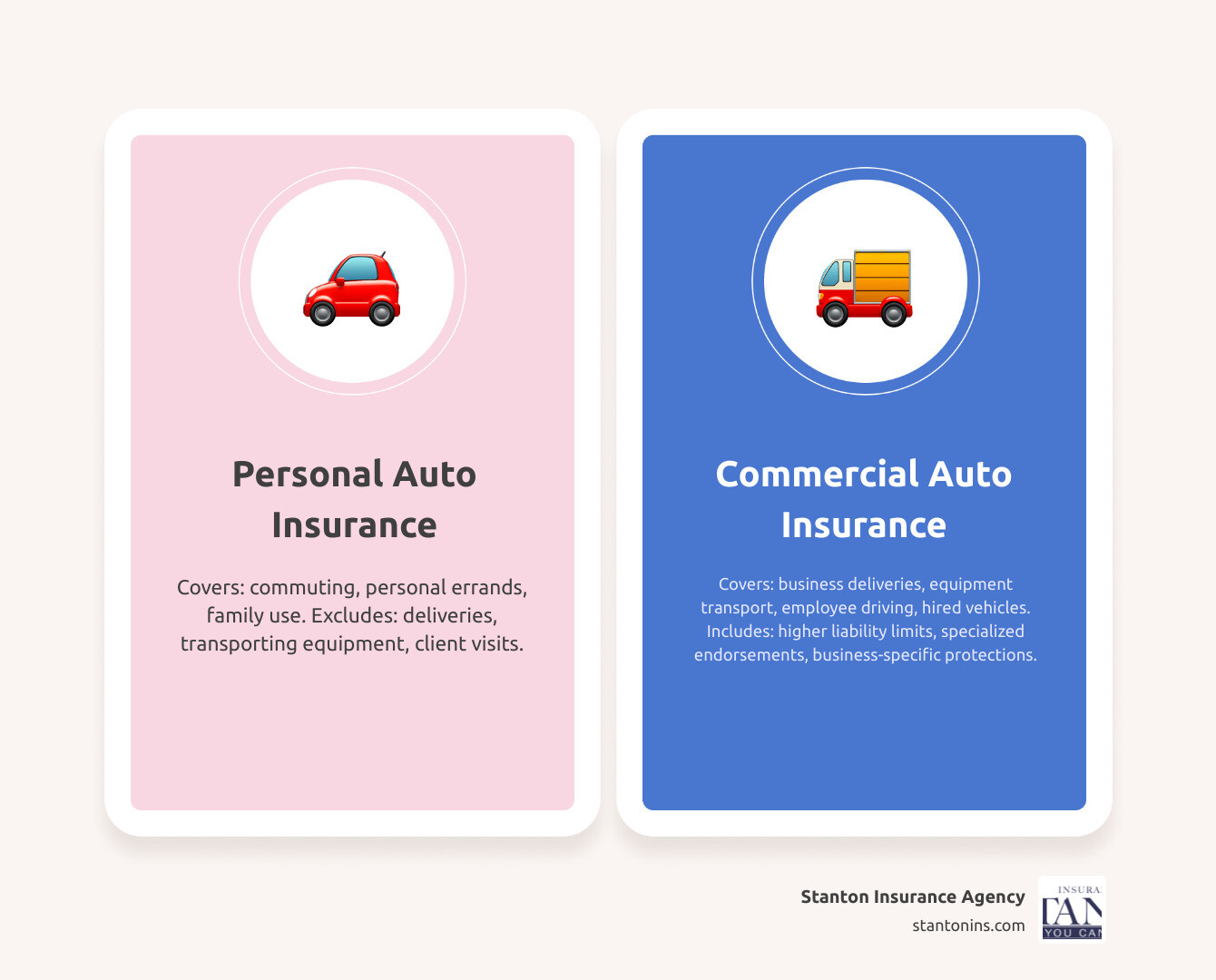
If your business owns, leases, or rents vehicles—or if employees use their own cars for work tasks—your personal auto policy will not cover you in a business-related accident. Commercial auto insurance provides specialized coverage for vehicles used in business operations. It offers higher liability limits than personal policies and includes protections custom to the unique risks businesses face, shielding your company from the financial fallout of an accident.
Who Needs Commercial Auto Insurance in MA?
If you use a vehicle for any business purpose beyond commuting, you almost certainly need commercial auto insurance MA coverage. This applies broadly across Massachusetts and catches many business owners off guard.
- Sole proprietors and partnerships often mistakenly assume a personal policy is enough. An electrician driving a pickup to job sites or a consultant visiting clients needs commercial coverage.
- Corporations and LLCs that own vehicles titled in the company name must have commercial auto insurance. These are business assets requiring business protection.
- Businesses that transport goods or people, such as delivery services, food trucks, and contractors, have an obvious need. Their vehicles are core to their operations.
- Businesses whose employees use personal vehicles for work can be held liable in an accident. Running a bank deposit or visiting a client in a personal car creates liability for your company. “Hired and non-owned auto” coverage is essential to cover this gap.
What Vehicles Are Covered?
Commercial auto insurance MA policies cover a wide range of vehicles, and the type you operate impacts your coverage needs and cost.
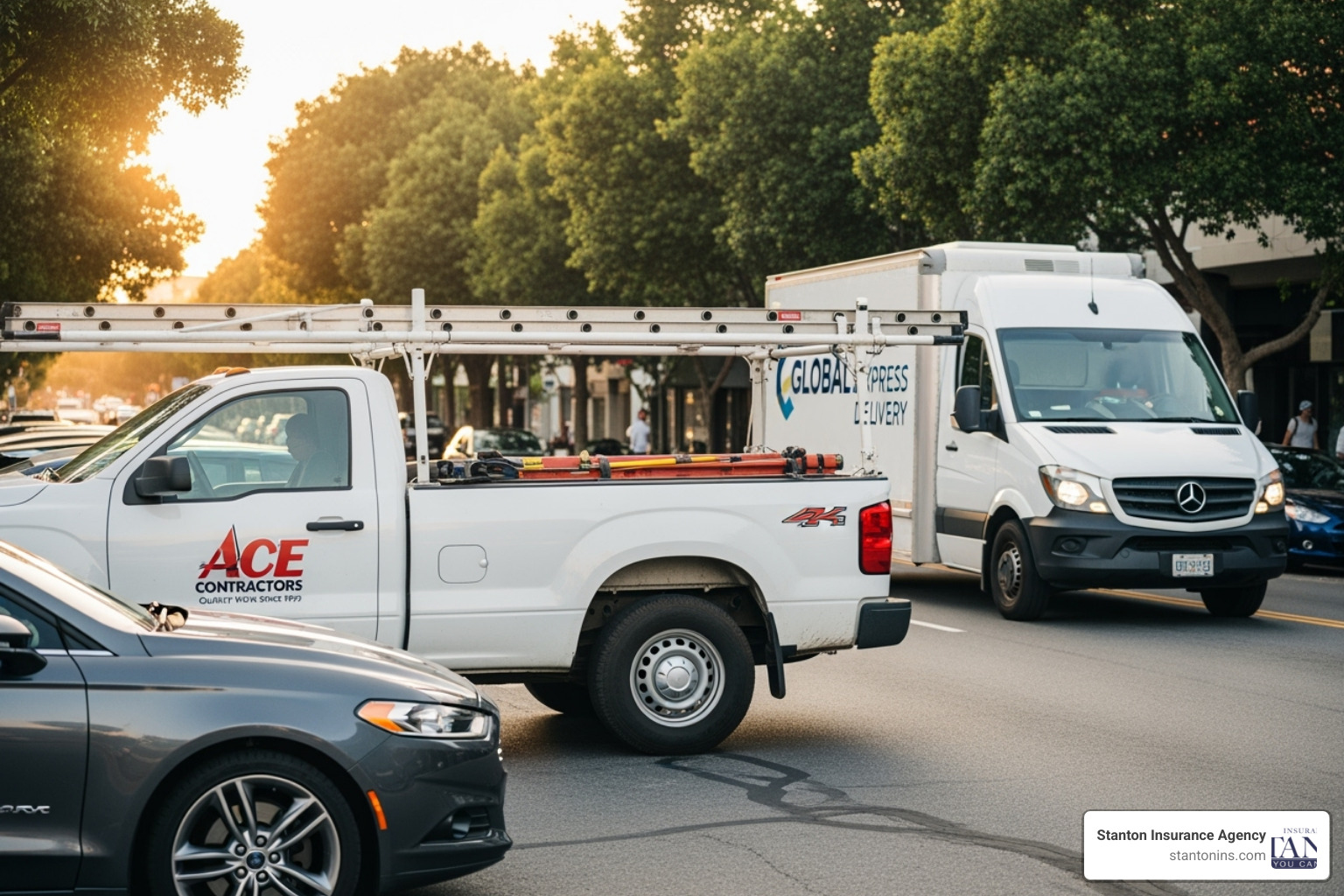
- Cars, pickup trucks, and service utility vans used for sales calls, client meetings, or transporting tools and equipment are common examples.
- Box trucks for movers and distributors, and food trucks with their specialized equipment, require robust coverage.
- Trailers used to haul equipment or goods must be specifically listed on your policy to be covered for physical damage.
- Heavy vehicles like dump trucks, cement mixers, and semi-trucks all fall under commercial auto policies.
Understanding your specific vehicle types and uses is the first step to securing the right protection. For more guidance, see our resource on Commercial Vehicle Insurance. If wheels are part of how you do business, commercial auto insurance is essential.
Navigating Massachusetts Law: Required Commercial Auto Insurance MA Coverage

Massachusetts law requires every registered vehicle, including commercial ones, to have insurance. However, the legal minimums are rarely enough to protect a business from the real financial risks of a serious accident. Think of state requirements as a starting point, not the finish line. Most businesses need higher limits to protect their assets and meet client contract requirements.
Compulsory Minimum Coverages in MA
Massachusetts mandates “compulsory coverage” for all registered vehicles. These are the absolute basics for your commercial auto insurance MA policy:
- Bodily Injury to Others: $20,000 per person / $40,000 per accident. Covers injuries to others when you are at fault.
- Personal Injury Protection (PIP): $8,000 per person. This is no-fault coverage for medical expenses and lost wages for you and your passengers.
- Bodily Injury Caused by an Uninsured Auto: $20,000 per person / $40,000 per accident. Protects you if you’re hit by an uninsured or hit-and-run driver.
- Damage to Someone Else’s Property: $5,000 per accident. Covers damage your vehicle causes to another person’s car or property.
These minimums are insufficient for most businesses, as costs from a single accident can easily exceed these limits. For official details, see the Basics of Auto Insurance in Massachusetts.
Optional Coverages and Higher Limits
This is the coverage that truly protects your business assets.
- Collision Coverage: Pays to repair or replace your vehicle after a collision with another object or vehicle, regardless of fault.
- Comprehensive Coverage: Covers non-collision events like theft, vandalism, fire, hail, or hitting an animal. Our guide on Collision vs Comprehensive explains more.
- Hired and Non-Owned Auto: Essential if you rent vehicles or if employees use their personal cars for work. It provides liability protection for your business in these situations.
- Higher Liability Limits: Most businesses should carry a Combined Single Limit of $1,000,000. This provides far greater protection and is often required by client contracts.
Other valuable options include Medical Payments, cargo coverage, and downtime coverage.
Special Programs: The MAIP
If your business struggles to find coverage in the standard market due to a challenging driving record or high-risk operations, the Massachusetts Automobile Insurance Plan (MAIP) can help. The MAIP serves as the insurer of last resort, ensuring every eligible business can obtain the legally required insurance. While rates are typically higher, it guarantees access to coverage so you can operate legally.
Key Factors Influencing Your Commercial Auto Insurance MA Cost
The price of your commercial auto insurance MA policy is based on your business’s unique risk profile. Insurers evaluate several factors to determine your premium. Understanding these factors helps you manage costs without sacrificing protection.
What Determines Your Premium?
- Vehicle Type and Value: A heavy-duty box truck costs more to insure than a sedan. Newer, more valuable vehicles also have higher premiums for physical damage coverage.
- Driving Records: The history of all operators is a major factor. Clean records lower your premium, while accidents and violations increase it.
- Garaging Location: Urban areas like Boston have higher rates than rural locations due to increased risks of theft, vandalism, and accidents.
- Travel Radius: Local operations generally have lower premiums than long-haul businesses that cover more miles.
- Industry and Business Use: A delivery service faces higher risks than a real estate agent. Your industry’s typical vehicle usage affects your rate. For larger trucks, see our guide on Insurance for Commercial Truck.
- Coverage Limits and Deductibles: Higher liability limits increase your premium but provide crucial protection. Higher deductibles can lower your premium.
- Claims History: A history of frequent or costly claims will lead to higher rates.
How to Save Money on Your Policy
You can take several steps to lower your commercial auto insurance costs.
- Bundle Policies: Combine your auto policy with general liability or other business insurance for a multi-policy discount.
- Implement a Driver Safety Program: Formal safety policies, training, and telematics can earn discounts and reduce accidents.
- Maintain Good Driving Records: Emphasize safe driving across your team to keep long-term costs down.
- Choose a Higher Deductible: If you can afford a higher out-of-pocket cost, a larger deductible will lower your premium.
- Pay in Full: Paying your annual premium upfront often eliminates installment fees and may come with a discount.
- Ask About Discounts: Inquire about all available discounts, such as those for anti-theft devices or continuous coverage.
- Review Your Policy Regularly: An annual review ensures your coverage matches your current operations and uncovers new savings opportunities.
While it’s helpful to understand the Average Cost of Car Insurance in MA for personal use, commercial rates are different. A complete Business Insurance Policy is the goal. Never sacrifice necessary coverage for a lower price; the risk isn’t worth it.
Custom Protection: Insurance for Different MA Professions
Your business isn’t generic, so your insurance shouldn’t be either. A one-size-fits-all policy often leaves dangerous coverage gaps. What protects a contractor won’t necessarily work for a food truck or a delivery service. Here’s how commercial auto insurance MA should be adapted for different professions.
Contractors (Electricians, Plumbers, Carpenters)
For contractors, a truck or van is a mobile office and tool shed. Standard auto policies cover the vehicle, but not the expensive tools and equipment inside. Inland Marine insurance, also known as a “Contractors Equipment Floater,” is essential to protect your gear from theft or damage, whether it’s in transit or at a job site.
If you tow trailers, they need to be specifically listed on your policy for physical damage coverage. Furthermore, many general contractors require subcontractors to carry high liability limits, often $1,000,000, to work on their sites. For more on specialized vehicles, see our page on Insurance for Commercial Truck.
Food Trucks and Caterers
A food truck is a restaurant on wheels, and insuring it requires more than a standard auto policy. You need specific endorsements to cover the permanently attached cooking equipment like grills, fryers, and refrigerators. Without it, a minor accident could damage your equipment and put you out of business during repairs.
Spoilage coverage is another critical addition. It protects you from losses if a power failure or equipment breakdown ruins your perishable food inventory. Given that food trucks operate in constantly changing, high-traffic environments, robust liability coverage is also a must.
Delivery, Courier, and For-Hire Livery Services
Businesses built on transporting goods or people face some of the highest risks due to high mileage and tight schedules. For these operations, Hired and Non-Owned Auto coverage is absolutely essential. It protects your business from liability if you rent vehicles or if your drivers use their personal cars for deliveries. A single accident in an employee’s car during a work task could lead to a devastating lawsuit against your business.
Additionally, a standard auto policy doesn’t cover the goods you’re transporting. You need separate cargo coverage to protect against loss or damage to the packages, documents, or products you are paid to deliver. This is a key part of a comprehensive Business Insurance Policy that protects your entire operation.
Frequently Asked Questions about Commercial Auto Insurance in MA
Business owners often have questions about commercial auto insurance MA. Here are straightforward answers to some of the most common concerns.
What are the consequences of not having adequate commercial auto insurance in MA?
The consequences are severe and can destroy a business. They fall into three categories:
- Legal Penalties: Driving without state-mandated insurance can lead to heavy fines, driver’s license suspension, and vehicle registration revocation.
- Financial Ruin: If you’re at fault in an accident without proper coverage, your business is personally liable for all damages. This includes medical bills, property damage, and legal fees that can easily reach six or seven figures, potentially leading to bankruptcy and the seizure of business assets.
- Operational Impact: Many clients require proof of insurance before signing a contract. Lacking proper coverage can cost you valuable business and damage your reputation.
Does my personal auto policy cover any business use?
No, with very few exceptions. A personal auto policy is designed for personal use like commuting, errands, and family travel. It explicitly excludes coverage for most business-related activities. Using your personal vehicle for tasks like making deliveries, visiting clients, transporting equipment, or driving for a rideshare service is considered business use. If you have an accident while performing these tasks, your personal insurer will likely deny the claim, leaving you and your business personally responsible for all costs.
How is commercial auto insurance different from personal auto insurance?
While they both insure vehicles, they are fundamentally different products designed for different risks.
- Liability Limits: Commercial policies offer much higher liability limits (often $1,000,000 or more) to protect business assets from major lawsuits. Personal policies have lower limits suited for protecting personal assets.
- Covered Vehicles: Commercial insurance can cover a wide range of vehicles, including trucks, vans, and specialized equipment. Personal policies are for standard cars, SUVs, and minivans.
- Specialized Coverage: Commercial policies include options unavailable on personal policies, such as Hired and Non-Owned Auto, Cargo coverage, and coverage for permanently attached equipment.
- Underwriting: Insurers assess your entire business operation—industry, driving radius, employee records, and vehicle use—not just an individual’s driving history.
In short, commercial auto insurance is designed to protect a business from the higher risks and catastrophic losses associated with using vehicles for work.
Your Partner for Business Vehicle Protection
Getting the right commercial auto insurance MA coverage is a foundational step in protecting your business. From meeting state requirements to selecting optional coverages that fit your industry, a well-designed policy is your first line of defense against financial loss. Navigating this landscape alone can be complex, which is why partnering with an independent insurance agent is so valuable.
An independent agent works for you, not a single insurance company. We compare offerings from multiple carriers to find the best balance of comprehensive protection and competitive pricing. At Stanton Insurance Agency, we’ve been protecting businesses in Massachusetts and New Hampshire for four generations. We understand the unique risks different industries face and never use a one-size-fits-all approach.
Whether you’re insuring your first work truck or managing a fleet, we’re here to help you secure coverage that works when you need it most. Ready to protect your business vehicles the right way? Explore our business insurance solutions and let’s start a conversation today.