
Understanding How to Cancel Your Car Insurance Correctly

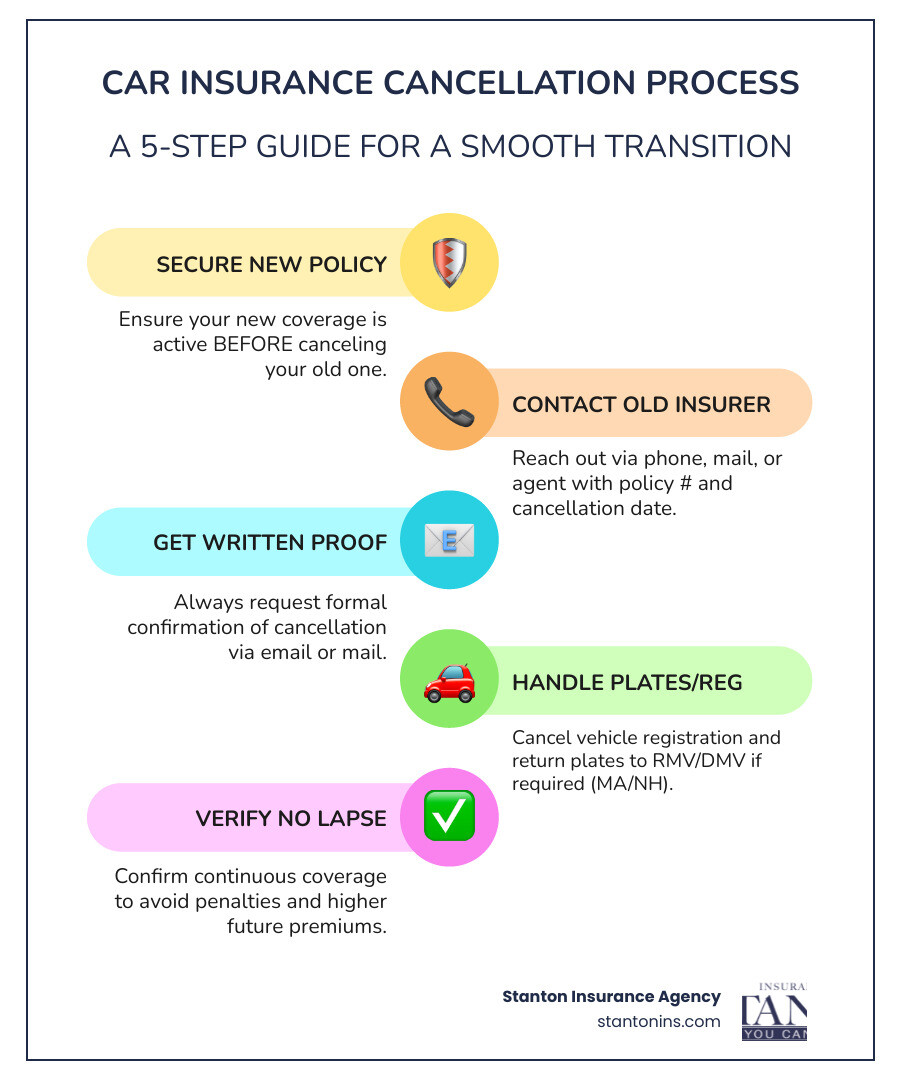
How to cancel auto insurance correctly involves a few key steps to protect yourself legally and financially. Here’s the essential process:
- Secure a new policy first – Your new coverage must be active before you cancel the old one.
- Contact your current insurer – Call, write, or visit your agent to request cancellation.
- Specify the cancellation date – This should match the start date of your new policy.
- Get written confirmation – Request proof that your policy has been canceled.
- Handle your plates and registration – In MA and NH, you must cancel registration when canceling insurance.
People cancel car insurance for many reasons, but the process is more than just stopping payments. Canceling incorrectly can lead to higher future premiums, legal penalties, and financial liability if you have an accident during a coverage gap.
You can usually cancel by phone, mail, or through your agent. Have your policy number and desired cancellation date ready. While you may face a small fee for canceling mid-term, you’ll typically receive a refund for unused premium. The most important rule is to maintain continuous coverage. Driving uninsured is illegal in Massachusetts and New Hampshire and can result in fines, license suspension, and much higher rates.
I’m Geoff Stanton, President of Stanton Insurance Agency. For over two decades, I’ve helped clients in Massachusetts and New Hampshire steer insurance decisions, including how to cancel auto insurance without costly mistakes. Proper planning is key to protecting your finances and peace of mind.
Before You Cancel: Key Preparations and Considerations
Canceling your policy isn’t the first step; it’s one of the last. Proper preparation is essential to protect yourself legally and financially. Before you pick up the phone, review these critical points.
1. Secure a New Policy First
This is the golden rule of switching insurance. Never cancel your current policy until your new one is officially active. A lapse in coverage, even for a single day, can have serious consequences:
- Higher Future Premiums: Insurers view a coverage lapse as a major risk, which often leads to significantly higher premiums for years. A history of continuous coverage demonstrates responsibility and helps you secure better rates.
- Legal Penalties: Driving without insurance is illegal in Massachusetts and New Hampshire. If caught, you face large fines and the suspension of your license and vehicle registration. In Massachusetts, the RMV is automatically notified of cancellations, which can trigger these penalties if your registration isn’t also canceled.
- Financial Risk: If you have an accident without insurance, you are personally liable for all costs. This includes vehicle repairs, medical bills for everyone involved, and potential legal fees. Your personal assets could be at risk, a situation that could lead to long-term financial hardship.
For more information about your car insurance options and how to secure adequate coverage, we encourage you to explore our resources on car insurance options.
2. Understand Your Reason for Canceling
Your motivation for canceling dictates the best approach. Common reasons include:
- Finding a Better Rate: Many drivers switch for a better rate. When you do, ensure the new policy offers comparable coverage, not just a lower price. A cheaper policy might have higher deductibles or less protection.
- Selling Your Vehicle: If you sell your car and aren’t replacing it, you can cancel your policy. However, you must keep coverage active until the title is officially transferred to the new owner.
- Moving to a New State: Insurance requirements vary by state. If you move, you’ll need a new policy that meets the laws of your new state of residence.
- No Longer Driving: If you’re permanently giving up driving, you can cancel your policy. You must still formally cancel to stop billing and avoid state penalties if the vehicle remains registered.
- Adding to Another Policy: If you’re joining another person’s policy (e.g., a spouse or parent), confirm you are officially added and covered before canceling your individual plan.
3. Check Requirements for Financed or Leased Vehicles
If your vehicle is financed or leased, your lender has specific insurance requirements to protect their investment.
- Lender as Loss Payee: The lender is listed as a “loss payee” on your policy, meaning they get paid first from an insurance claim if the car is totaled or stolen.
- Mandatory Coverage: Lenders typically mandate both collision and comprehensive coverage, often with specific deductible limits.
- Notification and Proof of New Insurance: You must notify your lender when you switch insurers and provide proof that the new policy meets their requirements. Failure to do so can lead to expensive “force-placed” insurance, where the lender buys a policy for you and adds the high cost to your loan payments.
4. Know the Best Time to Cancel
While you can cancel at any time, the timing can have financial implications.
- At Renewal: This is the ideal time to cancel. At the end of your policy term, you can switch without incurring cancellation fees. Start shopping for new quotes 30-60 days before your current policy expires to give yourself plenty of time.
- Mid-Term: Canceling in the middle of your policy term is common but may result in a short-rate cancellation fee. This is a small administrative charge. However, if the savings from your new policy are greater than the fee, it’s still a good financial move.
A Step-by-Step Guide on How to Cancel Auto Insurance
Once you have a new policy in place and have considered the points above, you’re ready to formally cancel your old policy. The process typically involves these four steps.

Step 1: Gather Your Information
Before contacting your insurer, gather the following information to make the process quick and easy:
- Policy Number: Found on your insurance ID card, policy documents, or billing statements.
- Personal Identification: Your full name, address, and date of birth for identity verification.
- Desired Cancellation Date: This should be the same day your new policy starts to avoid a coverage gap.
- New Policy Information: Proof of your new insurance policy. Some insurers may ask for this to confirm you aren’t creating a coverage gap.
Step 2: Contact Your Insurance Provider
Insurers have different cancellation procedures. Common methods include:
- Call Your Agent or Company: This is often the fastest method. A local independent agent can handle the process for you, or you can call the company’s customer service line.
- Mail a Written Request: Some insurers require a formal, signed letter. This creates a paper trail. Include your name, policy number, and cancellation date, and send it via certified mail for proof of delivery.
- Visit in Person: Visiting your local agent’s office is a convenient way to complete paperwork and ask questions directly.
- Cancel Online: A few insurers allow online cancellation via their website or app. Even so, it’s wise to follow up with a call to confirm the cancellation is complete.
For specific state guidelines, it’s helpful to review official resources, such as Massachusetts’ information on Procedures for Cancellation and Non-Renewal of Motor Vehicle Insurance Policies.
Step 3: Get Written Confirmation
Never assume your policy is canceled after a phone call or online request. Always request and obtain written confirmation of your policy cancellation. This document is your legal proof of termination and protects you from future billing errors. When you receive it, review it immediately to ensure the cancellation date is correct, preventing any coverage gap or overlap. Keep this confirmation with your important documents.
Step 4: Notify the RMV/DMV and Return Plates (If Required)
This step is crucial in Massachusetts and New Hampshire, where your vehicle’s registration is tied to your insurance. If you cancel your insurance, you must also cancel your registration to avoid penalties.
It is illegal to have a registered vehicle without insurance in these states. Insurers notify the RMV (in MA) or DMV (in NH) of cancellations, which can automatically trigger fines and suspensions if the registration is still active. To formally cancel your registration, you must return your license plates to the RMV/DMV. This is a required step if you are no longer insuring the vehicle, even if it’s just parked in your driveway.
Financial Implications: Cancellation Fees and Refunds
Canceling a policy mid-term can involve fees and affect your refund. It’s crucial to understand the difference between the two main refund calculation methods.

Pro-Rated vs. Short-Rate Cancellation
When you cancel your policy before its end date, the amount of your refund depends on the cancellation method used by your insurer.
- Pro-Rated Refund: This is the most favorable method for you. You receive a full refund for the exact unused portion of your premium. For example, if you paid for a 12-month policy and cancel after 6 months, you would get 50% of your premium back. This method is common when an insurer cancels your policy or when you cancel at your renewal date.
- Short-Rate Cancellation: This method is typically applied when you choose to cancel mid-term. The insurer refunds your unused premium minus a small fee to cover their administrative costs for the early termination. This is a standard industry practice. The fee might be a flat amount (e.g., under $100) or a small percentage of the remaining premium. Ask your insurer about their specific policy before canceling.
What Happens to Your Refund?
If you are owed a refund, your insurance company will process it after the cancellation is finalized. Refunds are usually sent to your original payment method (e.g., credited to your card or sent as a check) within 15 to 30 days. If you haven’t received your refund after 30 days, follow up with the company. If you financed your premium, the refund may go directly to the finance company to settle your outstanding balance.
The Dangers of a Lapse in Coverage
The single biggest risk when canceling insurance is creating a gap in your coverage history. A lapse can have lasting negative effects, especially in states like Massachusetts and New Hampshire where driving uninsured carries significant penalties.
What Are the Consequences of Not Knowing How to Cancel Auto Insurance Properly?
A common and dangerous mistake is to simply stop paying your premiums. This is not the correct way to cancel a policy. Your insurer will eventually cancel your policy for non-payment, which is a major red flag on your insurance record with severe repercussions:
- Difficulty Getting New Insurance: A non-payment cancellation makes you a higher risk, and many standard insurers may decline to cover you or charge you much higher rates. You could be forced into a costly “assigned risk” pool.
- State Penalties: In Massachusetts and New Hampshire, your insurer is required to notify the state RMV/DMV of the cancellation. This automatically triggers penalties for having a registered but uninsured vehicle, including hefty fines, license and registration suspension, and a possible requirement to file a high-risk form (like an SR-22 in New Hampshire), which further increases your insurance costs.
Always formally cancel your policy to avoid these pitfalls.
Can I Suspend My Car Insurance Instead?
Yes, in certain situations, suspending your policy is a smart alternative to outright cancellation. This is a good option if you plan to store your vehicle for an extended period (e.g., for military deployment, long-term travel, or seasonal use) and will drive it again in the future.
Suspending your policy has several benefits:
- Avoids a Policy Lapse: You maintain a continuous insurance history, which prevents the negative impact on future rates that a full cancellation would cause.
- Maintains Comprehensive Coverage: While you drop liability and collision coverage, you can keep comprehensive-only coverage. This protects your stored vehicle from theft, vandalism, fire, or weather damage.
- Cost-Effective and Simple: Suspending coverage is much cheaper than paying for a full policy on a stored car. Reactivating a suspended policy is also much simpler than applying for a new one.
Contact your insurance agent to explore this option and understand the specific terms for suspended policies in Massachusetts and New Hampshire.
Frequently Asked Questions about Canceling Car Insurance
Can my insurance company cancel my policy?
Yes, an insurer can cancel or choose not to renew your policy for specific reasons, but they are legally required to provide you with advance written notice. Common reasons include:
- Non-payment of premiums.
- Fraud or providing false information on your application.
- Having your driver’s license suspended or revoked.
- A pattern of serious traffic violations or at-fault accidents (this usually leads to non-renewal).
What should I do if I’m selling my car but not buying a new one right away?
To avoid a detrimental coverage lapse, you have two main options:
- Keep Your Policy Active: If you plan to buy another car soon, you can keep your policy. Simply notify your insurer to remove the sold vehicle. This maintains your continuous coverage history, and your premium will drop significantly.
- Switch to a Non-Owner Insurance Policy: If you don’t have immediate plans to buy another car, a non-owner policy is an excellent solution. It provides liability coverage when you drive borrowed or rental cars and, crucially, maintains your continuous insurance history. This helps you get better rates when you eventually purchase a car again.
Does canceling car insurance affect my credit score?
No, canceling your car insurance policy itself does not directly impact your credit score. However, if you cancel with an outstanding balance (like an unpaid premium or cancellation fee) and that debt is sent to a collections agency, the collection account will negatively affect your credit score. To avoid this, always ensure your account is fully settled when you cancel.
Get the Right Guidance for Your Insurance Needs
Navigating the rules of car insurance can be complex, but you don’t have to do it alone. Ensuring a seamless transition between policies protects you from legal penalties and financial risk. An independent insurance agent, like our team at Stanton Insurance Agency, plays a crucial role in this process. We can help you compare quotes from multiple carriers, understand the intricate details of various coverage options, and manage the cancellation of your old policy and the setup of your new one correctly. Our expertise ensures you avoid common pitfalls and secure the best possible protection.
At Stanton Insurance Agency, our team is dedicated to helping you find the best protection for your needs and budget. We can help you explore your options and ensure you’re never without the coverage you need, whether you’re in Massachusetts or New Hampshire. We pride ourselves on providing trusted protection for your valuable assets, exceeding customer expectations every step of the way.