
Introduction: Why Your Trip Isn’t Fully Booked Without Insurance
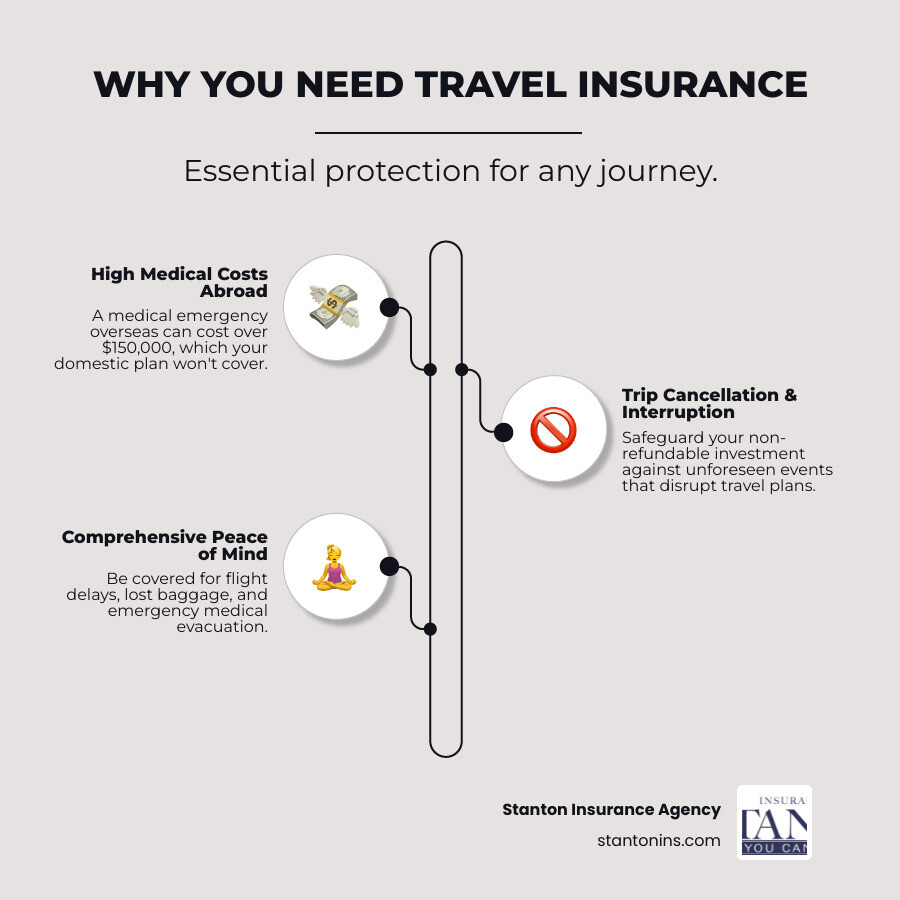
Planning a trip is exciting, but unexpected events can turn a dream vacation into a financial nightmare. Travel insurance is your financial safety net, protecting you from unforeseen medical emergencies, trip cancellations, and other travel-related mishaps. Your U.S. health plan, including Medicare and Medicaid, likely won’t cover you abroad, and the U.S. government will not pay your medical bills. A simple stomach bug requiring hospitalization in the USA could cost over $150,000 without insurance. This guide breaks down what you need to know to choose the best protection for your journey.
Core Types of Travel Insurance Coverage
Travel insurance isn’t a single product but a package of different coverages. Understanding these components is the first step to finding a policy that fits your needs. Most comprehensive plans bundle these protections, but you can sometimes purchase them separately.
Emergency Medical and Dental
A twisted ankle while hiking in New Hampshire’s White Mountains or a sudden toothache in Rome can become a financial crisis without proper coverage. The U.S. government, Medicare, and Medicaid do not pay medical costs for citizens abroad. Your personal health insurance likely has limited or no coverage outside the U.S., leaving you with a potentially hefty bill.
The CDC strongly recommends buying travel health insurance because medical costs abroad are significantly higher. For instance, a hospital stay for a stomach bug could cost over $150,000 for a visitor in the USA. Many foreign clinics, even outside Massachusetts or New Hampshire, may demand cash payment upfront or refuse treatment without adequate insurance.
Emergency medical travel insurance covers unexpected illnesses, injuries, emergency transport, and dental treatments. Some policies include COVID-19 coverage. This protection is crucial to ensure you get necessary medical care without draining your savings.
For more information on why this coverage is vital, especially for U.S. citizens, visit the Travel Insurance | Travelers’ Health | CDC page.
Trip Cancellation, Interruption, and Delay
Trip cancellation, interruption, and delay coverage protect you when plans change unexpectedly.
Trip cancellation insurance protects your pre-departure financial investment. If you must cancel flights or cruises for a covered reason like a sudden illness or injury, you can be reimbursed for non-refundable costs.
Trip interruption insurance covers you if you must cut your trip short after you’ve departed. If a family emergency or natural disaster forces you home early, it can reimburse you for the unused portion of your trip and the cost of an early return flight.
These policies can also cover:
- Flight delays: Reimbursement for meals or accommodation during a specified delay.
- Baggage loss/damage: Compensation to replace essential items.
- Travel accidents: Benefits for accidental death or dismemberment.
Without this travel insurance, you risk losing your entire trip investment if the unexpected happens.
Medical Evacuation and Repatriation
Medical evacuation and repatriation insurance is indispensable for emergencies in remote areas or places with inadequate medical facilities, where transport to proper care can be astronomically expensive.
Medical evacuation insurance covers emergency transportation to the nearest appropriate medical facility. This could be an air ambulance from a hiking trail or a specialized flight to a better-equipped hospital. The CDC notes that medical evacuation can cost over $100,000, and your policy should cover transport back to the United States if necessary.
Repatriation coverage handles the costs of preparing and returning a traveler’s remains to their home country (e.g., Massachusetts or New Hampshire) in the event of death abroad. It can also cover local burial or cremation and expenses for identification.
This coverage is vital when traveling to:
- Remote locations with basic or no medical care.
- High-risk areas.
- Places with limited or lower-quality medical facilities.
Credit Card ‘Free’ Insurance vs. Stand-Alone Policies: A Reality Check
Many premium credit cards offer travel insurance as a perk, but “free” doesn’t always mean comprehensive. Relying solely on credit card benefits can leave you exposed to major financial risks, as they often come with strict eligibility rules, low coverage maximums, and restrictive clauses for pre-existing conditions. For example, a card might cover rental car damage but not a full medical evacuation.
A stand-alone travel insurance policy, purchased directly from an insurer or through an agency like ours, is far more robust and customizable. It allows you to tailor coverage to your trip, health, and desired protection level. This means higher coverage limits, options for pre-existing conditions, and benefits like “Cancel for Any Reason” (CFAR) that are rarely included with credit card insurance.
Here’s a quick comparison to highlight the differences:
| Feature | Credit Card Insurance | Stand-Alone Travel Insurance |
|---|---|---|
| Coverage Limits | Often lower, with specific caps for each benefit. | Customizable, generally higher limits (e.g., $5,000,000 for medical). |
| Pre-existing Condition Waivers | Rare or very strict stability requirements. | Often available with proper declaration and underwriting. |
| ‘Cancel for Any Reason’ Options | Almost never included. | Available as an add-on for extra flexibility. |
| Medical Evacuation Caps | Lower limits, may not cover full cost of transport. | Higher limits, often designed to cover full evacuation costs (e.g., $100,000+). |
| Activation Requirements | May require booking the entire trip on that card, or specific steps to activate. | Activated upon purchase, with clear terms of coverage. |
For comprehensive protection, especially for international travel or significant trip investments, we strongly recommend a dedicated travel insurance policy over incomplete credit card coverage.
How to Choose the Right Travel Insurance Policy
Finding the best policy means matching coverage to your specific trip. Don’t just look at the price; the cheapest plan is rarely the best value. You need to dig into the policy details to ensure it covers your destination, activities, and personal health situation. A robust policy provides peace of mind, which is a key part of any successful trip.
What to Look for in a Travel Insurance Policy
Choosing the right travel insurance policy can feel like navigating a maze, but focusing on a few key areas will light your way. We always advise our clients from Massachusetts and New Hampshire to consider these points carefully:
- Policy Details and Coverage Limits: Dive into the policy document to understand what is and isn’t covered. Look for specific dollar amounts for medical expenses, trip cancellation, and medical evacuation. Ensure the limits are adequate for your destination (e.g., regions with high medical costs like the USA may require higher limits).
- Deductibles: This is the amount you’ll pay out-of-pocket before your insurance kicks in. A higher deductible usually means a lower premium, but be sure you can comfortably afford it.
- Pre-existing Conditions: You must declare any pre-existing conditions. Many policies offer coverage if they have been stable for a specific period (e.g., 60-180 days). Always get written confirmation that your condition is covered.
- Stability Clauses: This defines how long your condition must have been stable (no new symptoms, change in medication, etc.) before your policy’s effective date to be covered.
- High-Risk Activities: Planning to go scuba diving or rent a scooter? Many standard policies exclude “adventure” sports. Ensure your policy explicitly covers your planned activities, or purchase an add-on.
- 24/7 Emergency Assistance: A good provider offers a 24-hour helpline. This is crucial for getting immediate help and authorization for medical treatment, no matter the time zone.

Factors That Influence Your Travel Insurance Cost
The cost of travel insurance isn’t one-size-fits-all. Several factors determine your premium, and understanding them can help you find an affordable policy.
- Age: Premiums generally increase with age due to higher medical risks. Insurers may have different rates or restrictions for travelers over 65.
- Trip Duration: Longer trips cost more to insure due to increased exposure to risk.
- Destination: Travel to countries with high medical costs (like the United States for visitors) or political instability will result in higher premiums.
- Coverage Amount: Higher coverage limits for medical care or trip cancellation will increase your premium.
- Trip Cost: The higher your non-refundable trip costs, the more you’ll pay for cancellation/interruption coverage.
- Policy Type:
- Single-trip policy: Covers one specific journey. Ideal for one trip per year.
- Annual multi-trip policy: More cost-effective for two or more trips within 12 months. It covers all trips up to a certain duration each (e.g., 30 or 60 days).
- Health Status: Pre-existing conditions can increase your premium, depending on the type, severity, and stability.
- Planned Activities: High-risk activities like skiing or scuba diving may require special add-ons and increase the cost.
By understanding these factors, you can better estimate your potential travel insurance costs and choose a policy that fits your needs without breaking the bank.
Common Exclusions and Limitations to Watch For
Knowing what your policy doesn’t cover is as important as knowing what it does. Here are some common exclusions:
- Alcohol or Drug-Related Incidents: Claims for injuries or illnesses occurring while under the influence of alcohol or non-prescribed drugs will likely be denied.
- Undeclared Medical Conditions: Failing to disclose a pre-existing condition can void your policy and lead to claim rejection.
- High-Risk Sports and Activities: Activities like bungee jumping, skydiving, or even riding a moped without a proper license are often excluded unless you buy an add-on.
- Travel to High-Risk Destinations: Your policy may be invalid if you travel to a country with a “Do Not Travel” advisory from the U.S. Department of State.
- Unattended Baggage: Claims for stolen baggage may be denied if you left it unattended in a public place.
- Acts of War or Terrorism: Many policies have broad exclusions for war and civil unrest, though some offer limited terrorism coverage.
- Natural Disasters: Coverage varies. Some policies protect you if a disaster occurs before departure, but not if you travel into a known disaster zone.
- Mental Health Conditions: Coverage for mental health is not standard and varies widely. Check your policy for specific inclusions or exclusions.
- Elective Procedures: Travel insurance is for emergencies and will not cover planned medical procedures or routine check-ups.
- Legal Violations: Any illegal activity will void your coverage.
Understanding these exclusions helps you make informed decisions about your travel plans and ensures you’re not caught off guard.
Navigating the Fine Print: Claims, Advisories, and Your Responsibilities
Once you have a policy, knowing how to use it is critical. This includes understanding how government travel advisories can affect your coverage and what steps to take if you need to make a claim. Being prepared can make a stressful situation much more manageable.
How to Make a Travel Insurance Claim
Making a travel insurance claim is easier when you’re prepared. Here’s a guide to the process:
- Keep Your Emergency Contact Number Handy: Your policy will list a 24/7 emergency assistance number. Save it in your phone and keep a physical copy. In a medical emergency, contact them first for guidance.
- Contact Your Insurer ASAP: For serious medical issues, call the emergency line immediately. They can coordinate care and payment. For other claims like lost baggage, contact them as soon as possible.
- Gather Required Documentation: The more evidence, the better.
- Medical claims: Get detailed reports, invoices, and receipts from doctors or hospitals.
- Trip cancellation/interruption: Obtain official documents explaining the reason (e.g., doctor’s note, airline notice) and keep all receipts.
- Baggage claims: File a report with the airline or police immediately. Keep copies of tickets, baggage tags, and receipts for emergency purchases.
- Understand the Claim Submission Process: Follow your insurer’s specific instructions for submitting forms online, via email, or by mail to avoid delays.
- Be Patient: Claims processing can take time. Respond promptly to any requests for additional information.
The goal is to make your claim as clear and well-supported as possible. Being organized and proactive will significantly improve your experience.
How Government Travel Advisories Affect Coverage
Government travel advisories keep you safe and significantly impact your travel insurance coverage. This is critical information for any U.S. citizen traveling from Massachusetts or New Hampshire.
The U.S. Department of State issues travel advisories for every country, from Level 1 (Exercise Normal Precautions) to Level 4 (Do Not Travel).
Here’s how they can affect your policy:
- “Do Not Travel” Warnings (Level 4): If you travel to a destination against a Level 4 advisory issued before your trip, your policy will likely be invalid. Your insurer may refuse any claims, even if unrelated to the advisory.
- “Reconsider Travel” (Level 3): Some policies may have limitations for destinations under a Level 3 advisory. Check your policy wording.
- Existing Advisories vs. New Advisories: If a Level 4 advisory is issued after you buy your policy but before you depart, your trip cancellation benefits might apply. However, if you choose to travel anyway, your coverage will likely be void.
- Policy Validity: Always read your policy’s terms regarding government advisories. Some policies offer limited coverage in advisory regions, while others exclude it entirely.
We strongly advise checking the latest U.S. Department of State travel advisories for your destination before booking and again before departure. You can find up-to-date information on the Travel Insurance page.
Frequently Asked Questions about Travel Insurance
Do I really need travel insurance if I’m young and healthy?
Yes. Youth and good health don’t prevent unexpected accidents or illnesses. A broken leg while hiking in Spain could cost over $25,000, and a quad bike accident in Greece could lead to an $80,000+ bill for surgery and medical evacuation.
Your domestic health insurance, including Medicare and Medicaid, almost certainly won’t cover you abroad. Foreign hospitals may require immediate cash payment before providing treatment. Without travel insurance, you are personally responsible for these staggering costs. It protects your financial future from unpredictable events, ensuring peace of mind regardless of your age or health.
Will travel insurance cover my pre-existing medical condition?
It depends on the policy and your condition’s stability. You must declare all pre-existing conditions when you purchase a policy. Many insurers offer coverage if your condition has been stable for a specific period (e.g., 60, 90, or 180 days) before your trip, as defined by a “stability clause.”
Failure to declare a condition can void your policy and lead to claim denial. Always get written confirmation of your coverage from the insurer. For serious conditions, you may need a specialist policy.
Is it cheaper to buy a single-trip or an annual multi-trip policy?
This depends on your travel frequency.
- Single-trip policy: Covers one specific journey and is usually the most cost-effective choice for one vacation a year.
- Annual multi-trip policy: Often more cost-effective and convenient if you plan two or more trips within 12 months. It covers all trips during the year, up to a maximum duration per trip (e.g., 30 or 60 days).
Assess your travel plans for the upcoming year to determine which option provides the best value.
Get the Right Protection for Your Next Adventure
Choosing the right travel insurance is as essential as booking your flight. It requires you to assess your personal needs, understand the policy details, and never assume you’re covered. By comparing plans and reading the fine print, you can travel with the confidence that you’re protected against the unexpected.
We understand that navigating the complexities of travel insurance can be daunting. As a local agency serving Massachusetts and New Hampshire, we’re dedicated to helping our clients make informed decisions about protecting their valuable assets—including their travel plans. For expert guidance on tailoring an insurance plan that fits your life, whether at home or abroad, the team at Stanton Insurance Agency is here to help. We believe in providing trusted protection and exceeding customer expectations, ensuring your next adventure is truly worry-free.
Contact Stanton Insurance Agency today for personalized advice and trusted protection for all your personal insurance needs.