
What Is the Average Liability Coverage Auto Insurance Cost?
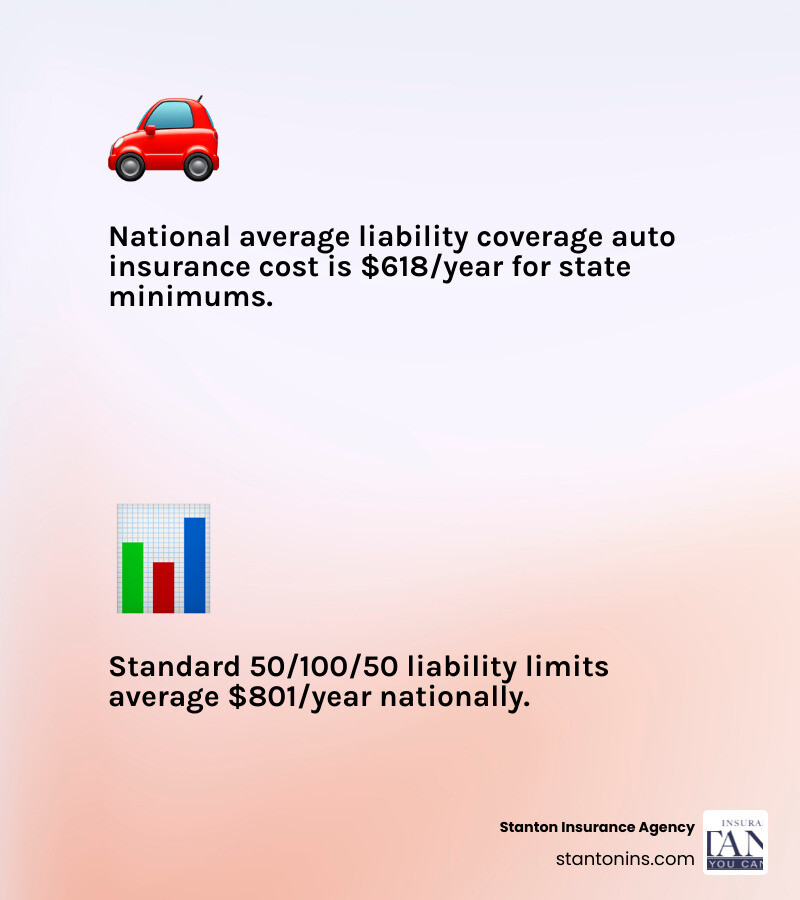
The average liability coverage auto insurance cost in the U.S. is around $618 per year for a state minimum policy and $801 per year for a standard 50/100/50 liability policy. Here’s a quick breakdown:
| Coverage Level | Average Annual Cost | Average Monthly Cost |
|---|---|---|
| State minimum liability | $618 | $52 |
| 50/100/50 liability limits | $801 | $67 |
| Full coverage (with collision/comprehensive) | $2,513 | $209 |
These are national averages. Your actual rate depends on where you live, your driving history, your age, and the limits you choose.
- Massachusetts drivers pay around $710/year for liability coverage on average
- New Hampshire drivers pay around $482/year on average
- Rates rose roughly 17.8% in 2024 due to inflation, higher repair costs, and rising claim severity
Car insurance can feel confusing, especially when you’re trying to figure out how much protection you actually need versus what you’re legally required to carry. Liability coverage is the foundation of almost every auto policy — it pays for other people’s injuries and property damage when you’re at fault in an accident. But the cost varies a lot, and getting it wrong in either direction can hurt you financially.
I’m Geoff Stanton, President of Stanton Insurance Agency and a fourth-generation insurance professional with over two decades of experience helping Massachusetts and New Hampshire drivers find the right coverage at the right price — including navigating the average liability coverage auto insurance cost for our region. In the sections below, I’ll walk you through exactly what drives those numbers and how to make sure you’re properly protected without overpaying.
Basic average liability coverage auto insurance cost terms:
Understanding the Average Liability Coverage Auto Insurance Cost

When we talk about the average liability coverage auto insurance cost, we are looking at the price of the most essential part of your policy. In the insurance world, liability is “third-party” coverage. This means it doesn’t pay to fix your car or your broken leg; instead, it protects your bank account when you accidentally cause damage to someone else’s property or person.
According to Facts + Statistics: Auto insurance | III, national expenditures for auto insurance have been on a steady climb. While the national average for a bare-bones policy is roughly $618, many drivers find themselves paying closer to $800 to $1,000 annually once they increase their limits to a safer level.
For a deeper dive into these numbers, you can explore more info about liability costs. One thing we always tell our clients at Stanton Insurance Agency is to look at the “total cost of ownership.” Paying your premium annually rather than monthly can often save you 5% to 10% because most carriers charge a small “installment fee” for the convenience of monthly billing.
National Benchmarks for Average Liability Coverage Auto Insurance Cost
To understand if you are getting a good deal, it helps to look at the benchmarks. The 2019/2020 Auto Insurance Database Report from the NAIC shows that liability premiums make up the largest portion of most drivers’ insurance bills.
- State Minimums: $618 is the “floor.” This is the absolute least you can pay to be legal.
- 50/100/50 Limits: This provides $50,000 for bodily injury per person, $100,000 per accident, and $50,000 for property damage. The average cost for this is $801.
It’s also important to understand the difference between written and earned premiums. Written premiums are what the insurance company expects to receive when they issue the policy, while earned premiums are the portion of the money the company has “earned” by providing coverage for a certain period. For you, the consumer, the focus is always on the written premium—the number on your bill.
Why Your Average Liability Coverage Auto Insurance Cost May Vary
Insurance isn’t a “one size fits all” product. We use a concept called risk pooling. Imagine everyone in a neighborhood puts $1,000 into a bucket. If one person has a $10,000 accident, the bucket pays for it. If everyone in that neighborhood starts having accidents, the bucket runs dry, and everyone has to put in $2,000 next year.
This is why actuarial analysis is so important. Insurance companies employ math geniuses (actuaries) who look at every possible detail to predict how likely you are to file a claim. Factors that influence this include:
- Urban vs. Rural Density: If you drive in downtown Boston or Worcester, you are surrounded by more cars, pedestrians, and distracted delivery drivers than if you are cruising through the White Mountains of New Hampshire. More “targets” means a higher average liability coverage auto insurance cost.
- Regional Inflation: The cost of a bumper or a headlight has skyrocketed. Modern cars have sensors and cameras in the bumpers that make a “fender bender” cost $3,000 instead of $300.
- Claim Frequency: In certain areas, there are simply more lawyers and more lawsuits, which drives up the cost for everyone in that “pool.”
For more context on these variations, check out our auto liability insurance cost guide.
Key Factors Influencing Your Liability Premiums
While the national and state averages give us a starting point, your personal “scorecard” is what determines your final price. We often see two neighbors with the same car paying completely different rates.
The Impact of Age and Gender on Rates
It’s no secret that experience matters. According to recent data, Gen Z and teen drivers face the highest hurdles. In fact, some young drivers pay 188% more for insurance than their older counterparts.
- The “Teen Tax”: A 16-year-old hasn’t developed the muscle memory or the “road sense” that a 40-year-old has. Statistics show they are much more likely to file a claim.
- Gender-Based Risk: While it might seem unfair, young men typically pay more than young women. Actuarial data suggests that young men are more likely to engage in “spirited” driving or take risks that lead to high-severity accidents.
- The Senior Sweet Spot: Drivers in their 50s and 60s often enjoy the lowest average liability coverage auto insurance cost. However, once a driver hits their late 70s or 80s, rates may start to creep back up as reaction times naturally slow down.
You can find more scientific research on auto insurance expenditures to see how these demographics play out over time. To learn more about what exactly is being covered, read our page on liability car insurance coverage.
Other major factors include:
- Driving Record: A single speeding ticket can increase your liability premium by 20% to 30%. A DUI can double or triple it, and in some cases, make it difficult to find coverage at all in the voluntary market.
- Credit Score: In many states (including New Hampshire), your credit score is used to calculate an “Insurance Score.” Data shows that people who manage their credit responsibly tend to be more responsible behind the wheel as well. In Massachusetts, however, the use of credit scores in auto insurance rating is more restricted.
- Vehicle Safety Ratings: If your car is built like a tank and has automatic emergency braking, your liability costs might be lower because the car helps you avoid hitting people.
- Annual Mileage: If you only drive 5,000 miles a year to the grocery store and back, your “exposure” to risk is much lower than a commuter driving 20,000 miles a year on Route 128.
Comparing Liability Costs in Massachusetts and New Hampshire
Living in New England gives us a front-row seat to two very different insurance systems. Massachusetts is a “compulsory” state, meaning you must have insurance to register a car. New Hampshire is the only state in the country that doesn’t strictly mandate auto insurance for everyone, though it has “Financial Responsibility” laws that make it a necessity for most.
| Feature | Massachusetts (MA) | New Hampshire (NH) |
|---|---|---|
| Average Liability Premium | ~$710 | ~$482 |
| System Type | Compulsory (Mandatory) | Financial Responsibility |
| Minimum BI Limits | $20,000 / $40,000 | $25,000 / $50,000* |
| Minimum PD Limits | $5,000 | $25,000* |
*Note: While NH doesn’t require insurance for all, if you choose to buy it, or are required to due to a conviction, these are the minimums.
In Massachusetts, the system is highly regulated. You can learn more about the specific requirements here: what is the minimum car insurance coverage in Massachusetts?. Because MA has a higher population density and a “no-fault” component for personal injury protection (PIP), the average liability coverage auto insurance cost tends to be higher than in the more rural Granite State.
Recommended Coverage Limits for New England Drivers
We need to have a heart-to-heart about “state minimums.” In Massachusetts, the minimum property damage limit is $5,000. Have you seen the price of a new truck lately? If you rear-end a $70,000 Ford F-150 and total it, your insurance pays $5,000, and you are on the hook for the other $65,000.
That is a recipe for financial ruin. We strongly recommend that our clients look at much higher limits.
- The $100/300/100 Standard: This is often the “sweet spot” for middle-class families.
- The $250/500/250 Level: Recommended if you own a home or have significant savings.
- Umbrella Policy Integration: If your assets exceed your auto limits, an Umbrella policy provides an extra $1 million or more of protection for a very low annual cost (usually $150–$300).
Check out our car insurance liability limits complete guide to see how these choices impact your long-term security.
How to Lower Your Liability Insurance Expenses
Just because the average liability coverage auto insurance cost is rising doesn’t mean you have to take it lying down. There are several proven ways to trim the fat from your premium without sacrificing the protection you need.
- Multi-Policy Bundling: This is the “Grand Slam” of insurance savings. When you put your home, condo, or renters insurance with the same company as your auto, you can save up to 20% on both policies.
- Telematics Programs: Many carriers now offer a discount if you plug a device into your car or use an app that monitors your driving. If you don’t speed, don’t slam on the brakes, and don’t drive at 2:00 AM, you can see significant savings.
- Defensive Driving Courses: Especially for seniors or young drivers, taking an approved safety course can trigger a mandatory discount in many jurisdictions.
- Higher Deductibles: While liability insurance doesn’t have a deductible (you don’t pay a deductible to fix someone else’s car), raising the deductible on your Collision and Comprehensive coverage can lower the overall “package” price of your policy.
- Continuous Coverage: Insurance companies love loyalty. If you have been insured for years without a “lapse” (a period where you had no insurance), you are viewed as a much lower risk.
- Annual Payments: As mentioned before, stop paying the $5 “convenience fee” every month. Pay the full amount upfront if you can afford it.
For more tips, see our guides on cheap liability auto insurance and low-cost liability car insurance.
Frequently Asked Questions about Liability Insurance Costs
Is $100 a month expensive for liability-only insurance?
It depends entirely on your profile. For a 45-year-old with a clean record in rural New Hampshire, $100 a month ($1,200 a year) for liability-only is quite high. However, for a 21-year-old in Boston with one speeding ticket, $100 a month might actually be a fantastic deal. On average, most drivers pay between $50 and $70 per month for liability.
Does liability insurance cover my car if I am hit by another driver?
No. Your liability coverage pays for the other person. If someone else hits you and they are at fault, their liability insurance pays to fix your car. If they don’t have insurance (or not enough), that’s where “Uninsured/Underinsured Motorist” coverage comes in—which is a separate, but equally important, part of your policy.
Why did my liability premium increase without any accidents?
This is a common frustration. Even if you are a perfect driver, your rates can go up due to “rate filings.” If your insurance company paid out millions more in claims this year because of a spike in local accidents or rising medical costs, they have to adjust the rates for the entire “pool” to stay solvent. Inflation is currently the biggest driver of these “no-accident” increases.
Conclusion
Navigating the average liability coverage auto insurance cost doesn’t have to be a solo mission. At Stanton Insurance Agency, we pride ourselves on being more than just a place to buy a policy—we are your neighbors and your advocates. Whether you are navigating the compulsory requirements of Massachusetts or the financial responsibility laws of New Hampshire, we have the local expertise to help you find the “Goldilocks” zone of insurance: not too much, not too little, but just right.
Your assets are too valuable to leave to chance or a “one-size-fits-all” website. Let us do the heavy lifting for you by comparing rates from multiple top-rated carriers to find the best fit for your life and your budget.
Get a quote for auto liability insurance today and see the Stanton difference for yourself. Trusted protection is just a click away.
