
Why the Average Cost of Commercial Auto Liability Insurance Matters for Your Business
Finding the average cost of commercial auto liability insurance is one of the most critical steps in protecting your business assets in 2026. If your business owns even a single vehicle, you cannot afford to guess at your insurance budget.
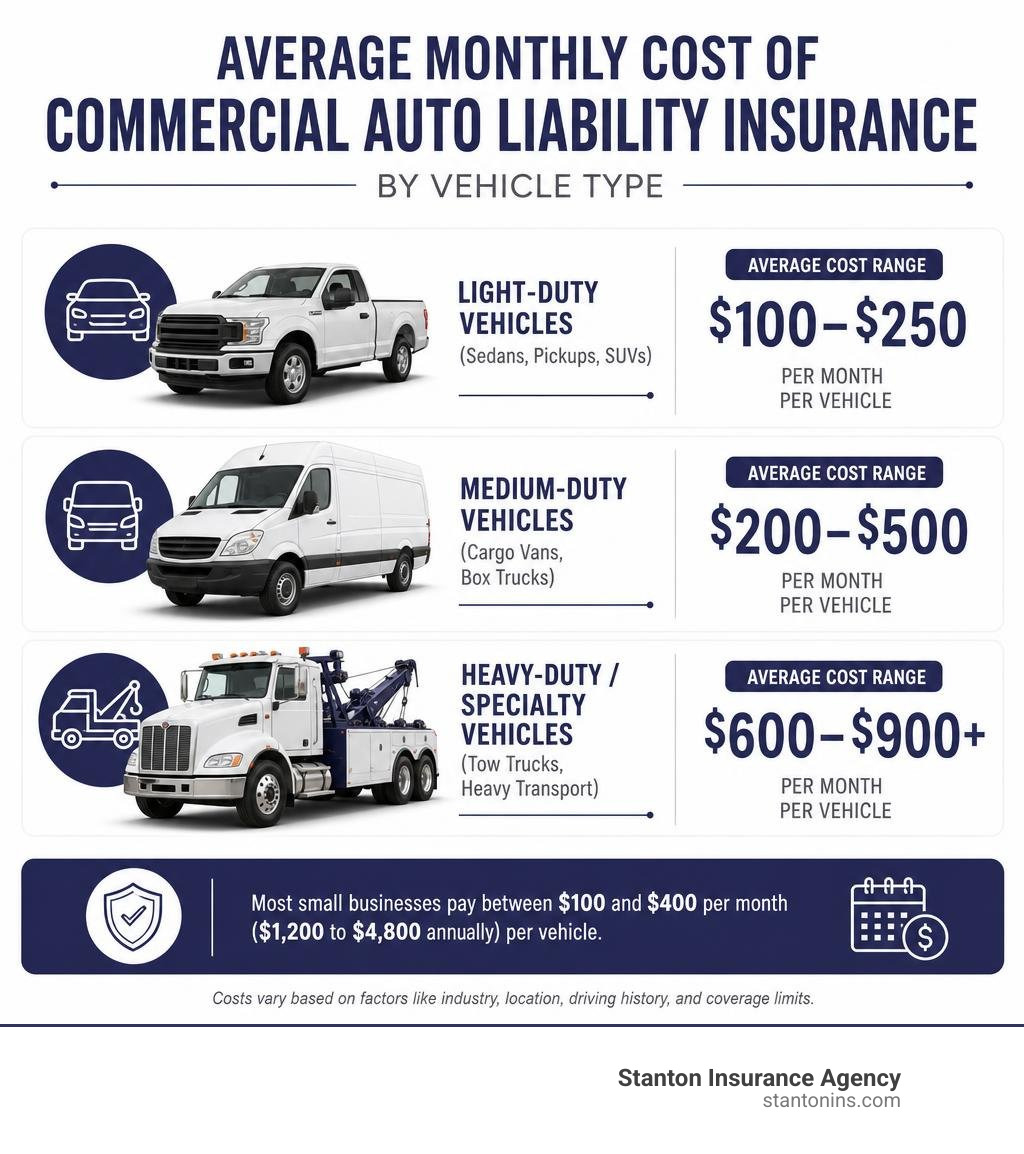
Here is a quick look at what most small businesses actually pay for coverage:
- National Average Range: Most small businesses pay between $100 and $400 per month ($1,200 to $4,800 annually) per vehicle.
- Light-Duty Vehicles (Sedans, Pickups, SUVs): Expect to pay $100 to $250 per month per vehicle.
- Medium-Duty Vehicles (Cargo Vans, Box Trucks): Typically range from $200 to $500 per month per vehicle.
- Heavy-Duty/Specialty Vehicles (Tow Trucks, Heavy Transport): Often range from $600 to $900+ per month per vehicle.
These numbers are helpful benchmarks, but your actual premium depends heavily on your industry, vehicle type, and driving history. For instance, a local contractor in Massachusetts with a clean driving record will pay a much different rate than a logistics business moving heavy cargo across state lines.
I’m Geoff Stanton, President of Stanton Insurance Agency and a Certified Insurance Counselor in Waltham, Massachusetts. With over 25 years of experience helping New England business owners, I specialize in simplifying the complex factors that drive the average cost of commercial auto liability insurance so you can get the best protection for your budget.
Average cost of commercial auto liability insurance terms to learn:
- Auto Liability Insurance Cost
- average liability coverage auto insurance cost
- car insurance liability limits
What is the Average Cost of Commercial Auto Liability Insurance?
When researching the average cost of commercial auto liability insurance, it is important to distinguish between “average” (the mean) and “median” costs. In the insurance world, average numbers can easily be skewed upward by high-risk operations, such as long-haul trucking fleets or hazardous material transport.
For the typical local business operating light-duty vehicles, the median premium is often much lower than the national average. Statistics show that roughly 40% of small businesses pay less than $200 per month for their commercial auto coverage, and another 29% pay between $200 and $400 monthly.
To help you plan your commercial budget, we have compiled the typical monthly premium ranges across several common small business industries. These figures represent standard liability-only or light physical damage packages for small fleets:
Average Monthly Commercial Auto Insurance Costs by Business Type
| Business Industry Type | Typical Monthly Cost Range (Per Vehicle) | Typical Annual Premium |
|---|---|---|
| Contractors & Construction | $135 – $190 | $1,620 – $2,280 |
| Professional Services | $75 – $110 | $900 – $1,320 |
| Cleaning & Janitorial | $95 – $140 | $1,140 – $1,680 |
| Food & Beverage Delivery | $150 – $225 | $1,800 – $2,700 |
As you can see, a consulting firm where employees occasionally drive to local client offices will pay significantly less than a contracting crew hauling heavy machinery to active job sites.
While commercial auto insurance is a critical shield for road-related accidents, it only covers your vehicles. To protect your business from other common liabilities—such as slip-and-fall accidents on your property or product-related claims—it is vital to secure comprehensive Business Liability Insurance alongside your auto policy.
Key Factors That Influence Commercial Auto Insurance Rates
Underwriters do not pull numbers out of a hat. They use a precise, risk-based formula to calculate your commercial vehicle premiums. Understanding these core factors allows you to see exactly where your insurance dollars are going and how you can influence them.

1. Driving Records and Claims History
Your employees’ motor vehicle records (MVRs) are the single most important factor in determining your premium. A history of speeding tickets, at-fault accidents, or DUI violations will instantly label your business as “high risk,” driving up costs or even causing carriers to deny coverage. Conversely, maintaining a team of drivers with clean records keeps your rates at the lower end of the spectrum.
2. Vehicle Weight and Type
The physics of an accident play a major role in pricing. A heavy commercial truck or a box truck causes far more property damage and bodily injury in a collision than a compact sedan. Therefore, as vehicle weight increases, so do your liability premiums.
- Light Vehicles (Sedans, SUVs, Pickups): Lowest risk and lowest premiums.
- Medium Vehicles (Cargo Vans, Box Trucks): Moderate risk due to blind spots and urban driving.
- Heavy Trucks (Semi-trucks, Dump Trucks): Highest risk, requiring specialized Commercial Insurance for Trucks policies that account for cargo weight and specialized rigging.
3. Business Location and Operating Radius
Where your vehicles are garaged and driven matters. Vehicles operating in congested urban areas like Boston, MA, face a statistically higher probability of collisions, vandalism, and theft compared to those parked in rural New Hampshire. Additionally, your operating radius impacts your rate; local driving (within a 50-mile radius) is far less risky in the eyes of an underwriter than regional or long-haul driving.
To ensure your vehicles have the exact protection required for their size, weight, and usage, you must work with an experienced agent to build a custom Commercial Vehicle Insurance policy.
Commercial Auto vs. Personal Auto Insurance Costs
A common question we hear from small business owners is: “Can’t I just use my personal auto insurance policy for my business tasks?”
The short answer is no. Doing so is a major financial risk. Personal auto policies are written with the assumption that the vehicle is used for commuting, running errands, and personal travel. They almost always contain strict exclusions for business use, such as delivering goods, transporting heavy tools, or carrying clients for a fee. If you or an employee are involved in an accident while performing business duties, your personal insurance carrier can—and likely will—deny the claim.
Why Commercial Auto Insurance Costs More
Commercial auto insurance is typically more expensive than personal coverage because the risks involved are structurally different:
- Higher Liability Limits: While a personal policy might carry $100,000 in liability coverage, commercial policies routinely start at $1,000,000 Combined Single Limit (CSL). This is because businesses are primary targets for lawsuits, and commercial accidents often involve larger payouts.
- Multiple Insured Drivers: Commercial policies cover multiple employees driving the same fleet vehicles, increasing the statistical exposure to accidents.
- Heavier Loads and Cargo: Business vehicles often haul heavy equipment, inventory, or hazardous materials, which can cause severe damage during an accident.
To understand how liability works in a broader corporate context, it helps to review the core Liability Insurance Definition to see how these policies safeguard your business’s financial future.
State Requirements and Regional Cost Variations
Commercial auto insurance is heavily regulated at the state level. Because Stanton Insurance Agency serves business owners throughout Massachusetts and New Hampshire, we know how different the rules and pricing pressures are between these two neighboring states.
Massachusetts Commercial Auto Requirements
Massachusetts is a compulsory insurance state with a complex, no-fault system. To register and operate a commercial vehicle in the Bay State, you must carry at least:
- Bodily Injury to Others: $20,000 per person / $40,000 per accident
- Personal Injury Protection (PIP): $8,000 per person (covers medical bills and lost wages regardless of fault)
- Bodily Injury Caused by an Uninsured Auto: $20,000 per person / $40,000 per accident
- Damage to Someone Else’s Property: $5,000 per accident
While these are the bare legal minimums, they are dangerously low for any operating business. A single moderate accident can easily exceed $5,000 in property damage. Most Massachusetts commercial clients opt for a $1,000,000 Combined Single Limit to protect their corporate assets. For additional official background on auto insurance requirements in the state, review the Massachusetts law about auto insurance resources from Mass.gov.
For a deeper dive into Bay State rules, read our Commercial Auto Insurance MA Ultimate Guide.
New Hampshire Commercial Auto Requirements
New Hampshire operates under “financial responsibility” laws. This means you are not legally required to buy auto insurance to register a vehicle, but you must prove you have the financial means to pay for damages if you cause an accident. If you choose to buy insurance (which almost every business does to protect its survival), the minimum liability limits are:
- Bodily Injury: $25,000 per person / $50,000 per accident
- Property Damage: $25,000 per accident
- Medical Payments: $1,000 per person
Because New Hampshire lacks the dense urban congestion of the Boston metro area, average commercial premiums in the Granite State are generally lower. However, severe winter weather, wildlife hazards, and rural road conditions still present unique risks.
Learn more about local Granite State coverage options by visiting our guide on Commercial Auto Insurance in New Hampshire.
How to Lower Your Commercial Auto Insurance Premiums
While the average cost of commercial auto liability insurance has faced upward pressure in 2026 due to rising vehicle repair costs and medical inflation, you are not powerless. There are several highly effective strategies you can use to lower your premiums without sacrificing vital protection.
1. Bundle Your Policies
One of the easiest ways to secure an immediate discount is to bundle your commercial auto policy with other essential coverages. Combining your auto policy with general liability, commercial property, or a Business Owner’s Policy (BOP) under the same carrier can save you 5% to 15% annually. Explore how to build a unified protection plan with our comprehensive Business Insurance options.
2. Leverage Telematics and GPS Fleet Tracking
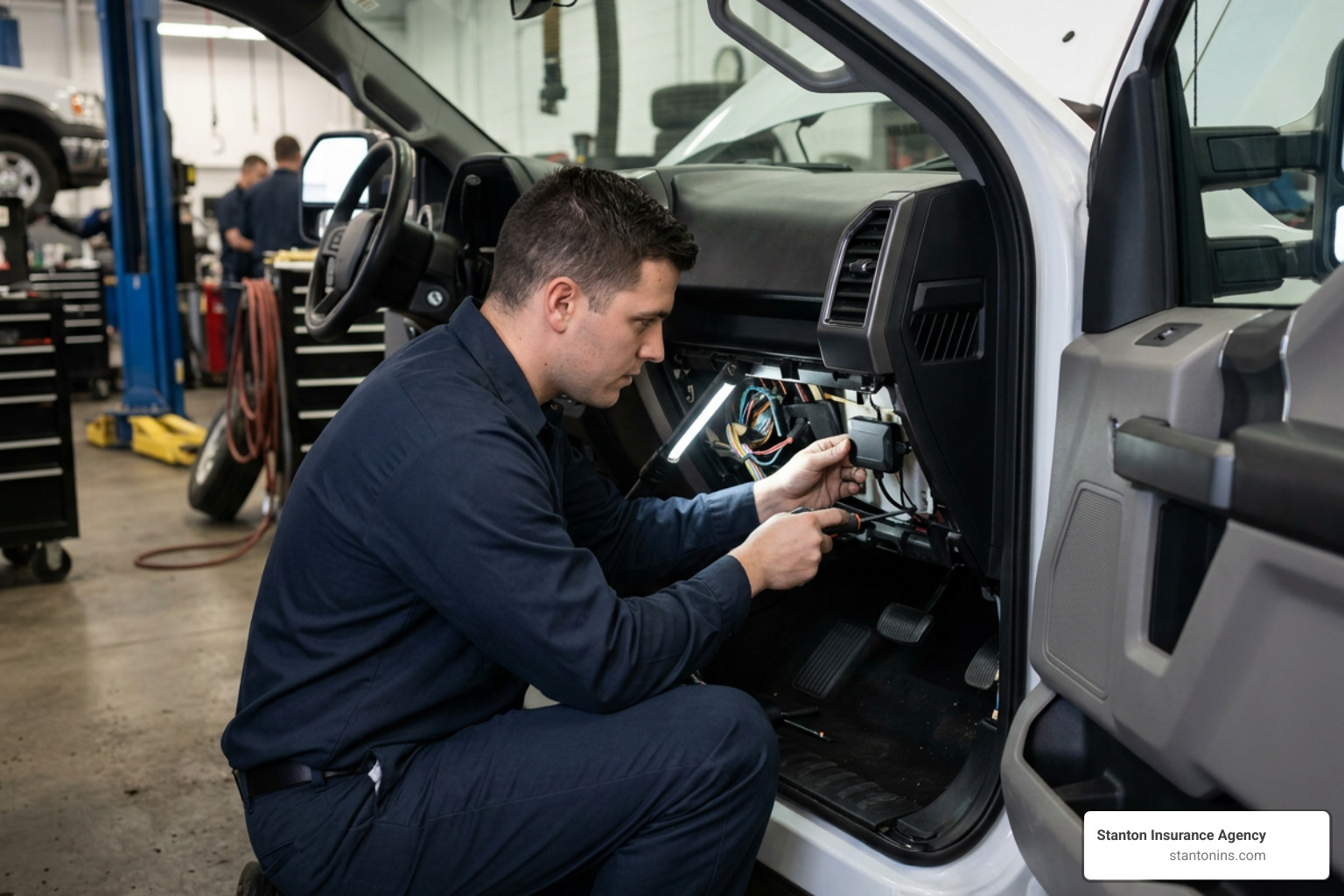
Many modern insurance companies offer significant discounts to businesses that install telematics devices in their vehicles. These small devices track real-time driving behaviors, such as hard braking, rapid acceleration, and average speeds. By proving your drivers operate safely, you can secure renewal discounts of 10% to 15%.
3. Raise Your Deductibles
If your business has healthy cash reserves, raising your physical damage deductibles (comprehensive and collision) from $500 to $1,000 or $2,500 can substantially lower your monthly premium. Just make sure you can easily afford to pay the higher deductible out-of-pocket if an accident occurs.
4. Implement a Written Driver Safety Policy
Establish strict hiring guidelines that include annual Motor Vehicle Record (MVR) checks. Document safe-driving expectations—such as zero-tolerance policies for mobile phone use or driving under the influence—and conduct regular safety training sessions. Underwriters love to see documented safety controls and will often reward your business with preferred tier pricing.
Frequently Asked Questions about Commercial Auto Insurance
What is the average cost of commercial auto liability insurance for a single vehicle?
For a single light-duty passenger vehicle (like a sedan or standard pickup truck used for local business errands), the average cost ranges from $100 to $250 per month ($1,200 to $3,000 annually). If you are insuring a cargo van or a light work truck with permanently attached toolboxes, the cost typically lands between $150 and $300 per month.
Why is the average cost of commercial auto liability insurance higher than personal auto?
Commercial auto insurance carries higher premiums because business vehicles are on the road more frequently, travel higher annual mileages, and are often driven by multiple employees. Furthermore, commercial policies feature significantly higher liability limits (typically $1,000,000 CSL) to protect the business entity from devastating lawsuits, whereas personal policies often carry much lower state-mandated limits.
Is hired and non-owned auto (HNOA) coverage a cost-effective alternative?
Yes, HNOA is an incredibly cost-effective option for businesses that do not own company vehicles but have employees who use their personal cars for business errands (such as picking up supplies, visiting clients, or delivering food). HNOA can easily be added to your general liability policy as an endorsement, providing liability protection for the business if an employee causes an accident while driving their personal vehicle for work.
Conclusion
Navigating the average cost of commercial auto liability insurance does not have to be an overwhelming chore. While the national and regional baselines in 2026 provide a helpful starting point, the key to securing the best rate is customizing your policy to fit your exact fleet size, industry, and risk profile.
At Stanton Insurance Agency, we pride ourselves on delivering trusted protection for your most valuable business assets. Whether you operate a single contractor pickup truck in New Hampshire or a growing delivery fleet in Massachusetts, our local team is here to help you find competitive rates without cutting corners on coverage.
Protect your business fleet and secure your peace of mind today. Contact us to get your personalized Commercial Auto Liability Insurance Quote and see how much you can save.