
What Happens When You Cancel Insurance After an Accident?
Cancel insurance after accident is something many drivers consider — and the short answer is: yes, you can, and it won’t hurt your existing claim.
Here’s what you need to know right away:
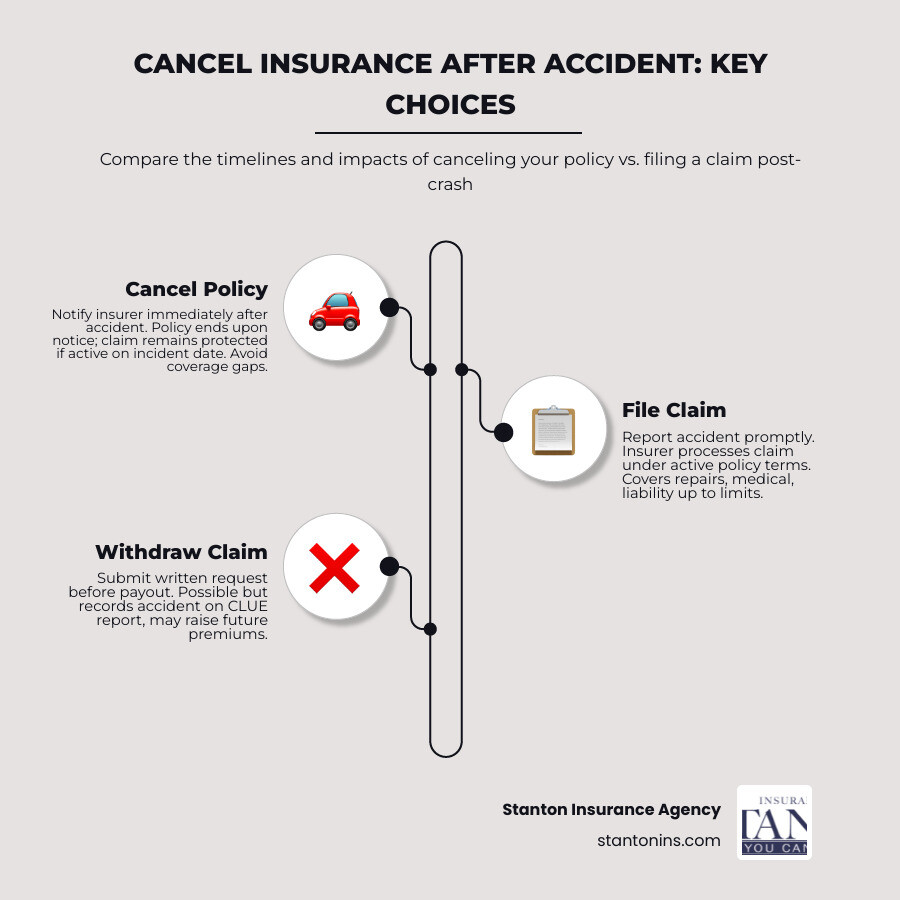
- Your claim is protected. As long as your policy was active on the day of the accident, canceling afterward has no effect on your claim.
- You can cancel at any time. You don’t have to wait for the claim to close before canceling your policy.
- A coverage lapse has real costs. Going without insurance — even briefly — can raise your future premiums and put you at legal risk.
- Canceling a claim is different from canceling a policy. You can withdraw a filed claim in some situations, but there are consequences worth understanding first.
After an accident, the insurance process can feel overwhelming. You’re dealing with repairs, possibly injuries, and a stack of paperwork — all while wondering whether your current insurer is actually working for you. It’s no surprise that many drivers start questioning whether to stick with their policy, cancel it, or even pull back a claim they’ve already filed.
The good news is that you have more control than you might think. But the decisions you make in the days and weeks after a crash can affect your rates and coverage for years to come.
I’m Geoff Stanton, President of Stanton Insurance Agency and a Certified Insurance Counselor with over 25 years of experience helping Massachusetts and New Hampshire drivers navigate exactly these kinds of post-accident decisions, including when and how to cancel insurance after accident situations without making a costly mistake. Let’s walk through everything you need to know.
Glossary for Cancel insurance after accident:
- Cancel car insurance renewal
- Cancel car insurance Massachusetts
- What happens if my car insurance is cancelled in Massachusetts
Can You Cancel Insurance After Accident?

One of the most common myths we hear at Stanton Insurance Agency is that you’re “locked in” to your policy if you have an open claim. That simply isn’t true. You have the contractual right to terminate your policy at any time, provided you follow the proper notification procedures required by your state’s laws—especially here in Massachusetts and New Hampshire.
When you decide to cancel insurance after accident events, the most critical factor is the incident date. Insurance works on an “occurrence” basis. If you had a valid, active policy at 2:15 PM on Tuesday when the fender-bender happened, that insurer is legally obligated to handle the claim, even if you fire them at 2:16 PM.
However, before you pick up the phone to cancel, you must verify your coverage dates. If you cancel your old policy before your new one starts, you create a “lapse,” which is a major red flag for insurance companies and state registries. In Massachusetts, for example, the Registry of Motor Vehicles (RMV) is notified electronically the moment a policy is canceled. If you don’t have a new policy in place, you could face a license suspension or steep fines.
For more details on the logistics of ending a policy, check out our guide on canceling car insurance what you need to know. Additionally, the Frequently Asked Questions about Auto Insurance Claims – Mass.gov provides excellent state-specific insights into your rights as a consumer.
Impact on existing insurance claims
We often get asked, “If I leave my current company, will they stop paying for my repairs?” The answer is a resounding no. Your insurer’s obligations are set in stone based on the policy that was active at the time of the crash.
Retroactive coverage ensures that as long as the premium was paid and the policy was in force during the accident, the claim processing continues as usual. You still have settlement rights, and the adjuster is still required to negotiate in good faith. Switching to a new agency doesn’t mean your old claim disappears into a black hole; it just means you’ll be dealing with two different companies for a while: your old one for the claim and your new one for your ongoing coverage.
If you’re currently in the middle of this process, our auto insurance accident claim complete guide can help you manage the paperwork without losing your mind.
Risks of a coverage lapse when you cancel insurance after accident
While you can cancel, you should never do so without having a replacement policy lined up. Maintaining continuous insurance is one of the best ways to keep your rates low.
If you cancel insurance after accident and wait a few weeks to find a new provider, you will likely be hit with a “high-risk” status. Insurance companies love stability. Even a one-day lapse can cause your future premiums to jump by 15% to 30% or more. In Massachusetts specifically, a lapse in coverage is reported to the RMV, which can lead to the revocation of your registration. You don’t want to be the person getting pulled over for an “uninsured vehicle” because you were trying to save a few bucks on a premium.
To understand the full weight of these penalties, read our breakdown of what happens if my car insurance is cancelled in Massachusetts.
Handling a Totaled Vehicle and Premium Payments
If your car is declared a “total loss,” the situation gets a bit more complex. A car is typically considered totaled when the cost of repairs exceeds a certain percentage of its Actual Cash Value (ACV)—usually around 70% to 80%.
Many drivers think, “My car is a pile of scrap metal now, so I should stop paying the bill today.” Not so fast! Until the insurance company cuts a check and the title is officially transferred, you are still the legal owner of that vehicle.
If you have a loan or lease, your lienholder must be notified immediately. The insurance settlement will go to them first to satisfy the loan payoff. If the check is more than what you owe, you get the difference. If it’s less, and you don’t have GAP insurance, you’re on the hook for the remainder.
Once the settlement is finalized and you’ve signed over the title, you can often receive premium refunds for any “unearned premium” (the part of the bill you paid for time you won’t use). For a step-by-step look at this, see how to cancel car insurance in Massachusetts.
When to stop paying for a totaled car
The “magic moment” to stop paying isn’t the day of the crash. It is the day the title transfer is complete and, most importantly in Massachusetts, the day you return your license plates.
In MA, you must have an RMV plate return receipt or a transfer of registration to a new vehicle before you can legally cancel your policy. If you cancel before returning the plates, the RMV will flag you for a “compulsory insurance violation.”
In New Hampshire, while the rules are slightly different because insurance isn’t strictly “compulsory” for everyone, you still need to ensure your financial responsibility requirements are met until the vehicle is officially out of your name. Check out our cancel car insurance MA guide for the specific forms you’ll need.
Withdrawing or Canceling an Insurance Claim
Sometimes, after the dust settles, you realize that filing a claim was a mistake. Maybe the damage is minor, or you’re worried about your rates going up.
Before you decide to withdraw a claim, you need to do a deductible analysis. If your deductible is $1,000 and the repair estimate is $1,100, the insurance company is only going to give you $100. Is that $100 worth having an accident on your record for the next three to five years? Probably not.
| Scenario | Repair Cost | Deductible | Insurer Pays | Est. 3-Year Rate Hike | Total Long-Term Cost |
|---|---|---|---|---|---|
| Minor Scrape | $800 | $1,000 | $0 | $0 (if withdrawn) | $800 |
| Fender Bender | $1,200 | $1,000 | $200 | $1,500 | $2,300 |
| Major Damage | $5,000 | $1,000 | $4,000 | $1,500 | $2,500 |
As the table shows, for minor repairs, paying out-of-pocket is almost always cheaper in the long run. Even if you withdraw the claim, the “incident” might still show up on your CLUE report (Comprehensive Loss Underwriting Exchange), but it will be listed as a $0 payout, which is much better for your risk profile. For a deeper dive into managing these records, read our auto insurance claims complete guide.
Can you cancel insurance after accident claims are filed?
Yes, you can withdraw a claim after filing it, provided the insurer hasn’t already issued a payment or finalized the settlement. The withdrawal process usually requires a written request. You should contact your adjuster and state clearly that you wish to withdraw the claim and handle the repairs privately.
If you’ve already received a check but haven’t cashed it, you can sometimes return it to the insurer to close the claim with a $0 payout. However, once the check is cashed or the repair shop is paid, the claim is considered “settled” and cannot be undone.
For NH residents, the [PDF] New Hampshire Insurance Department 2022: Automobile Guide outlines the specific timelines you have to work with.
Consequences of withdrawing a claim
Don’t expect the accident to completely vanish just because you withdrew the claim. Insurance companies are in the business of risk profiling. If you report an accident and then withdraw it, the insurer still knows you were involved in an “incident.”
While a $0 payout claim is unlikely to trigger a massive premium surcharge, it could still affect your eligibility for accident forgiveness or other “claims-free” discounts. Future underwriters will see the reported incident on your CLUE report (which stays there for up to seven years) and may factor it into your rates.
You can learn more about these “hidden” impacts in the article What Happens When You Withdraw an Insurance Claim?.
When Your Insurer Drops You: Cancellation vs. Non-Renewal
Sometimes, the choice to cancel insurance after accident isn’t yours—it’s the insurance company’s. There is a big difference between a “cancellation” and a “non-renewal.”
Cancellation: This happens mid-term. In most states, including MA and NH, an insurer can only cancel your policy after the first 60 days for very specific reasons:
- Non-payment of premium.
- Material misrepresentation (you lied on your application).
- Your driver’s license was suspended or revoked.
- You were convicted of a DUI/DWI.
Non-Renewal: This is when the insurer decides not to offer you a new policy at the end of your current term. They might do this if you’ve had multiple at-fault accidents in a short period or if your risk profile has changed significantly. They must provide you with a notice (usually 30 to 45 days) before the policy expires.
If you find yourself in this situation, don’t panic. There are “high-risk” markets available, though the premiums will be higher. Our cancel car insurance Massachusetts guide explains how to navigate these waters if your insurer decides to part ways.
Frequently Asked Questions about Post-Accident Cancellation
Do I get a refund if I cancel my policy early?
Yes, usually. Most policies are prorated, meaning if you pay for six months upfront and cancel after two, you get the remaining four months back. However, some companies use short-rate cancellation, where they keep a small percentage (usually around 10%) as a penalty for ending the contract early. Always ask your agent about “unearned premium” refunds before you sign the cancellation forms. Our page on cancel car insurance renewal has more on this.
Will my rates go up if I switch companies after a crash?
If the accident was your fault, yes—your rates will likely go up regardless of which company you choose. An at-fault surcharge typically stays on your record for three to six years. However, different companies weigh accidents differently. Shopping for value is always a good idea after a crash because one insurer might penalize you less than another. Just make sure you don’t lose your continuous coverage discount by letting your policy lapse. See How To Cancel Car Insurance In Massachusetts for more shopping tips.
What is a non-owner policy?
If your car was totaled and you don’t plan on buying a new one immediately, a non-owner policy is a lifesaver. It provides liability protection when you drive borrowed or rented vehicles and—more importantly—it prevents a “coverage gap.” By keeping a non-owner policy active, you maintain your “continuous insurance” status, which will save you thousands when you eventually buy a car again. It’s a very affordable alternative for those “in-between” vehicles. Learn more at Don’t get stuck in neutral: the best time to cancel your auto insurance.
Conclusion
At Stanton Insurance Agency, we know that the days following a car accident are some of the most stressful you’ll face as a driver. Whether you’re looking to cancel insurance after accident because you’re unhappy with your current provider, or you’re trying to figure out if you should withdraw a claim to save your rates, you don’t have to make these decisions alone.
Our goal is to provide trusted protection and professional guidance to our neighbors in Massachusetts and New Hampshire. We treat your assets like our own, ensuring you have the right coverage at the right price, even when things go wrong on the road.
If you’re ready for a fresh start with a local agency that actually answers the phone, we’re here to help. Whether you need to navigate a total loss or find a more affordable policy after a surcharge, let’s talk.
Get a Quote and Protect Your Assets with Stanton Insurance Agency
