
Why Understanding Innkeeper’s Legal Liability Matters

Innkeepers legal liability is the legal responsibility that hotel, motel, bed and breakfast, and other lodging operators have for their guests’ safety and property. This liability has deep historical roots but is now primarily governed by state statutes that both define and limit an innkeeper’s responsibility—provided they meet specific legal requirements.
Quick Answer: What You Need to Know
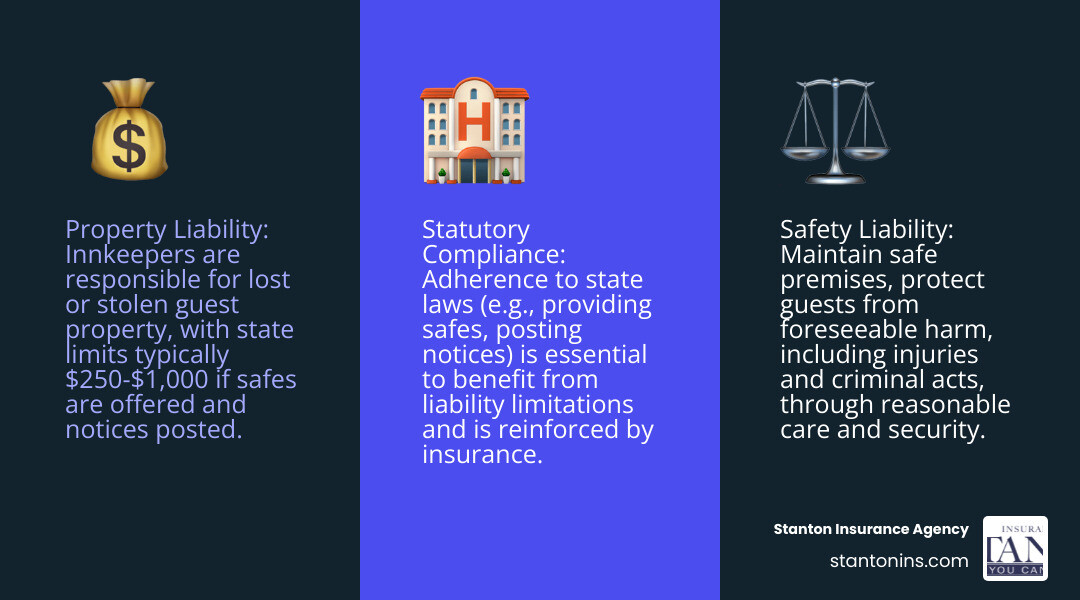
- Property Liability: Innkeepers can be held responsible for lost or stolen guest property, but most states limit this liability to $250-$1,000 if the innkeeper provides a safe and posts proper notices.
- Safety Liability: Innkeepers must maintain safe premises and protect guests from foreseeable harm, including injuries from defective conditions and criminal acts.
- Statutory Requirements: To benefit from liability limits, innkeepers must typically provide safes for valuables, post conspicuous notices about liability limitations, and comply with fire safety regulations.
- Insurance Protection: Innkeeper’s liability insurance covers guest property loss, bodily injury claims, and legal defense costs, with typical coverage limits around $1,000 per guest.
The stakes are high. A single lawsuit over a guest injury or stolen property can cost tens of thousands of dollars in legal fees alone—not to mention the potential damage to your reputation. Yet many small lodging operators remain unaware of their specific legal duties or how to properly protect themselves.
The challenge stems from the fact that innkeeper’s liability is not uniform across the country. Each state has its own statutes with different monetary limits, notice requirements, and conditions for limiting liability. In Massachusetts, for example, an innkeeper’s liability for most items is capped at $300, while in California, the limit is $1,000—but only if you’ve properly posted notices and provided a safe. Failing to meet these statutory requirements can expose you to liability for the full value of a guest’s lost property, which could be substantial.
Beyond property, innkeepers face significant exposure for guest safety. Courts have consistently held that lodging operators owe guests a high duty of care—not just to maintain safe physical premises, but also to protect them from foreseeable criminal acts. If your hotel is located in a high-crime area or has experienced prior security incidents, your duty to implement reasonable security measures increases accordingly.
I’m Geoff Stanton, President of Stanton Insurance Agency in Waltham, Massachusetts, and I’ve spent over two decades helping businesses steer complex liability exposures, including innkeepers legal liability for hotels, bed and breakfasts, and other lodging establishments throughout Massachusetts and New Hampshire. This guide will break down the essential elements of your legal duties, explain how state statutes work, and show you how the right insurance strategy can protect your business from devastating losses.
Simple guide to innkeepers legal liability:
What is Innkeeper’s Legal Liability?
Innkeeper’s legal liability refers to the legal responsibility that operators of hotels, motels, and other lodging establishments have for the well-being of their guests and the protection of their property. This legal doctrine has deep roots, evolving significantly from its historical origins.
The Evolution from Strict Liability to Modern Negligence
For centuries, the law has recognized the unique relationship between an innkeeper and their guest. Under common law, innkeepers were once held to a standard of “strict liability.” This meant they were almost automatically responsible for any loss of a guest’s property, irrespective of fault. The only exceptions were if the loss was caused by an “act of God” (like a hurricane), a public enemy, or the guest’s own negligence. This stringent rule emerged from the dangerous travel conditions of medieval times, where travelers were vulnerable and innkeepers were seen as having a critical role in their safety and the security of their belongings. The law essentially treated innkeepers as insurers of guest property.
However, as society evolved and travel became safer, the strictness of this common law rule began to be seen as outdated. Today, the standard has largely shifted from strict liability to one based on negligence. While the duty of care remains high, a guest typically needs to prove that the innkeeper failed to exercise reasonable care and that this failure directly caused their injury or loss. This means that while innkeepers are still held to a higher standard than many other businesses, they are not automatically liable for every incident. We, as innkeepers, must be vigilant, but we also have avenues to limit our exposure if we meet certain statutory requirements.
How Innkeeper Liability Differs from General Premises Liability
It’s easy to confuse innkeeper’s liability with general premises liability, but there are crucial distinctions. General premises liability applies to any property owner and requires them to keep their property reasonably safe for visitors. For example, a supermarket owner has a duty to clean up a spill to prevent customers from slipping.
Innkeeper’s legal liability, however, is a specialized and often more stringent form of premises liability. The unique relationship between an innkeeper and a guest imposes a higher duty of care. This means we’re not just responsible for preventing physical hazards like a slippery floor; we also have a heightened duty to:
- Protect Guest Property: As we’ll discuss, this involves safeguarding personal belongings, often by providing secure storage.
- Prevent Foreseeable Criminal Acts: We must take reasonable steps to protect guests from criminal activities by employees, other guests, or even outside intruders, especially if such risks are foreseeable.
This distinction highlights why operating a lodging establishment carries unique legal burdens that require specialized attention.
Understanding Your Innkeepers Legal Liability for Guest Property
One of the most frequent areas where innkeepers face legal challenges is the loss, theft, or damage of a guest’s personal property. While common law was incredibly strict, modern state statutes provide a more nuanced framework that aims to protect guests while also offering innkeepers a way to limit their financial exposure, provided they meet specific conditions.
The Role of Safes and Posted Notices
To benefit from statutory limitations on innkeeper’s legal liability for guest property, two critical requirements almost universally apply across states, including Massachusetts and New Hampshire:
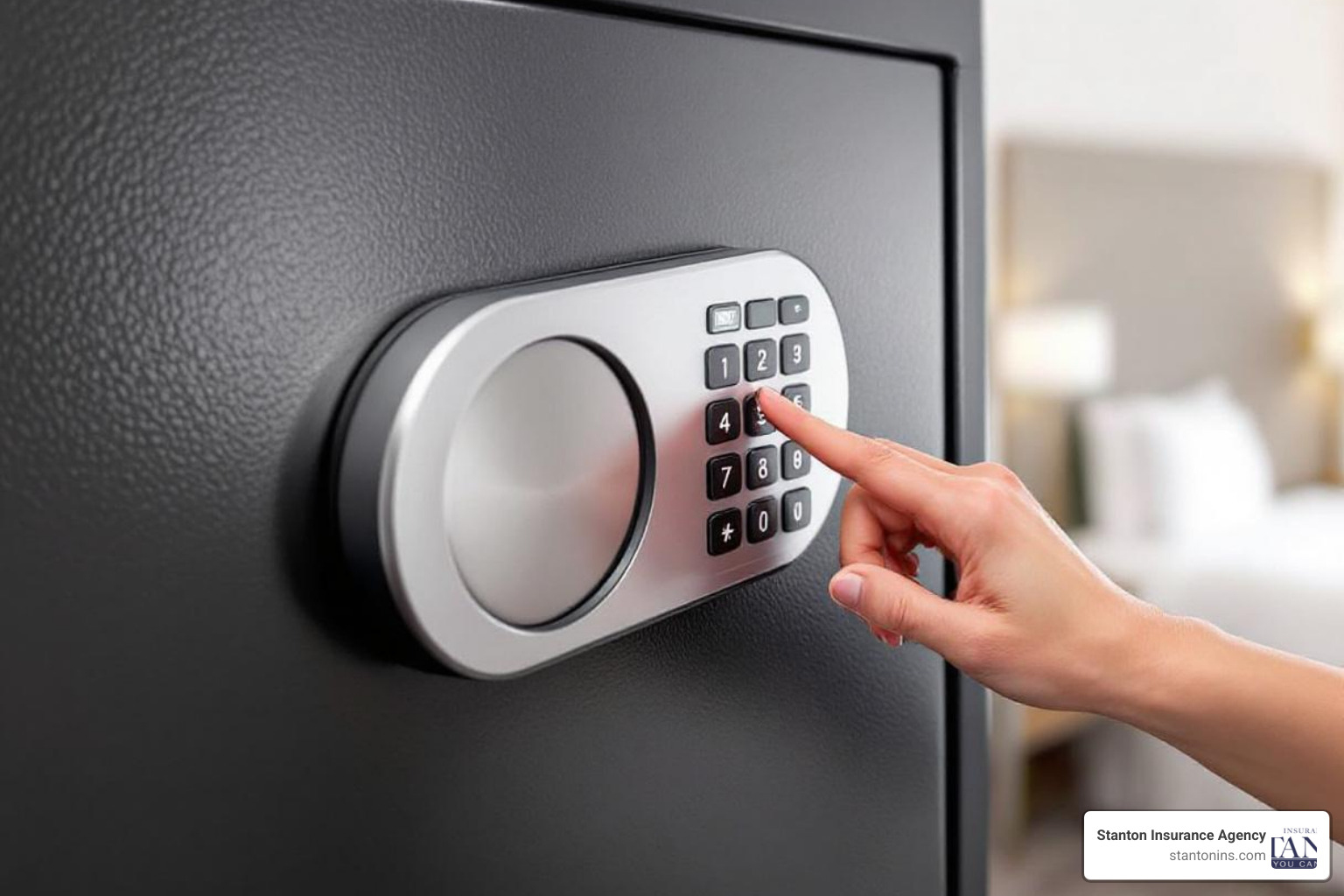
- Provide a Safe: We must make a secure safe or vault available for guests to store their valuables. This typically includes money, jewelry, and important documents. The safe should be in good working order and easily accessible. Many modern hotels offer in-room safes with digital keypads, which are generally recommended.
- Post Notices: We are legally obligated to post conspicuous notices informing guests about the availability of the safe and the limitations of our liability for items not stored within it. These notices are usually required in guest rooms (often on the back of the door), at the front desk, and in other public areas of the establishment. The specific language, size, and placement of these notices are often dictated by state law.
Failing to comply with these straightforward requirements can be very costly. If we do not provide a safe, or if we fail to post the proper notices as mandated by law, we may forfeit the statutory protection and be held liable for the full value of a guest’s lost property. This could be a substantial amount, far exceeding the typical statutory limits. For instance, in one case, a hotel was held liable for the full value of stolen jewelry worth $1.2 million because it failed to post required notices in public areas, despite having them in guest rooms. This shows just how vital proper compliance is.
State-Specific Liability Limits: A Comparison
The monetary limits on innkeeper’s legal liability for guest property vary significantly from state to state. Understanding the specific laws where you operate—in our case, Massachusetts and New Hampshire—is absolutely critical. While we won’t dig into every state’s specifics, here’s how some laws compare, illustrating the variations:
| State | Liability Limit for Items in Room | Liability Limit for Items in Safe | Key Conditions |
|---|---|---|---|
| Massachusetts | $300 | $1,000 | Under Massachusetts General Laws Chapter 140, Sections 10-12, an innkeeper’s liability for a guest’s property in the room is limited to $300. If a safe is provided and notices posted, the innkeeper is not liable for valuables not placed in the safe. For items deposited in the safe, liability is limited to $1,000. |
| New Hampshire | $400 | $500 | Per RSA 353, liability is limited to $400 for property in the room. If a safe is provided and notices posted, the innkeeper is not liable for valuables not placed in the safe. Liability for items in the safe is limited to $500 unless a written agreement states otherwise. |
| California | $1,000 (in aggregate) | $500 | This state’s law (Civil Code sections 1859 and 1860) limits hotel operator liability to either $1,000 or $500 for stolen, damaged, or lost guest valuables. It requires posted notice of the safe’s availability and applies unless the innkeeper agrees to greater liability in writing. |
| Michigan | $250 (general); lower for specific items like bags ($50) and trunks ($150) | N/A (liability is negated if safe is offered and not used, barring staff theft/negligence) | Michigan’s Act 42 of 1905 requires a metal safe, proper locks, and notices posted in at least 10 conspicuous places. Its statute limits liability significantly for various types of property. |
As you can see, the specifics vary significantly. For operators in New Hampshire, the law (RSA 353) provides similar protections. Liability is limited to $400 for property in a guest’s room and $500 for valuables stored in the hotel safe, provided the innkeeper has posted the required notices. It is critical for innkeepers in both Massachusetts and New Hampshire to strictly adhere to these statutory requirements for providing safes and posting notices, as failure to do so can void these liability limits and expose the business to full responsibility for any guest property losses.
The Duty of Care for Guest Safety

Our responsibility as innkeepers extends far beyond just protecting property; it encompasses the personal safety and well-being of every guest. This involves actively maintaining a safe environment and taking proactive steps to protect guests from foreseeable harm.
Preventing Injuries on the Premises
We have an obligation to reasonably protect guests from injury while at our establishment. This means we must be vigilant in identifying and mitigating foreseeable risks. Our duties include:
- Maintenance: We must regularly inspect and maintain all areas of our premises. This includes ensuring floors are not slippery, stairs are in good repair and well-lit, handrails are secure, elevators are properly maintained, and furniture is safe. A guest suffering injuries due to a defective staircase or a malfunctioning elevator due to lack of maintenance could lead to significant liability.
- Fire Safety: Complying with all local and state fire codes is non-negotiable. This means installing and regularly checking functional smoke detectors and carbon monoxide alarms, ensuring fire extinguishers are accessible and charged, and maintaining clear and unobstructed fire escapes and exit routes. Failure to comply with fire regulations can lead to severe civil liability if a guest is injured or worse.
- Sanitation: Maintaining sanitary conditions throughout the entire property is essential to prevent the spread of disease or foodborne illness. This applies to guest rooms, common areas, swimming pools, and especially any food and beverage service areas. We are liable for serving unwholesome food, often under an implied warranty of fitness, regardless of negligence.
Our duty of care extends to making our premises as safe as reasonable skill and security can make them, and this includes protecting guests from foreseeable risks caused by other guests or our employees.
Security and Protection from Criminal Acts
A critical and often challenging aspect of our innkeepers legal liability is protecting guests from foreseeable criminal acts. This can involve crimes committed by our own employees, other guests, or outside intruders. The legal linchpin here is foreseeability.
If our establishment is in a high-crime area, or if we have experienced previous incidents of theft, assault, or other criminal activity on the premises, then we have a heightened duty to implement reasonable security measures. This is not about guaranteeing absolute safety, but about taking reasonable steps to deter crime and protect our guests. Such measures can include:
- Security Personnel: Employing security guards or patrols, especially during night hours.
- Surveillance: Installing and maintaining operational surveillance cameras in common areas, hallways, and parking lots.
- Lighting: Ensuring all outdoor areas, parking lots, and hallways are adequately lit.
- Access Control: Implementing secure key card systems, ensuring all guest room doors have robust locks, and promptly changing locks after a theft report. For example, if a hotel fails to change door locks after a theft is reported, and another guest subsequently experiences a theft, we may be held liable for not taking reasonable security measures.
The legal elements a guest must prove to hold us liable for damages or losses typically include showing that we owed them a duty of care, we breached that duty (e.g., by failing to implement reasonable security), that the breach caused the harm, and that they suffered actual damages. Factors like guest negligence (e.g., leaving a door open uped) or the foreseeability of a crime can significantly affect our liability. If a crime was not foreseeable, our liability is generally much lower.
The Role of Insurance in Managing Liability
No matter how diligent we are, no innkeeper can eliminate all risks. Accidents happen, and unforeseen events occur. This is where a robust business insurance portfolio becomes a critical line of defense. Innkeeper’s liability insurance is a specialized policy designed to cover the unique exposures of the hospitality industry, providing a crucial safety net for our operations in Massachusetts and New Hampshire.
What Does an Innkeeper’s Liability Policy Cover?
While specific policy details can vary, innkeeper’s liability insurance (also known as hotel/motel liability insurance or guest lodging liability insurance) is specifically designed to respond to the unique legal duties we have as hotel operators. Common coverages typically include:
- Guest’s Property: This coverage helps us manage claims for damage to or loss of guest property, often up to the statutory limits established by state law. These policies typically have a per-guest limit, such as $1,000, unless the loss results from natural events (like a hurricane), civil unrest, or actions taken by the guests themselves. This is vital for mitigating the financial impact of claims related to stolen or damaged belongings.
- Guest’s Safety (Bodily Injury): This is a broad category that covers claims arising from bodily injury sustained by guests on our property. This includes slip and fall claims, injuries from defective premises, or even assaults where we are found negligent in providing security. It covers legal expenses and damages if we are found liable.
- Legal Defense Costs: One of the most significant benefits of this insurance is that it pays for the attorneys’ fees, court costs, and other expenses associated with defending a lawsuit, even if the suit is ultimately found to be without merit. This alone can save our business from financial ruin.
- Other Coverages: Depending on the policy and our specific operations, coverage can also extend to claims for libel and slander (e.g., a guest alleging defamation), and food poisoning claims if we operate a restaurant or serve food. If we serve alcohol, liquor liability (or dram shop liability) is also a critical consideration.
Having the right business liability insurance is not just about paying claims; it’s about protecting our business’s assets, reputation, and future from the financial devastation a lawsuit can cause. It allows us to focus on providing exceptional guest experiences, knowing we have a strong foundation of protection. We can help you steer these options.
Frequently Asked Questions about Innkeepers Legal Liability
What should a guest do if their belongings are stolen from a hotel?
If a guest experiences a theft of belongings from our hotel, the first and most crucial step is to immediately report the incident to hotel management. We will guide them through our internal procedures. They should also file a police report, as this creates an official record of the incident. It’s important for the guest to document everything, including a detailed list of the items lost, their approximate value, and any relevant circumstances surrounding the theft. We can provide information on our liability policy and how to file a claim. If the loss is significant or the guest believes we were negligent, consulting with a legal professional to discuss their options is a wise next step.
Can a hotel be sued for a crime that occurred on its property?
Yes, a hotel can be sued if a guest is a victim of a crime on the premises. However, for the lawsuit to be successful, the guest must typically prove that the hotel was negligent. This involves demonstrating several key elements:
- Duty of Care: We, as innkeepers, owed a duty to protect the guest from such harm.
- Breach of Duty: We failed to exercise reasonable care (e.g., inadequate security measures).
- Causation: Our breach of duty directly led to the crime and the guest’s injury or loss.
- Damages: The guest suffered actual damages as a result.
The critical factor here is foreseeability. If the crime was not foreseeable (e.g., a random, isolated incident with no prior history of similar crimes), it’s much harder to prove negligence. However, if there’s a history of criminal activity in the area or on the property, our duty to provide improved security measures increases, and failure to do so could lead to liability.
Are hotels automatically liable for any lost or damaged guest property?
No, under modern law, hotels are not automatically liable for all lost or damaged guest property. While common law once held innkeepers to a very strict standard, most states, including Massachusetts and New Hampshire, have enacted statutes that significantly limit an innkeeper’s liability. These limitations apply especially to valuables, provided we, as innkeepers, follow specific rules like:
- Offering a secure safe or vault for guest valuables.
- Posting conspicuous notices in guest rooms and public areas informing guests of the safe’s availability and the limitations of liability for items not deposited there.
If we comply with these statutory requirements and a guest fails to use the safe for their valuables, our liability may be limited to a few hundred dollars (as low as $300 in Massachusetts for most items) or even eliminated entirely, unless the loss was due to our own negligence or the negligence of our staff. It’s a balance of responsibility: we provide the means for security, and guests must use them to benefit from the full protections of the law.
Conclusion
The landscape of innkeepers legal liability is a delicate balance between a hotel’s historic duty to protect its guests and the modern legal framework that allows for risk management. For innkeepers in Massachusetts, New Hampshire, and beyond, success depends on a two-pronged approach: diligent compliance with state statutes and proactive safety measures, backed by a comprehensive insurance strategy. By understanding your duties and taking the right steps to protect your guests and your business, you can focus on what you do best—providing outstanding hospitality.
At Stanton Insurance Agency, we understand the unique risks faced by the hospitality industry. We can help you steer your insurance options to ensure you have the trusted protection you need. Contact us today to discuss a business insurance plan custom to your establishment. We also offer comprehensive solutions for personal insurance, home insurance, and car insurance to ensure all aspects of your life are protected.