Should I get uninsured: Must-Have 2025 Guide
Is Uninsured Motorist Coverage Right for You?
If you’re asking should I get uninsured, the short answer is a resounding yes. This coverage is a critical safeguard for almost every driver.
Here’s why:
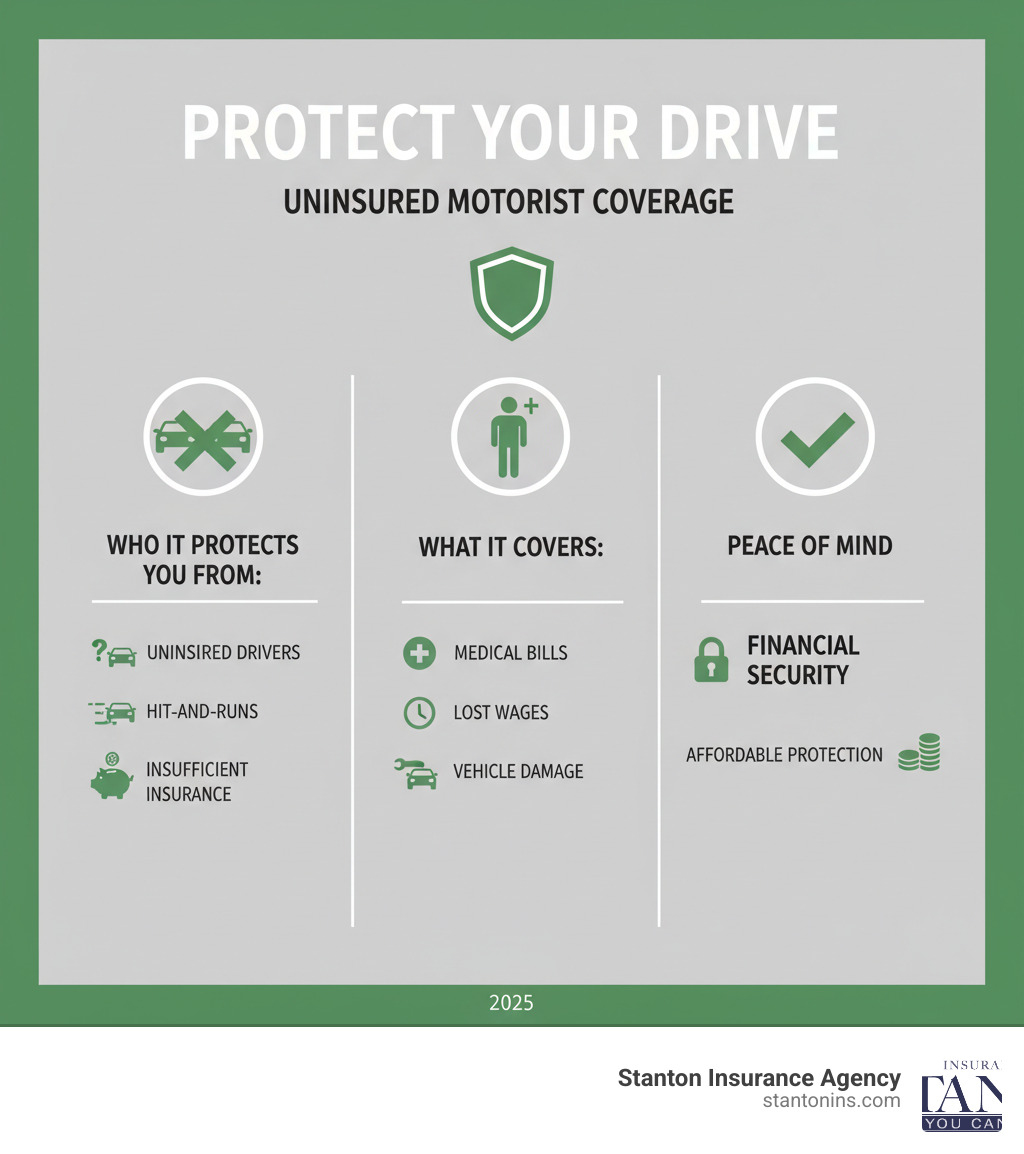
- Financial Protection: It shields you from the costs of an accident if the at-fault driver has no insurance or not enough insurance.
- Covers Injuries: It can pay for your medical bills, lost wages, and pain and suffering.
- Protects Your Car: It can cover damage to your vehicle.
- Covers Hit-and-Runs: It often applies in hit-and-run situations.
- Affordable Peace of Mind: It’s usually one of the most cost-effective parts of your policy.
It’s bad enough when you’re in a car wreck. But it can be much worse if the driver who caused the accident doesn’t have insurance or doesn’t have enough insurance. With about 6.2% of drivers in Massachusetts and 9.5% in New Hampshire on the road without liability insurance in 2022, you’re more likely than you think to encounter one.
I’m Geoff Stanton, President at Stanton Insurance. My two decades of experience in the insurance industry, particularly in helping individuals and families protect their cars and other valuables, gives me a deep understanding of why people ask should I get uninsured and how crucial this coverage truly is. I’ve seen how it can make all the difference for our clients after an accident.
What is Uninsured and Underinsured Motorist Coverage?
If you’re wondering should I get uninsured motorist coverage, you first need to understand what it actually does. These two types of protection—Uninsured Motorist and Underinsured Motorist coverage—are often bundled together on your policy, but they protect you from slightly different, yet equally risky, scenarios on the road.
Q: What is the difference between Uninsured and Underinsured Motorist coverage?
A: Think of these two coverages as your financial safety nets when other drivers let you down. They sound similar, and they work together, but each one addresses a distinct problem.
Uninsured Motorist (UM) coverage protects you, your passengers, and your vehicle when you’re in an accident caused by a driver who has absolutely no auto insurance. Picture this: you’re stopped at a red light, and someone plows into you from behind. You exchange information, only to find they have no insurance whatsoever. Without UM coverage, you’d be stuck paying for your own medical bills and vehicle repairs, even though the accident wasn’t your fault. This coverage also steps in during hit-and-run situations where the at-fault driver speeds away and can’t be identified. It’s your backup plan when the person who caused the accident is either untraceable or financially irresponsible.
Underinsured Motorist (UIM) coverage handles a different but equally frustrating situation. This kicks in when the at-fault driver does have insurance, but their liability limits are simply too low to cover all of your damages. Let’s say you’re seriously injured in an accident, and your medical bills, lost wages, and other expenses add up to $75,000. But the driver who hit you only carries the minimum state-required liability insurance—just $20,000 per person in Massachusetts or $25,000 per person in New Hampshire. That leaves you with a $50,000 gap. UIM coverage bridges that gap between their insufficient coverage and the total cost of your damages, up to your own policy limit. You shouldn’t have to suffer financially just because someone else decided to skimp on their insurance.
Both UM and UIM coverage typically include two components: Bodily Injury coverage, which pays for your medical expenses, lost wages, and pain and suffering, and Property Damage coverage, which handles repairs to your vehicle.
For a deeper dive into how these coverages work, we’ve put together a detailed guide on the Difference Between Uninsured and Underinsured. Understanding these protections is the first step in answering the question should I get uninsured motorist coverage—and the answer, as you’ll see, is almost always yes.
Why Is This Coverage So Important?
Understanding the “why” behind this coverage is truly key to answering the question, “should I get uninsured motorist coverage?” The simple reality is that while you can be the safest driver on the road, you can’t control the actions or insurance status of other drivers. We might drive defensively, follow all the rules, and keep our vehicles in top shape, but we can’t guarantee that everyone else will do the same. This coverage acts as your personal safety net, protecting you when others fail to be adequately insured.
This isn’t just about following rules; it’s about safeguarding your future from the unpredictable.

Q: What situations does Uninsured/Underinsured Motorist coverage protect against?
This coverage is truly your financial safety net in several common and costly scenarios, ensuring that an accident doesn’t turn into a financial disaster. It’s all about making sure you’re protected when others aren’t.
First up, let’s talk about accidents with uninsured drivers. Despite laws requiring insurance, a surprising number of people on the road don’t carry any. In fact, about 6.2% of drivers in Massachusetts and 9.5% in New Hampshire drove without liability insurance in 2022. That means the chances of you encountering one are higher than you might think! If an uninsured driver causes an accident that injures you or your passengers, or damages your vehicle, your UM coverage steps in to cover those medical expenses, lost wages, and even your car repairs. It’s a huge relief when the at-fault driver has no way to pay.
Then there are accidents with underinsured drivers. Imagine a situation where another driver causes a serious accident, but they only carry the minimum state-required insurance. That minimum coverage might only be a fraction of your extensive medical bills and repair costs. For instance, in Massachusetts, the minimum bodily injury coverage is $20,000 per person. If your injuries require $50,000 in medical care and lost wages, their policy would only cover $20,000. This is where your UIM coverage becomes a lifesaver; it would then pay the remaining $30,000 (up to your policy limits), ensuring you don’t bear that financial burden yourself. It effectively bridges the gap between their insufficient coverage and your real expenses.
Another crucial protection comes with hit-and-run accidents. This is where UM coverage truly shines for many. If you are the victim of a hit-and-run, and the at-fault driver cannot be identified, your UM coverage can step in to cover your bodily injuries. In states like Massachusetts and New Hampshire, this is a crucial component of your protection. Without UM, a vanishing driver could leave you with substantial medical bills and no recourse, which is a devastating situation we never want our clients to face.
Finally, your auto policy’s UM/UIM coverage isn’t just for when you’re in your car. It extends to protect you even as a pedestrian or cyclist. If you are hit by an uninsured or underinsured driver while walking, jogging, or biking, your auto policy’s UM/UIM coverage can still protect you. This broadens the umbrella of protection beyond just your vehicle, recognizing that you are still vulnerable to negligent drivers even outside your car.
Q: What happens if I don’t have Uninsured/Underinsured Motorist coverage?
Without this vital protection, you are left with very few good options, and often, significant financial vulnerability. If an uninsured driver causes an accident that injures you or damages your property, you might be forced to pursue legal action against them personally. However, someone driving without insurance is highly unlikely to have the assets to pay a judgment, making it difficult, if not impossible, to recover your losses. This often means you are forced to pay for medical bills, lost income, and car repairs entirely out of your own pocket.
Consider this: medical bills can escalate quickly and unexpectedly. An ambulance ride alone can average thousands of dollars, and that’s before any emergency room visits, surgeries, or ongoing therapy. Without UM/UIM, you could face staggering medical debt. It’s a gamble we simply don’t recommend taking with your financial future and peace of mind.
How Does UM/UIM Work With My Other Insurance?
A common point of confusion is how Uninsured Motorist coverage interacts with other policies you might already have, like health insurance or collision coverage. We hear this question all the time at Stanton Insurance Agency: “But I already have health insurance, so do I really need this?” or “My collision coverage will fix my car, right?” While those policies are certainly helpful, they leave critical gaps that UM/UIM is specifically designed to fill.
Think of it this way: your health insurance, collision coverage, and UM/UIM coverage are like different tools in a toolbox. Each has its own job, and you need all of them to be truly protected. One tool can’t do everything, and relying on just one leaves you vulnerable when things go wrong.
Q: Should I get uninsured motorist coverage if I have health and collision insurance?
A: Yes, absolutely. We understand why this question comes up so often. After all, you’re already paying for health insurance and collision coverage, so it seems like you should be covered, right? Unfortunately, that’s not quite how it works. While health and collision insurance provide important protection, they are not a complete substitute for UM/UIM coverage. Each policy has its own specific purpose and limitations.
Let’s start with health insurance. Your health insurance is wonderful for covering medical care, but it has some significant limitations when it comes to car accidents. First, there are those deductibles and copays that can add up quickly. If you have a $5,000 deductible, you’re paying that amount out of pocket before your health insurance even starts to help. Second, and this is crucial, health insurance generally does not cover lost wages if your injuries prevent you from working. If you’re out of work for weeks or months recovering from a serious accident, those lost paychecks can devastate your finances. Health insurance also won’t compensate you for pain and suffering, which can be substantial after a traumatic accident.
Here’s another important consideration: if your passengers are injured in the accident, your health insurance won’t cover their medical bills. They’d need to rely on their own health insurance, and if they don’t have any, you could be facing a lawsuit. UMBI/UIMBI coverage, on the other hand, typically has no deductible for bodily injury and covers all these crucial aspects—your lost income, your pain and suffering, and your passengers’ injuries.
Now let’s talk about collision coverage. This coverage is essential for getting your car repaired after an accident, regardless of who caused it. However, collision coverage has one big limitation: it only covers damage to your vehicle, not injuries to you or your passengers. Yes, it will pay to fix your car (after you pay your deductible), but it won’t help with a single medical bill, won’t replace your lost wages, and won’t address the physical and emotional pain you’re experiencing. If you’re asking should I get uninsured motorist coverage when you already have collision, collision fixes your car, but UM/UIM protects you.
UM/UIM coverage fills these significant gaps beautifully. It’s designed specifically to protect you and your loved ones from the financial fallout of an accident when the at-fault party can’t or won’t pay. It covers your injuries, your passengers’ injuries, your lost wages, your pain and suffering, and in many cases, your vehicle damage with a lower or no deductible.
Here’s a quick comparison to show you exactly how these coverages differ:
| Feature | Uninsured/Underinsured Motorist (UM/UIM) | Health Insurance | Collision Coverage |
|---|---|---|---|
| Covers Your Injuries | Yes | Yes (with deductibles/copays) | No |
| Covers Passenger Injuries | Yes | No (covers their own policy) | No |
| Covers Lost Wages | Yes | No | No |
| Covers Pain & Suffering | Yes | No | No |
| Covers Vehicle Damage | Yes (UMPD) | No | Yes (with deductible) |
| Deductible | Often low or none for bodily injury | Yes, often high | Yes |
As you can see from this comparison, UM/UIM offers a unique and comprehensive layer of protection that your other policies simply don’t provide. Each coverage has its own role, and they work together to create a complete safety net. For more detailed information about how these coverages interact, we have helpful resources on Uninsured Motorist Coverage vs Collision and the Difference Between Collision and Uninsured Motorist.
Many people assume that “full coverage” means they’re protected from everything, but that’s not always the case. “Full coverage” typically refers to having liability, collision, and comprehensive insurance. It doesn’t automatically include UM/UIM coverage, which is why we always recommend reviewing your policy carefully. If you’re wondering If I Have Full Coverage Do I Need Uninsured Motorist coverage, the answer is almost always yes. Without it, you’re leaving yourself exposed to serious financial risk, even if you think you’re fully covered.
How Much Coverage Do I Need and Is It Required?
Determining the right amount of coverage and understanding your state’s laws are the final steps in making an informed decision about whether you should I get uninsured motorist coverage. It’s not just about having some coverage, but having enough coverage to truly protect yourself and your family.

Q: How much Uninsured/Underinsured Motorist coverage do I need?
A: When it comes to determining the right amount of UM/UIM coverage, we at Stanton Insurance Agency generally recommend a straightforward approach that’s easy to remember: purchase UM/UIM limits that match your own bodily injury liability coverage limits. This creates a balanced protection plan that makes a lot of sense.
Here’s what we mean. If you carry $100,000 per person and $300,000 per accident in bodily injury liability coverage (often written as $100,000/$300,000), you should select the same limits for your UMBI/UIMBI coverage. Think about it this way: you’ve decided that $100,000/$300,000 is the appropriate level of protection for someone else if you cause an accident. Shouldn’t you have that same level of protection for yourself and your passengers when someone without insurance (or without enough insurance) causes an accident that injures you? It’s about treating yourself as well as you treat others!
For property damage coverage (UMPD/UIMPD), the calculation is a bit different but equally important. You should choose a limit that is high enough to cover the actual value of your vehicle. If your car is worth $30,000, having $30,000 in UMPD coverage means you’re protected against total loss if an uninsured driver wrecks your ride. We encourage you to assess your vehicle’s current market value and consider what it would realistically cost to repair or replace it after a serious accident.
There’s also another powerful option to consider: stacked coverage. If you have multiple vehicles on your policy, or even multiple policies, stacked UM/UIM coverage allows you to combine the UM/UIM limits to increase your overall protection. For example, if you have two cars, each with $100,000/$300,000 in UM coverage, stacking would give you $200,000/$600,000 in total protection. This can be a very effective way to boost your coverage without a massive increase in premium. Our article on the Difference Between Stacked and Unstacked Insurance provides more insight into how this works and whether it’s right for you.
Q: Is Uninsured/Underinsured Motorist coverage required in my state?
A: The requirements for UM/UIM coverage vary significantly from state to state, which is why it’s so important to understand the specific laws where you live and drive. Since we serve clients in Massachusetts and New Hampshire, let’s break down what the law requires in each state.
In Massachusetts, Uninsured Motorist (UM) coverage is not optional—it’s mandatory. Massachusetts law requires every driver to carry minimum limits of $20,000 per person and $40,000 per accident for bodily injury. This means if an uninsured driver injures you, your policy will cover up to $20,000 for your injuries, with a maximum of $40,000 for all injured parties in the accident. While Underinsured Motorist (UIM) coverage is technically optional in Massachusetts, we strongly recommend adding it to your policy. Given the potentially sky-high costs of medical care, lost wages, and ongoing treatment after a serious accident, UIM can be an invaluable asset that prevents financial devastation. You can learn more about protection in Massachusetts through this helpful resource.
In New Hampshire, the rules are a bit different because New Hampshire is unique—auto insurance itself is not mandatory for all drivers. However, here’s the important part: if you choose to buy auto insurance (which we absolutely recommend), your policy must include Uninsured Motorist coverage with minimum limits of $25,000 per person and $50,000 per accident for bodily injury. Underinsured Motorist (UIM) coverage is also typically included or offered as part of your policy. Even though insurance isn’t required by law, if you’re involved in an accident, you’re still financially responsible for any damages you cause. For those who opt for insurance, UM/UIM is a built-in safeguard that we believe is absolutely essential. You can discover the importance of NH coverage to understand why this protection matters so much in the Granite State.
Even if UM/UIM coverage isn’t legally required in your state—which it is, at least for UM, in both Massachusetts and New Hampshire—we believe it’s a serious financial risk to drive without it. When you consider that about 6.2% of drivers in Massachusetts and 9.5% in New Hampshire are on the road without any insurance at all, the odds of encountering an uninsured or underinsured driver are simply too high to ignore. The statistics alone make a compelling case for this added layer of protection, and the relatively low cost makes it one of the smartest insurance decisions you can make.
Frequently Asked Questions about Uninsured Motorist Coverage
We know that navigating insurance can sometimes feel a bit like trying to solve a puzzle with a few pieces missing! At Stanton Insurance Agency, we hear a lot of similar questions. So, to help clear things up and make sure you feel confident about your choices, here are some common concerns we address about UM/UIM coverage.
Is Uninsured Motorist coverage expensive?
Here’s some good news: When you look at the big picture, Uninsured Motorist (UM) and Underinsured Motorist (UIM) coverage is generally quite affordable! Think about the massive financial risk you face if you’re hit by a driver who has no insurance or not enough insurance. Compared to paying for serious medical bills or car repairs completely out of your own pocket, UM/UIM is one of the most valuable, budget-friendly parts of your auto insurance policy.
The exact cost does vary. Factors like where you live, the coverage limits you choose, and your driving history will play a role. However, it’s typically a small fraction of your total premium. It truly offers a lot of peace of mind for a modest investment – much less expensive than dealing with a major accident without it!
Does “full coverage” automatically include Uninsured Motorist coverage?
This is a really common misconception, and it’s an important one to clarify! The term “full coverage” is actually industry slang. It usually means you have a combination of liability, collision, and comprehensive coverage.
While Uninsured Motorist (UM) coverage is mandatory in some states (like Massachusetts and New Hampshire for UM bodily injury), in other places, it’s an optional add-on. This means you have to specifically select it to be included in your policy. So, even if you think you have “full coverage,” it’s absolutely crucial to take a closer look at your policy details. Or, even better, just give us a call at Stanton Insurance Agency! We can review your policy together to make sure you know exactly what protections you have. Don’t just assume you’re covered for every scenario! For more details, you might find our article If I Have Full Coverage Do I Need Uninsured Motorist helpful.
Should I get uninsured motorist property damage (UMPD) if I have collision coverage?
That’s an excellent question, and the answer often comes down to your personal situation and how you feel about deductibles. Let’s break it down!
Your collision coverage is fantastic because it pays for your car’s repairs no matter who is at fault in an accident, after you pay your deductible. UMPD (Uninsured Motorist Property Damage) also covers your car’s repairs if you’re hit by an uninsured driver.
The key difference often lies in that little word: deductible. UMPD frequently has a lower deductible than collision coverage. In some cases, it might even have no deductible at all for property damage! So, if you already have collision coverage, adding UMPD could still be a smart move. It might save you a significant amount on your deductible if an uninsured driver damages your car.
Now, if you don’t have collision coverage (perhaps your car is a bit older and you decided to save on premiums), then UMPD becomes absolutely essential. It’s an inexpensive way to get at least some protection for your vehicle against uninsured drivers. It’s a smart way to protect your ride without the higher cost of a full collision policy. You can learn more about these differences in our articles like Collision vs Comprehensive and What is the Difference Between Collision and Comprehensive Insurance Coverage?.
Secure Your Financial Future on the Road
After exploring all the ins and outs of Uninsured and Underinsured Motorist coverage, the question “should I get uninsured” starts to sound a little different, doesn’t it? Perhaps it’s better phrased as, “Can I truly afford not to be insured against the choices of other drivers?” When you consider that roughly 6.2% of drivers in Massachusetts and 9.5% in New Hampshire are on the road without any insurance at all, the risk is very real.
This isn’t just about statistics; it’s about your peace of mind and financial security. Given the high number of uninsured drivers and the surprisingly low cost of this vital protection, Uninsured and Underinsured Motorist coverage isn’t just a smart choice; it’s a genuine necessity for any responsible driver. It acts as a critical shield, carefully protecting your health, your vehicle, and your hard-earned financial well-being from the irresponsible choices of others.
At Stanton Insurance Agency, we believe every driver deserves to feel safe and protected on the road. Our team is dedicated to helping you steer the complexities of insurance and find the right protection custom to your specific needs. We’re here to review your current policy, discuss your unique situation, especially if you’re driving in Massachusetts or New Hampshire, and ensure you have the coverage that truly brings you peace of mind. We pride ourselves on making insurance simple, clear, and easy to understand.
Protect your journey. Get a comprehensive auto insurance quote today!