
Definition for liability insurance: Ultimate 101 Guide
Understanding the Essential Definition for Liability Insurance
Definition for liability insurance: Liability insurance is a type of coverage that protects you financially when you’re legally responsible for causing injury to another person or damage to their property. It pays for the other party’s medical bills, repair costs, and legal expenses—not your own.
Quick Answer:
- What it covers: Third-party injuries and property damage you cause.
- What it pays: Medical bills, repair costs, legal defense, and settlements.
- Who it protects: The injured party (not you directly).
- Where you need it: Auto insurance, homeowners insurance, and business insurance.
Imagine your dog bites a delivery person, or your washing machine floods a downstairs neighbor’s apartment. Without proper coverage, a single accident could wipe out your savings. The global liability insurance market is expected to reach $433 billion by 2031, reflecting a simple truth: liability insurance is essential protection in a world where accidents happen and lawsuits follow.
As Geoff Stanton, President of Stanton Insurance Agency, I’ve helped countless Massachusetts and New Hampshire residents understand the definition for liability insurance and find the right protection. My 25 years of experience as a Certified Insurance Counselor have shown me that the right coverage provides invaluable peace of mind.
Liability insurance is a financial safeguard against the fallout of being found legally responsible for harm to a third party. Often called “third-party insurance,” it’s unique because it pays the other person for costs associated with bodily injury, property damage, legal defense, and settlements.
The Fundamental Principles: Fault, Duty, and Proximate Cause
Understanding the definition for liability insurance requires knowing the legal principles that determine if you are responsible for damages:
- Fault: This determines who is to blame. If your negligent actions (or inactions) directly led to harm, you are at fault.
- Duty: We all have a legal duty of care to act in a way that doesn’t harm others. A property owner must keep their premises safe; a driver must operate their vehicle safely. Breaching this duty can lead to liability.
- Proximate Cause: This establishes a direct link between your actions and the damages. Your actions must be the direct cause or a significant contributing factor.
How Liability Insurance Works in a Claim
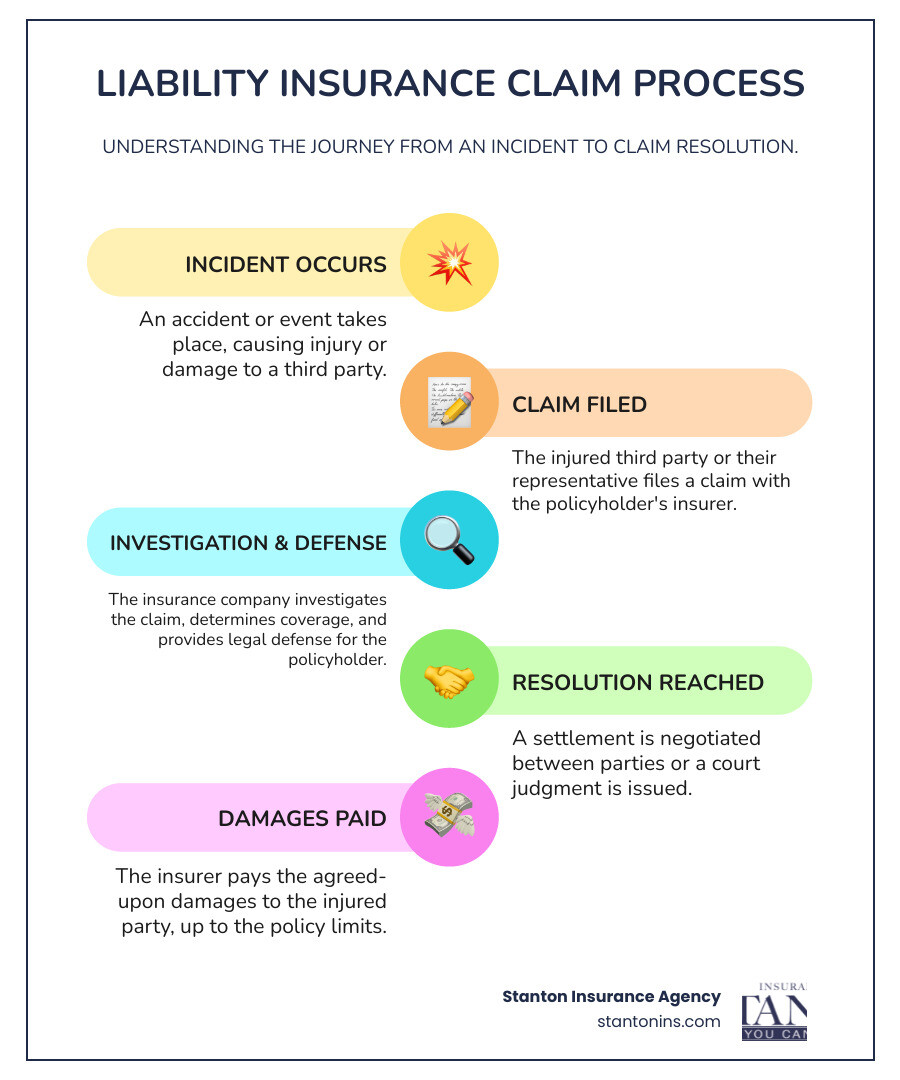
When an incident occurs, the claims process follows a clear path:

- Incident Occurs: Someone is injured or their property is damaged, and they believe you are responsible.
- Claim Filed by Third Party: The injured party files a claim against you seeking compensation.
- Insurer Investigates: After you notify your insurer, they investigate the incident to determine fault and coverage.
- Insurer Defends the Policyholder: If a lawsuit is filed, your insurer pays for legal counsel to represent you, covering legal fees.
- Settlement or Judgment Paid: If you are found legally responsible, your insurer pays the damages up to your policy’s limits, compensating the third party for their losses.
The Main Categories: Personal vs. Business Liability Insurance
Your daily life and your professional life carry different risks. That’s why the definition for liability insurance branches into two distinct paths: personal and business coverage. The core principle is the same—protecting you financially when you’re legally responsible for harm to others—but the application differs.
Personal liability insurance protects your personal assets (home, savings) from claims arising from non-business activities. In contrast, business liability insurance safeguards your company’s assets and operations from lawsuits emerging from commercial activities.
Here’s how they compare:
| Feature | Personal Liability Insurance | Business Liability Insurance |
|---|---|---|
| Who is covered | Individuals, family members | Business entity, employees, directors, officers |
| What is covered | Non-business activities, personal property, individual actions | Business operations, products/services, employees, professional actions |
| Common examples | Guest injuries at home, dog bites, car accidents, accidental damage to neighbor’s property | Customer slip-and-falls, product defects, professional errors, employee lawsuits, data breaches |
| Typical policy types | Homeowners, Renters, Auto, Personal Umbrella | General Liability, Professional Liability (E&O), D&O, Cyber Liability, Commercial Auto, Workers’ Comp, Commercial Umbrella |
Understanding Personal Liability Insurance
Most people have personal liability insurance, often without realizing it, as it’s typically bundled into other policies.
Your homeowners insurance includes personal liability coverage for incidents on your property. Similarly, renters insurance provides this protection. Your auto insurance includes liability coverage, which is legally required to drive in Massachusetts and necessary to meet financial responsibility laws in New Hampshire.

Personal liability insurance often covers you worldwide. If you accidentally cause injury while on vacation, your home insurance liability might still protect you. Common scenarios include guest injuries (a slip on an icy walkway), damage to others’ property (a baseball through a neighbor’s window), and dog bites. Understanding What is Personal Liability in Home Insurance? is key to grasping this crucial, and likely existing, protection.
Exploring Business Liability Insurance
The business world presents a different universe of risks. As a business owner, you are potentially liable for your employees, products, services, and professional advice. The financial stakes are much higher, and a single lawsuit can threaten your company’s survival.
Business Liability Insurance is essential for all businesses, protecting against lawsuits from daily operations, customer interactions, and products or services. It shields business assets from financial loss and helps mitigate the reputational harm that accompanies legal battles. In today’s litigious environment, robust liability coverage isn’t just smart—it’s often required by clients, landlords, and lenders.
A Deeper Dive into the Types of Liability Coverage
Comprehensive liability protection requires different tools for different jobs. While the core definition for liability insurance is consistent, specialized coverage addresses unique risks. Just as you wouldn’t use a hammer for a leaky pipe, you can’t rely on one policy for every potential liability. Modern insurance has evolved to meet these specific needs.

Let’s explore the main types of liability coverage: General Liability, Professional Liability, Directors and Officers, Cyber Liability, and Employer’s Liability.
General Liability Insurance (GLI)
Often called Public Liability Insurance, GLI is the Swiss Army knife of business insurance, handling the most common risks nearly every business faces. It’s the foundation upon which other policies are built.
- Bodily injury on premises: Covers claims if a customer slips on a wet floor or trips in your office.
- Customer property damage: Pays for damage your business operations cause to someone else’s property, like a delivery driver backing into a client’s fence.
- Advertising injury: Protects against claims of libel, slander, or copyright infringement in your marketing.
Professional Liability (Errors & Omissions or E&O)
If your business provides advice or services, E&O insurance is essential. While GLI covers physical accidents, E&O protects against financial harm your professional work might cause.
It covers claims arising from:
- Mistakes in services: An accountant’s tax error that costs a client penalties.
- Negligence: Failing to exercise the proper care expected in your profession.
- Misrepresentation: Providing incorrect information that leads to poor client decisions.
- Undelivered services: Failing to complete projects as promised.
This is crucial for consultants, realtors, IT professionals, and even fitness experts who need Personal Trainer Liability Insurance.
Directors and Officers (D&O) Insurance
Directors and Officers Liability Insurance protects the personal assets of a company’s leaders if they are sued for decisions made in their official capacity. It covers wrongful acts like breach of duty or mismanagement alleged in lawsuits from shareholders, employees, or regulators. These lawsuits can target personal assets, making D&O coverage critical for any business with a formal leadership structure.
Cyber Liability Insurance
Cyber threats are a fast-growing risk. What is Cyber Liability Insurance? This coverage is essential for handling the fallout from:
- Data breaches: Exposing sensitive customer information.
- Hacking and ransomware attacks: Crippling business operations.
- Associated costs: Including forensic investigations, legal counsel, notification costs, and credit monitoring services for affected individuals.
Cybercriminals often target small businesses with weaker security, making this coverage vital for companies of all sizes.
Employer’s Liability and Workers’ Compensation
If you have employees, these two coverages are essential and often mandatory. Workers’ Compensation pays for medical bills and lost wages for employee work-related injuries, regardless of fault. You can learn more from the Department of Labor about Workers Compensation.
Employer’s Liability Insurance protects your business if an employee sues for a work-related injury, claiming your negligence caused it. This covers situations outside the scope of the standard workers’ comp system. Understanding the Workers Compensation Insurance Importance is key to protecting both your employees and your business.
Advanced Concepts and Common Exclusions
When you dive deeper into the definition for liability insurance, the details matter. Understanding policy limits, endorsements, and exclusions can mean the difference between full protection and a costly surprise. Reading the fine print is essential for making informed decisions.
What is Umbrella Insurance? A Crucial Extra Layer
Imagine a massive umbrella that provides extra coverage over your existing auto, home, or business liability policies. That’s what Umbrella Insurance does.

This extra layer of liability protection kicks in when the limits of your primary policies are exhausted. It’s crucial for individuals and businesses with significant assets, as it safeguards your net worth from catastrophic claims. For example, if your auto liability limit is $300,000 but you cause an accident with $800,000 in damages, an umbrella policy would cover the remaining $500,000. Both personal and commercial umbrella policies are available, offering substantial protection at an affordable cost. Learn more about What is Umbrella Insurance? to see if it’s right for you.
Understanding Backdated Liability and Policy Types
For professional coverage, the timing of incidents and claims is critical.
- Occurrence policies cover incidents that happen during the policy period, regardless of when the claim is reported. This offers excellent long-term protection because coverage doesn’t end when the policy expires.
- Claims-made policies only cover claims that are first made and reported during the active policy period. Most Professional Liability (E&O) policies are written this way. If you let the policy lapse, you may not have coverage for past work.
This is where retroactive dates and tail coverage are important. A retroactive date sets how far back in time your policy covers past work. Tail coverage (an extended reporting period) lets you report claims for a set time after your policy ends, which is vital when retiring or changing insurers.
What is Not Covered? The Common Definition for Liability Insurance Exclusions
Liability insurance is robust, but it doesn’t cover everything. Understanding exclusions is critical to avoid gaps in your protection.
- Intentional harm and criminal acts: Insurance covers accidental negligence, not deliberate wrongdoing.
- Damage to your own property: Liability insurance pays for harm you cause to others. For example, Does Liability Insurance Cover My Car If I Hit Someone? The answer is no; it only covers the other person’s car.
- Your own injuries: Your liability policy won’t pay your medical bills if you’re at fault. You would need health insurance or other first-party coverage.
- Employee injuries: These are typically covered by Workers’ Compensation insurance, not a general liability policy.
- Contractual liability: If you sign a contract assuming another party’s liability, your standard policy may not cover it unless specifically endorsed.
Determining Your Liability Insurance Needs
After exploring the definition for liability insurance, the next question is: “How much do I need?” The answer depends on your unique situation. The global liability insurance market is projected to reach $433 billion by 2031, showing that more people and businesses recognize these risks are real and potentially devastating.
Do I Need Liability Insurance?
The short answer is almost certainly yes. Here’s why:
- Legal mandates: Auto liability insurance is legally required in Massachusetts and necessary to satisfy financial responsibility laws in New Hampshire. Massachusetts has specific minimum auto coverage requirements, and New Hampshire has its own auto insurance requirements.
- Contractual requirements: Mortgage lenders typically require liability coverage on your homeowners insurance. Landlords often require it in a lease, and business clients may demand it before signing a contract.
- Prudent financial planning: Most importantly, a single liability claim can wipe out years of savings. Adequate protection prevents a personal or business financial catastrophe.
How Much Coverage is Enough?
The right amount of coverage depends on what you have to protect and the risks you face.
A good rule of thumb is to have enough liability coverage to protect your net worth. If a claim exceeds your coverage, creditors can pursue your personal assets, including your home, savings, and future wages.
- Analyze your personal assets: Add up the value of your home, cars, savings, and investments. Also, consider your future earning potential.
- Evaluate business risks: Consider your industry, public contact, and the potential severity of an accident. A contractor faces different risks than a home-based consultant.
- Consider potential lawsuit costs: Legal defense alone can be expensive, even for baseless claims. High-risk professions like healthcare and financial services need more robust coverage.
For a specific look at your vehicle, understanding How Much Liability Insurance Do I Need for My Car? is an excellent starting point. The goal is to find the right balance of protection and affordability.
Frequently Asked Questions about Liability Insurance
Over my 25 years in insurance, I’ve heard the same questions from Massachusetts and New Hampshire residents. Here are the answers to the most common ones.
What are the main duties of a liability insurer?
Your insurer has three key duties when a claim is filed:
- The duty to defend: Your insurer must pay for legal counsel to represent you against any covered claim, even if the lawsuit is baseless. This covers legal fees, court costs, and investigation expenses.
- The duty to indemnify: This is the obligation to pay for damages if you are found legally responsible, up to your policy’s limits. This protects your assets from being seized to satisfy a judgment.
- The duty to settle: Your insurer must consider reasonable settlement offers to protect you from a potentially larger judgment at trial.
Does liability insurance cover my own car if I hit someone?
No. This is a common misconception. Liability insurance is strictly third-party coverage; it only pays for the other person’s injuries and property damage when you are at fault. To cover damage to your own vehicle, you need a separate Collision Insurance policy.
Can I get liability insurance for a single event?
Yes. Special event insurance, or one-day event insurance, is perfect for anyone hosting a gathering like a wedding, charity fundraiser, or business conference. This temporary policy protects you from claims of bodily injury (a guest slips and falls) or property damage (you damage a rented venue). It’s an affordable way to gain peace of mind for your special day.
Secure Your Future with the Right Protection
After exploring the definition for liability insurance, it’s clear this coverage is not optional—it’s your financial safety net. A moment of distraction or a simple mistake can lead to a claim that costs everything you’ve worked to build. Liability insurance is an absolute necessity for protecting your personal and professional life.
Understanding the definition for liability insurance shows how it creates a protective barrier around your assets. Whether it’s bodily injury coverage for a guest who falls at your home or professional liability insurance defending your business, each policy serves a vital purpose.
The true value of liability insurance is the peace of mind it provides. You can run your business, host events, and drive your car knowing that if the unexpected happens, you are protected.
Here in Massachusetts and New Hampshire, having the right liability coverage is essential. At Stanton Insurance Agency, we’ve spent over 25 years helping our neighbors make smart insurance decisions. We take the time to understand your unique needs to ensure you have the right protection.
Whether you need to secure your family’s future or protect your company with comprehensive business insurance, we are here to guide you. The best policy is the one that lets you sleep soundly at night, knowing you’re truly protected.
