
Non stacked uninsured motorist: Avoid 2025 Gaps
Why Non-Stacked Uninsured Motorist Coverage Matters
Non stacked uninsured motorist coverage is a type of auto insurance that provides a fixed coverage limit per vehicle, without combining limits from multiple vehicles on your policy. Here’s what you need to know:
- Coverage Limit: You get only the amount listed on your declarations page (e.g., $100,000 per person)
- No Combining: Even with multiple cars, limits don’t stack together
- Lower Cost: Typically cheaper than stacked coverage
- Key Exclusion: May not cover you in vehicles you own but aren’t specifically insured for UM under that policy
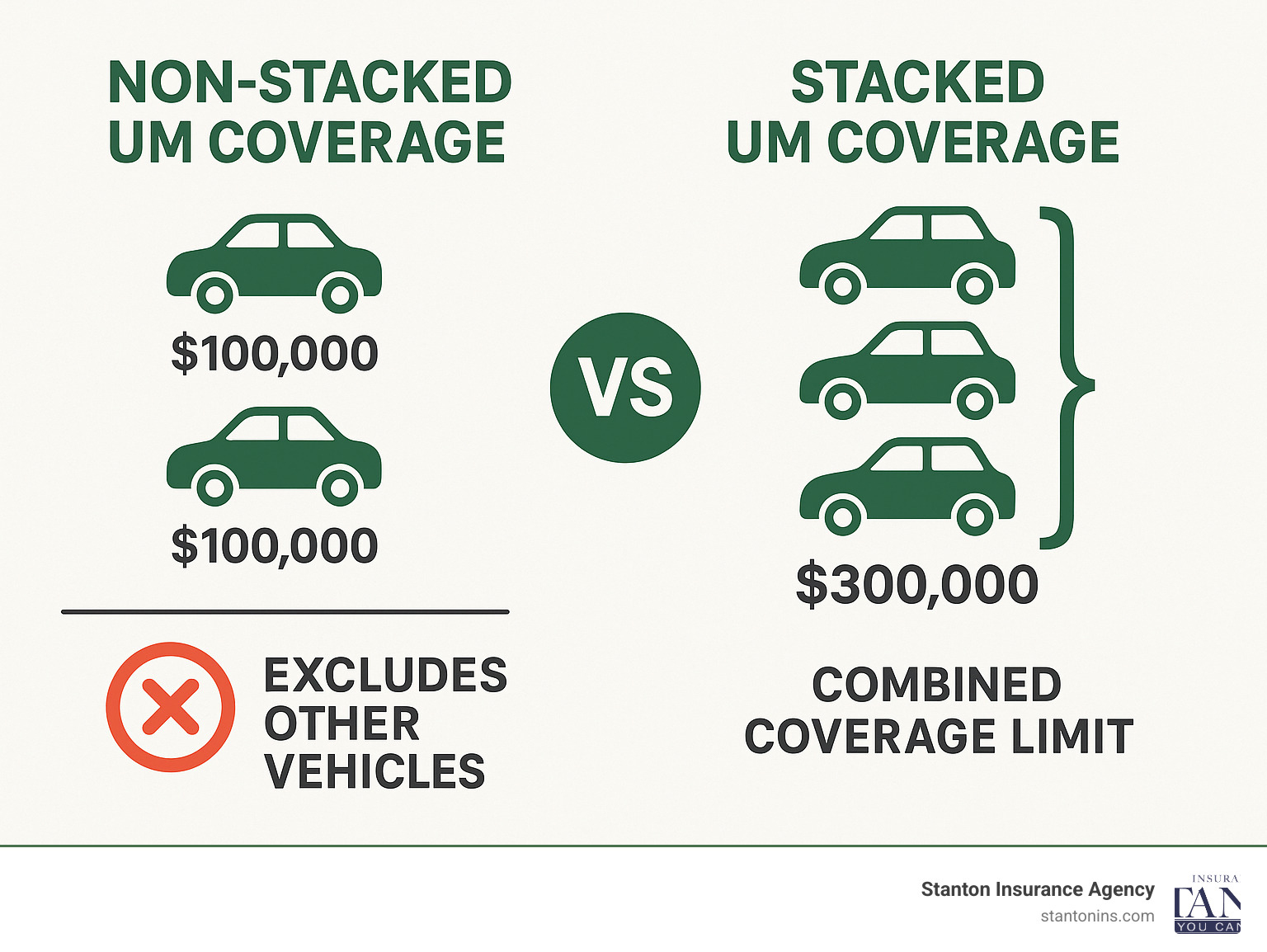
When you’re hit by an uninsured driver, this coverage pays for your medical bills, lost wages, and pain and suffering. The choice between stacked and non-stacked can mean the difference between having $100,000 in protection versus $300,000 if you own three vehicles.
Understanding this difference is crucial because the wrong choice could leave you financially exposed when you need coverage most. In Massachusetts, non-stacked is your only option since stacking isn’t permitted. In New Hampshire, you get to choose – making this decision even more important.
I’m Geoff Stanton, President of Stanton Insurance Agency, and I’ve spent over two decades helping families steer complex insurance decisions including non stacked uninsured motorist coverage choices. My experience in both claims and policy design gives me unique insight into how these coverage gaps can impact real families when accidents happen.
What is Non-Stacked Uninsured Motorist Coverage?
Picture this: you’re driving down the road when an uninsured driver crashes into you. Your non-stacked uninsured motorist coverage kicks in—but only up to the limit tied to that specific car you’re driving. That’s the essence of non-stacked UM coverage.
Non-stacked uninsured motorist coverage is a type of auto insurance that provides protection with a fixed dollar limit for each vehicle on your policy. Unlike its stacked counterpart, this coverage doesn’t allow you to combine limits from multiple vehicles. Think of it as having separate buckets of money for each car, rather than one big pool you can draw from.
The coverage limit you see on your policy’s declarations page is exactly what you get—no more, no less. If you have three cars insured with $50,000 in UM coverage each, you still only get $50,000 in protection, regardless of which vehicle you’re in when an accident happens.
This approach often comes with lower premiums, which makes it appealing to budget-conscious drivers. However, as we’ll see, those savings can come at a significant cost when you actually need the coverage.
How Non-Stacked UM Coverage Works
Non-stacked uninsured motorist coverage operates on a simple principle: one vehicle equals one coverage limit. When you’re injured by an uninsured driver, your insurance company will pay up to the coverage limit shown on your policy’s declarations page for that specific vehicle.
Here’s how it breaks down in practice. Your policy declarations page clearly states your chosen limits—perhaps $100,000 per person and $300,000 per accident. That’s your ceiling, and it’s tied directly to the vehicle you were occupying when the accident occurred.
The key characteristic that defines this coverage is its single vehicle focus. Even if you insure a fleet of family cars under one policy, there’s no combining of limits. Each vehicle stands alone with its individual UM coverage amount.
Let’s say you have that policy with $50,000 in non-stacked uninsured motorist coverage and you insure three cars. Whether you’re in the sedan, the SUV, or the pickup truck when an uninsured driver hits you, your maximum available coverage remains $50,000. It’s a straightforward “one car, one limit” arrangement that doesn’t change based on how many vehicles you own.
The Core Limitation of Non-Stacked Uninsured Motorist Coverage

Here’s where non-stacked uninsured motorist coverage can really bite you: many policies include a specific exclusion that can leave you high and dry when you least expect it.
This exclusion states that you cannot collect UM benefits if you’re injured while in a vehicle you own but haven’t specifically insured for UM coverage under that policy. It sounds like insurance jargon, but it has very real consequences.
Let’s make this concrete with an example. You have a car with non-stacked uninsured motorist coverage, but you also own a motorcycle that’s either on a separate policy or listed on your main policy without UM coverage (maybe you declined it to save money). If an uninsured driver hits you while you’re on that motorcycle, your car’s UM coverage won’t help you one bit.
The same situation could happen with a classic car you only drive on weekends, an RV for family trips, or even a work truck. If these vehicles don’t have their own UM coverage, your non-stacked uninsured motorist protection from other vehicles won’t step in to help.
This is a crucial difference from stacked coverage, which typically provides broader protection across all your vehicles. It’s one of those coverage gaps that can catch people completely off guard—and it’s exactly why we always encourage our clients at Stanton Insurance Agency to think carefully about all their vehicles and how they’re protected.
Stacked vs. Non-Stacked UM: A Head-to-Head Comparison
When you’re choosing between stacked and non-stacked uninsured motorist coverage, you’re essentially deciding how much financial protection you want after an accident with an uninsured driver. Think of it as choosing between a safety net with standard coverage or one that’s reinforced with extra layers of protection.
The appeal of non-stacked uninsured motorist coverage is clear—it typically costs less. But here’s where we always encourage our clients to pause and think: is saving on your premium today worth potentially facing thousands in uncovered expenses tomorrow? The answer depends entirely on your unique situation, including where you live, since state laws can dramatically affect your options.
Let’s break down the key differences so you can see exactly what each option offers:
Cost is where non-stacked coverage shines. Since insurers limit their risk to a single vehicle’s coverage amount, they can offer lower premiums. Stacked coverage costs more because it provides significantly broader protection, but many families find the extra peace of mind worth every penny.
Coverage limit calculation is where the rubber meets the road. With non-stacked uninsured motorist coverage, you get the limit listed for one vehicle—period. Even if you insure five cars, you’re still capped at that single vehicle’s limit. Stacked coverage, however, lets you combine limits from multiple vehicles, potentially doubling or tripling your protection.
Coverage scope reveals another crucial difference. Non-stacked coverage can leave you exposed if you’re injured in a vehicle you own but haven’t specifically insured for UM coverage under that policy. Stacked coverage typically offers much broader protection, often covering you even as a pedestrian or in vehicles not listed on your primary policy.
Who benefits most from each option? Non-stacked coverage works best for drivers with just one vehicle or those in states where stacking isn’t allowed. Stacked coverage is ideal for families with multiple vehicles or anyone who wants maximum protection against uninsured drivers.
Calculating Your Potential Payout
Here’s where the numbers tell the real story. Let’s say you have two cars on your policy, each with UM limits of $100,000 per person and $300,000 per accident—pretty standard coverage amounts.
If you’re injured by an uninsured driver while driving one of your cars, non-stacked uninsured motorist coverage gives you exactly what’s listed on your declarations page: $100,000 per person and $300,000 per accident. It doesn’t matter that you have two cars insured—you can’t tap into the second car’s limits to boost your protection.
With stacked coverage, those limits combine like building blocks. Your two vehicles would give you $200,000 per person and $600,000 per accident. If you had three cars with the same limits, you’d have $300,000 per person and $900,000 per accident. When medical bills from a serious accident can easily reach six figures, this difference becomes life-changing.
State Laws in Massachusetts and New Hampshire
Where you live makes all the difference in your coverage options. State laws don’t just influence your choices—they can eliminate them entirely.
In Massachusetts, the decision is made for you: stacking isn’t permitted. This means non-stacked uninsured motorist coverage is your only option. While this simplifies your choice, it also means you need to be extra thoughtful about your coverage limits. Since you can’t combine limits from multiple vehicles, consider purchasing the highest UM limits you can afford. Understanding What is the Minimum Car Insurance Coverage in Massachusetts? is just the starting point—many families benefit from going well beyond the minimums.
New Hampshire drivers have it better when it comes to flexibility. You can choose to stack your UM coverage, making this decision a critical part of customizing your New Hampshire Automobile Insurance. This choice can dramatically increase your protection against uninsured drivers, but it also puts the responsibility squarely on your shoulders to make an informed decision. New Hampshire is one of 32 states that allow some form of stacking, giving you real power to shape your coverage. Make sure you understand the Auto Insurance Requirements in New Hampshire as you weigh your options.
The bottom line? Your state’s laws set the playing field, but within those rules, the choice is yours to make.
Advantages and Disadvantages of Non-Stacked Coverage
Every insurance choice comes with trade-offs, and non-stacked uninsured motorist coverage is no exception. Think of it like choosing between a smaller, fuel-efficient car versus a larger SUV—each has its place, but the right choice depends on your specific needs and circumstances. The decision often boils down to weighing immediate savings against comprehensive protection down the road.
The Primary Advantage: Lower Premiums

Let’s be honest—most drivers who choose non-stacked uninsured motorist coverage do so for one simple reason: it costs less. And that’s perfectly understandable. When your insurance company only has to worry about paying out the coverage limit for a single vehicle, their risk is lower. Lower risk for them means lower premiums for you.
This budget-friendly approach makes sense for certain drivers. If you’re managing a tight budget or you genuinely own just one vehicle and rarely find yourself behind the wheel of other cars, non-stacked uninsured motorist coverage can provide basic protection without stretching your finances too thin. The insurance company’s exposure is limited to one vehicle’s liability limit, and those savings get passed along to you.
For a single-car household where money is tight, this option allows you to meet state requirements and maintain some protection against uninsured drivers without breaking the bank. It’s like having a safety net—just a smaller one.
The Disadvantages: Significant Coverage Gaps
Here’s where things get a bit more complex. While saving money on premiums feels good today, non-stacked uninsured motorist coverage can leave some pretty substantial gaps in your protection. These gaps might not seem important until you’re dealing with the aftermath of a serious accident, but by then it’s too late to change your coverage.
Serious accidents present the most obvious risk. Medical bills have a way of climbing faster than you’d expect, especially when you factor in emergency room visits, surgery, physical therapy, and lost wages while you recover. If your injuries from an uninsured driver accident exceed your single-vehicle limit, you’re on the hook for everything above that amount. What seemed like adequate coverage at $100,000 might not look so generous when you’re facing $200,000 in medical expenses and months of missed work.
Multiple vehicle owners face a particularly frustrating limitation. Imagine you own three cars, each with $100,000 in UM coverage. With non-stacked uninsured motorist coverage, you’re still only protected up to $100,000, even though you’re paying for coverage on three vehicles. It’s like buying three lottery tickets but only being allowed to claim winnings from one of them.
The owned but unlisted vehicles exclusion can be a real gotcha moment. Let’s say you have a motorcycle on a separate policy where you skipped UM coverage to save money, or maybe you own a classic car that only comes out on weekends. If an uninsured driver hits you while you’re on that bike or in that classic car, your non-stacked uninsured motorist coverage from your regular car insurance won’t help you. You’re essentially unprotected, despite paying for UM coverage elsewhere.
Newly acquired vehicles present another potential pitfall. Life moves fast, and sometimes you buy a car and don’t immediately call your insurance agent to add it to your policy. If you’re in an accident during that gap period, non-stacked coverage might leave you without protection when you need it most.
The reality is that while non-stacked uninsured motorist coverage offers upfront savings, it can create financial headaches later when you’re least prepared to handle them. We’ve seen too many families find these limitations at the worst possible time—after an accident has already happened.
How to Choose the Right UM Coverage for You
Making the right decision about your UM coverage requires a careful look at your personal situation, finances, and risk tolerance. It’s not just about finding the cheapest premium; it’s about ensuring you and your family are adequately protected against the unexpected. We’re here to help you steer this important choice.

Key Factors to Influence Your Decision
When considering whether non-stacked uninsured motorist coverage is right for you, we encourage you to think about these key factors:
- Risk Tolerance: How comfortable are you with assuming financial risk? If you prefer maximum protection and peace of mind, even for a slightly higher premium, stacked UM might be a better fit. If you’re willing to accept more risk to save money, non-stacked could be considered.
- Budget: While we always advocate for robust coverage, we understand that budget is a real concern. Non-stacked UM is undeniably less expensive. However, consider the potential cost of a serious accident without adequate coverage – it could far outweigh any premium savings.
- Number of Vehicles: This is one of the most significant factors. If you own multiple vehicles (cars, motorcycles, RVs) that are insured on the same policy or even separately, stacked UM offers a multiplier effect that can dramatically increase your available coverage. For a single-vehicle owner, the benefit of stacking is less about multiplying limits and more about the broader “portability” of coverage.
- Health Insurance: What kind of health insurance do you have? Does it have a high deductible? Will it cover extensive long-term care? While UM coverage is primarily for injuries, it can help cover medical bills that your health insurance might not fully address, especially if you have a high-deductible plan. Strong UM coverage can act as a crucial backup for medical expenses.
- State Laws: As we’ve discussed, state laws are paramount. If you’re in Massachusetts, non-stacked is your only option. If you’re in New Hampshire, you have the choice, and understanding that choice is key.
By considering these factors, you can make a more informed decision that aligns with your financial situation and your desire for protection.
How to Find Out if Your Policy is Stacked or Non-Stacked
We often get asked, “How do I even know what kind of UM coverage I have?” It’s a great question, and we’re here to help you figure it out. The easiest and most reliable way to know if your policy includes stacked or non-stacked uninsured motorist coverage is to check your auto insurance policy’s declarations page. This document, usually found at the beginning of your policy packet, clearly states your coverage types, limits, and whether your Uninsured/Underinsured Motorist coverage is explicitly listed as “Stacked” or “Non-Stacked.” Look for terms like “UM/UIM” followed by the word “stacked” or “non-stacked.”
In some states, especially those where stacking is the default unless rejected, you may have signed a specific form when you purchased your policy to formally reject stacked coverage. If you’re unsure after reviewing your declarations page, or if you simply prefer a direct answer, the best course of action is always to contact your insurance agent. We can quickly look up your policy details and explain exactly what kind of UM coverage you have and what it means for you. We believe in clarity and want to ensure you fully understand your protection.
Frequently Asked Questions about Non-Stacked UM
We know that understanding insurance can sometimes feel like trying to solve a puzzle with half the pieces missing. Over the years, we’ve heard countless questions from our clients about non-stacked uninsured motorist coverage, and we’ve noticed the same concerns come up again and again. Let’s tackle the most common ones to help clear up any confusion.
Is non-stacked UM coverage ever a good idea?
Absolutely, non-stacked uninsured motorist coverage can be a smart choice in certain situations. The key is understanding when it makes sense for your specific circumstances.
For drivers with only one vehicle, particularly in Massachusetts where stacking isn’t even an option, non-stacked uninsured motorist coverage is simply the standard form of UM protection available. In this case, your focus should shift to selecting the highest coverage limit you can comfortably afford rather than worrying about stacking options that don’t exist.
In New Hampshire, where you do have a choice, non-stacked coverage can be a budget-conscious decision for single-vehicle owners who want UM protection but need to keep premiums manageable. However, even in these scenarios, we always encourage our clients to choose the highest coverage limit possible within their budget. While non-stacked coverage might save you money upfront, being underinsured in a serious accident can cost you far more in the long run.
The bottom line? If you’re comfortable with the coverage limits and understand the potential gaps, non-stacked uninsured motorist coverage can provide valuable protection at a lower cost.
Does non-stacked UM cover me as a pedestrian?
Yes, and this is one of the great features of both stacked and non-stacked uninsured motorist coverage. If you’re hit by an uninsured or underinsured driver while walking, jogging, or cycling, your UM coverage will typically step in to protect you, up to your policy limits.
This protection exists because UM coverage is designed to follow the insured person, not just the vehicle. It’s portable coverage that stays with you even when you’re not behind the wheel. Many people assume their auto insurance only works when they’re actually in their car, but that’s not the case with UM coverage.
Whether you have stacked or non-stacked uninsured motorist coverage, you’ll have this same pedestrian protection. The difference lies in the coverage limits available to you, not in the scope of when the coverage applies.
Can I change my policy from non-stacked to stacked?
If you live in New Hampshire, where stacking is permitted, you can typically switch from non-stacked uninsured motorist coverage to stacked coverage at any time. You don’t have to wait for your policy renewal period to make this important change.
Making the switch is straightforward. Simply contact us at Stanton Insurance Agency, and we can help you adjust your policy. We’ll walk you through exactly how the change will affect your coverage limits and explain any premium adjustments upfront, so there are no surprises.
That switching to stacked coverage will likely increase your premium since you’re opting for broader protection with potentially much higher coverage limits. We believe in complete transparency about costs, so we’ll make sure you understand exactly what you’re paying for and why it might be worth the extra investment.
For our Massachusetts clients, unfortunately, this change isn’t possible since state law doesn’t permit stacking. In that case, we focus on helping you optimize your non-stacked uninsured motorist coverage limits to provide the best protection possible within the state’s framework.
Get the Right Protection for Your Needs
Choosing between non-stacked uninsured motorist and stacked uninsured motorist coverage is one of those insurance decisions that can significantly impact your family’s financial security down the road. It’s a classic case of weighing immediate savings against long-term protection, and honestly, there’s no one-size-fits-all answer.
Non-stacked uninsured motorist coverage does offer the appeal of lower premiums, which can be attractive when you’re trying to balance your monthly budget. But as we’ve explored throughout this guide, those savings come with real limitations and potential coverage gaps that could leave you vulnerable when you need protection most. This is especially true for families with multiple vehicles, or anyone who owns motorcycles, classic cars, or other vehicles that might be insured separately.
On the flip side, stacked UM coverage typically costs more upfront, but it provides a much broader safety net. Think of it as buying peace of mind. When you’re dealing with serious injuries, mounting medical bills, and lost wages after an accident with an uninsured driver, having that extra coverage can mean the difference between financial recovery and financial disaster.
The reality is that non-stacked uninsured motorist coverage works best for specific situations: single-vehicle households, drivers in Massachusetts where stacking isn’t allowed, or those who truly understand the limitations and are comfortable with the risk. For everyone else, the additional protection of stacked coverage often proves worth the extra premium.
Understanding these differences puts you in the driver’s seat when it comes to making informed decisions about your insurance protection. We’ve seen too many families struggle with inadequate coverage after serious accidents, and our goal is to help you avoid that situation entirely.
If you’re feeling uncertain about which option makes the most sense for your specific situation, or if you’d like us to review your current policy to see exactly what protection you have right now, we’re here to help. The team at Stanton Insurance Agency has been helping families steer these important decisions for decades, and we’d be happy to walk through your options with you.
Contact us today for a personalized car insurance quote that’s custom to your needs and budget. We’re committed to helping you find the right balance of protection and affordability, so you can drive with confidence knowing you’re properly covered.
