
Commercial Vehicle Insurance: 10 Best Powerful Picks 2025
Understanding Commercial Vehicle Insurance: Protection for Your Business on Wheels
Commercial vehicle insurance is specialized coverage designed for vehicles used in business operations. Unlike personal auto policies, it offers higher liability limits and broader protection for business-related risks.
Key Information About Commercial Vehicle Insurance:
| Coverage Type | Description | Typically Required? |
|---|---|---|
| Liability | Covers damage you cause to others | Yes (by law in most states) |
| Physical Damage | Covers your vehicle (collision & comprehensive) | Optional but recommended |
| Medical Payments | Covers injuries regardless of fault | Optional |
| Uninsured Motorist | Protection if hit by uninsured driver | Required in some states |
Most businesses need commercial vehicle insurance if they:
- Own vehicles titled to the business
- Transport goods or people for a fee
- Have employees driving for business purposes
- Haul equipment or tools between job sites
- Operate a fleet of any size
The average cost for commercial auto insurance is approximately $574 per month or $6,884 annually, though prices vary significantly based on vehicle type, business industry, driving records, and coverage limits.
For reliable protection, industry experts recommend carrying at least $500,000 in liability coverage per vehicle, with many businesses opting for $1 million limits for adequate protection against today’s high medical costs and potential litigation.
I’m Geoff Stanton, President of Stanton Insurance Agency and a Certified Insurance Counselor who has specialized in commercial vehicle insurance since 1999, helping businesses across Massachusetts find the right coverage to protect their mobile assets. As a fourth-generation insurance professional, I’ve seen how proper commercial vehicle insurance can mean the difference between a minor setback and a business-ending catastrophe.

Commercial vehicle insurance glossary:
Why Commercial Vehicle Insurance Is Non-Negotiable
Let’s face it—if your business has wheels, you need proper protection. Commercial vehicle insurance isn’t just another expense to consider—it’s an absolute necessity for any business that puts vehicles on the road. Most states require commercial vehicles to carry insurance minimums that go well beyond what’s needed for personal vehicles. And if your business crosses state lines? The Federal Motor Carrier Safety Administration (FMCSA) has even stricter requirements you’ll need to meet.
Driving without proper commercial vehicle insurance can lead to consequences that could devastate your business. We’ve seen it happen—substantial fines that drain cash reserves, suspended business licenses that halt operations entirely, and business owners suddenly facing personal liability for accidents. Some business owners even face criminal charges depending on the jurisdiction.
The financial shield that commercial vehicle insurance provides is just as important as meeting legal requirements. Think about it—a single accident without proper coverage could mean paying enormous out-of-pocket expenses, dealing with extended downtime that kills your cash flow, watching your hard-earned reputation crumble, and in worst-case scenarios, facing bankruptcy from claims you can’t afford to pay.

Commercial Vehicle Insurance vs Personal Auto — Key Differences
One of the most common misconceptions we hear at Stanton Insurance Agency is that personal auto policies cover business use. This misunderstanding can be incredibly costly. Commercial vehicle insurance is fundamentally different from your personal coverage in several important ways.
For starters, the liability limits are substantially higher—while your personal policy might top out at $100,000/$300,000, commercial policies typically offer $500,000 to $1 million or more in protection. This matters because business accidents often involve more complex and costly claims.
The coverage scope is also much broader with commercial policies, addressing business-specific scenarios that personal policies explicitly exclude. Your rates will be calculated differently too, taking into account your business type, how your vehicles are used, and who’s behind the wheel.
Personal policies almost always contain deal-breaking exclusions for business activities like delivering goods, transporting people for payment, or carrying business equipment. As one of our insurance experts often tells clients, “Your personal auto policy was never designed to handle business risks—it’s like trying to use a rowboat to cross the ocean.”
Another crucial difference is legal defense coverage. Commercial policies typically include more robust protection when you need to fight a claim in court—something that happens more frequently with business vehicles.
Who Needs Commercial Vehicle Insurance?
If you’re wondering whether your business needs commercial vehicle insurance, the answer is probably yes. Contractors and tradespeople who transport tools and equipment between job sites absolutely need this coverage—that includes electricians, plumbers, landscapers, and similar professions.
Retailers who deliver products to customers—whether you’re a local florist, a restaurant offering delivery, or an e-commerce business with your own delivery vehicles—you need commercial coverage to protect both your vehicle and your business.
Transportation services of all kinds require specialized coverage too. This includes traditional taxi services and limousine companies, but also extends to independent rideshare drivers (though some may qualify for specialized rideshare insurance depending on circumstances).
Even nonprofit organizations aren’t exempt. Churches, charities, and community groups with vans or buses for member transportation need proper commercial coverage to protect their mission and assets.
Service-based businesses where employees drive to client locations—like cleaning services or home healthcare providers—and sales representatives visiting clients need this protection as well.
Here’s a simple rule of thumb we share with our clients across Massachusetts, New Hampshire, and Maine: if your vehicle is essential to how your business makes money, you need commercial vehicle insurance. Even occasional business use of a personal vehicle might require commercial coverage—it’s always better to check than to find you’re unprotected after an accident.
Coverage Building Blocks & Smart Add-Ons
Building the right commercial vehicle insurance policy is a bit like assembling a protective shield for your business on wheels. You need strong core components, but you might also want some extra features that match your specific needs.
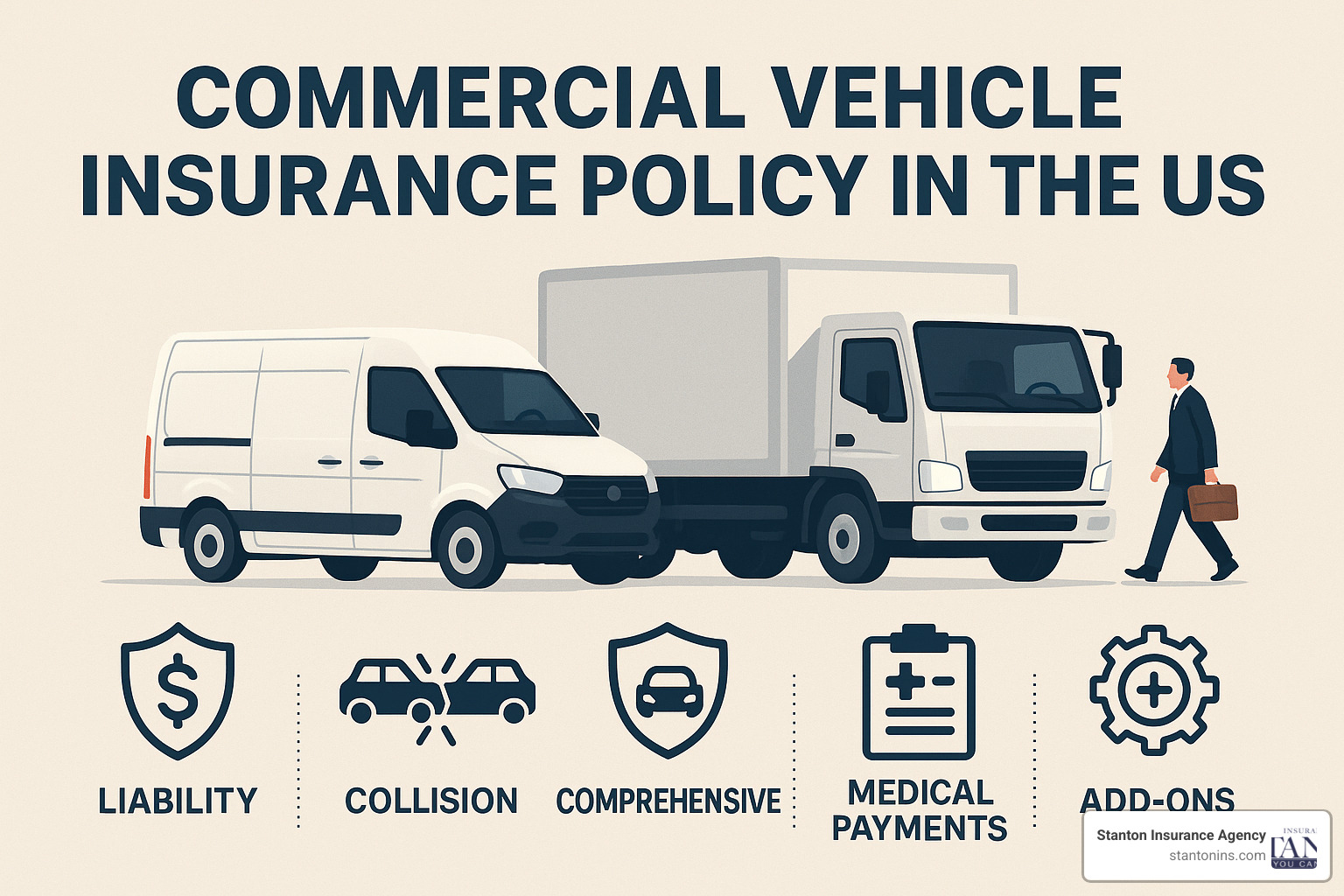
Core Protections Every Policy Should Include
When we sit down with clients at Stanton Insurance Agency, we always start by explaining the foundation pieces. Liability coverage is the absolute must-have—it’s the backbone of your protection plan. This includes bodily injury liability that covers medical costs if someone else gets hurt in an accident where you’re at fault, and property damage liability that pays for repairs to other people’s vehicles or property.
Don’t overlook the value of legal defense coverage either. If you’re sued after an accident, this pays for your attorney fees and court costs—which can add up quickly. While state minimums exist, they rarely provide enough protection. We typically recommend at least $500,000 in liability coverage, with $1 million being ideal for most businesses we work with.
Your vehicles deserve protection too. That’s where physical damage coverage comes in, with collision paying for repairs after accidents regardless of who’s at fault, and comprehensive covering those other unfortunate events like theft, vandalism, or that deer that jumped out of nowhere.
What happens when someone hits your delivery van but doesn’t have insurance? That’s when uninsured/underinsured motorist coverage saves the day. And for taking care of immediate medical needs after an accident, medical payments or personal injury protection (which is actually required by law here in Massachusetts) steps in to help.
Optional Improvements Worth Considering
Beyond the basics, there are some smart add-ons that might be worth every penny for your business.
Do your employees sometimes use their own cars for deliveries or client visits? Hired and non-owned auto coverage extends your protection to vehicles your business rents or borrows, as well as employees’ personal vehicles used for business purposes.
Business continuity matters too. Rental reimbursement keeps you moving when your vehicle is in the shop after a covered claim. For financed or leased vehicles, gap coverage protects you from owing money on a loan for a vehicle that’s been totaled.
Those expensive tools in your work truck? Standard commercial vehicle insurance doesn’t typically cover them, but a tools and equipment endorsement will. And for those roadside emergencies that can derail your day, roadside assistance coverage is a small investment that pays big dividends when you need a tow or jump-start.
Many of our clients are taking advantage of telematics-based discounts by installing devices that monitor driving habits. Not only can this lower premiums, but it often leads to safer driving overall. And as vehicles become more high-tech, cyber endorsements are emerging as important protections against vehicle system hacking.
| Coverage Type | Core or Optional? | Typical Cost Impact | Business Benefit |
|---|---|---|---|
| Liability | Core | High | Legal compliance, asset protection |
| Physical Damage | Core | Medium | Vehicle replacement/repair |
| UM/UIM | Core | Low-Medium | Protection from uninsured drivers |
| Medical Payments/PIP | Core in some states | Low | Immediate medical expense coverage |
| Hired/Non-Owned | Optional | Low | Extended liability protection |
| Rental Reimbursement | Optional | Very Low | Business continuity |
| Gap Coverage | Optional | Very Low | Financial protection for financed vehicles |
| Tools Coverage | Optional | Low-Medium | Protection for business equipment |
At Stanton Insurance Agency, we love sitting down with business owners across Massachusetts, New Hampshire, and Maine to build protection packages that make sense for their unique operations. The right coverage doesn’t just protect your vehicles—it protects everything you’ve worked so hard to build.
Best Ways to Buy Commercial Vehicle Insurance in 2024
Purchasing the right commercial vehicle insurance isn’t just about finding the lowest price—it’s about finding the right protection that fits your business like a well-custom suit. In today’s market, you have several paths to securing that perfect coverage. Let’s explore the options that make the most sense for businesses in 2024.
Work With a Local Independent Agent
There’s something reassuring about sitting across from someone who truly understands your business needs. At Stanton Insurance Agency, we’ve seen how this personal approach makes a difference for our clients across Massachusetts, New Hampshire, and Maine.
A local independent agent brings several advantages to the table. They understand the unique challenges businesses face in your community—whether it’s navigating the hazards of New England winter driving or meeting specific state insurance requirements that might be overlooked by national providers.
What truly sets local agents apart is their ability to listen. When you describe your business operations, a good agent translates that information into coverage recommendations custom specifically to your risks. No cookie-cutter policies here!
Since independent agents like us represent multiple insurance carriers, we can shop around on your behalf. This means you get the benefit of comparison shopping without the headache of filling out multiple applications or making numerous phone calls.
Perhaps most valuable is having an advocate in your corner when claims happen. Your local agent can help steer the claims process, explain your options, and often help secure more favorable outcomes. As your business grows and changes, they’ll be there to ensure your coverage evolves accordingly.

Digital-First Platforms & Instant Quotes
While the personal touch remains invaluable, technology has opened new doors for purchasing commercial vehicle insurance. Many business owners appreciate the convenience of digital solutions that complement the traditional approach.
Today’s online platforms offer remarkable accessibility—you can request quotes, make policy changes, or access important documents at midnight if that’s when you finally have time to tackle insurance matters. No need to wait for business hours!
Digital documentation has been a game-changer for fleet managers who need to provide proof of insurance to drivers quickly. With electronic ID cards and policies, everything is just a few clicks away when you need it.
Behind the scenes, sophisticated AI-powered systems are analyzing your business data and driving history to generate customized quotes with impressive speed and accuracy. These systems can often identify discount opportunities that might otherwise be missed.
Some business owners enjoy using online comparison tools to get a broad overview of available options. While these tools provide a helpful starting point, they typically lack the nuanced understanding that comes from a conversation with a knowledgeable agent.
At Stanton Insurance Agency, we believe in offering the best of both worlds. Our clients enjoy the convenience of requesting quotes online and accessing policy documents through our secure customer portal, while still benefiting from the personalized advice and relationship that only a local agent can provide.
For more information about our approach to commercial vehicle insurance and how we can help protect your business vehicles, visit our Commercial Auto Insurance page.
What Drives Premiums & How to Control Costs
Ever wonder why your commercial vehicle insurance costs what it does? Understanding what influences your premiums is like having a roadmap to potential savings. While some factors might be out of your hands, many can be managed with a bit of strategy and foresight.
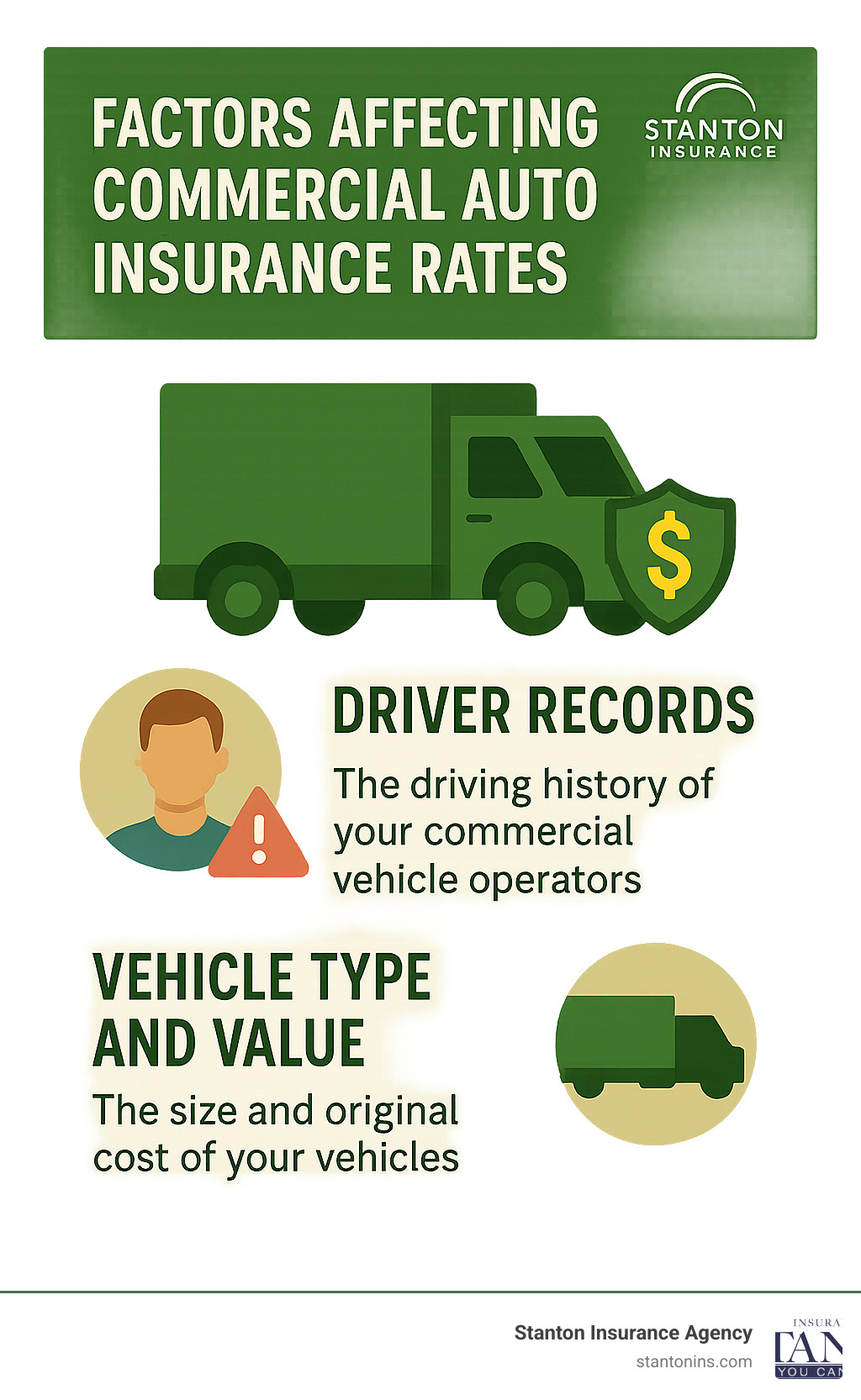
Pricing Factors You Can’t Ignore
Your drivers’ records are perhaps the single biggest influence on your premiums. Those speeding tickets and fender benders? They follow you and can dramatically bump up your rates. Think of your drivers as ambassadors of your insurance costs—their habits behind the wheel directly impact your bottom line.
The vehicles themselves matter too. That shiny new delivery truck with its higher gross vehicle weight (GVW) will typically cost more to insure than a standard pickup. It’s simple math—bigger, more expensive vehicles generally mean bigger premiums.
Where you park your fleet overnight plays a surprising role too. Vehicles garaged in busy urban areas with higher crime rates will cost more to insure than those tucked away in quiet suburban or rural locations. Your ZIP code carries more weight than you might think!
What you’re hauling makes a difference as well. Transporting hazardous materials or high-value cargo increases your risk profile substantially. The same goes for how you use your vehicles—a delivery service making 30 stops daily presents different risks than vehicles used for occasional client visits.
Your coverage choices naturally affect your costs too. Higher liability limits offer better protection but come with higher premiums, while your deductible choice works in the opposite direction—higher deductibles mean lower premiums (but more out-of-pocket expense when claims happen).
As one insurance expert noted in a recent article about factors affecting commercial auto insurance costs, “Your claims history is essentially your insurance report card—and insurers take it very seriously when calculating your premiums.”
Money-Saving Tips That Really Work
Here at Stanton Insurance Agency, we’ve helped countless businesses across Massachusetts, New Hampshire, and Maine trim their insurance costs without sacrificing protection. Let me share some strategies that actually work:
Bundle your policies for significant savings. When you combine your commercial vehicle insurance with other business coverages like general liability or property insurance, you’ll often open up discounts of 10-15%. It’s one of the easiest ways to save.
Strategic deductible adjustments can make a meaningful difference. Raising your deductible from $500 to $1,000 might save you 10-15% on your premium. Just be certain you have the cash reserves to cover that higher deductible if you need to file a claim.
Driver training programs deliver double benefits—they create safer drivers and can lead to insurance discounts. Many of our clients have seen premium reductions after implementing formal safety training.
Telematics technology has revolutionized fleet management and insurance pricing. These small devices monitor driving behaviors like speed, braking patterns, and acceleration. Not only can they qualify you for discounts, but they also encourage safer driving habits among your team.
Regular policy reviews are essential as your business evolves. We recommend sitting down with your agent annually to make sure your coverage still matches your needs. You might find you’re over-insured in some areas or have vehicles that could be moved to a less expensive coverage option.
Maintaining strong credit might seem unrelated to vehicle insurance, but in many states, business credit scores influence insurance rates. Healthy business credit can translate to healthier premium rates.
For seasonal businesses or vehicles with limited use, usage-based insurance options might offer substantial savings. Why pay full premiums for vehicles that spend significant time parked?
While it’s tempting to shop purely on price, focus on value rather than just the lowest premium. The cheapest policy often contains coverage gaps that could prove devastatingly expensive down the road. As we like to tell our clients: good insurance doesn’t have to be expensive, but cheap insurance can cost you everything.
At Stanton Insurance Agency, we’re committed to helping you find that sweet spot—comprehensive protection at a price that makes sense for your business. Our experience shows that thoughtful risk management almost always leads to lower insurance costs over time.
Claims 101 & Reputation Protection
Even with the best commercial vehicle insurance and safety practices, accidents happen. The way you handle these unexpected events can make or break both your finances and your company’s reputation in the community.
Step-by-Step Claim Process
When one of your commercial vehicles is involved in an accident, knowing exactly what to do helps everything go more smoothly:
First, document everything at the scene. Make sure everyone’s safe and call emergency services if needed. Exchange information with other drivers, snap plenty of photos of all vehicles and damage, collect contact details from witnesses, and note important details like time, weather conditions, and exactly what happened.
Next, report your claim promptly. At Stanton Insurance Agency, we always recommend filing your First Notice of Loss (FNOL) within 24 hours. You can typically do this by phone, through an online portal, via a mobile app, or by contacting your agent directly – whichever works best for you in that moment.
Once reported, an adjuster will investigate your claim thoroughly. They’ll review all the details, inspect the damage, talk to everyone involved including witnesses, analyze police reports, and determine exactly what your policy covers in this situation.
If your vehicle needs repairs, you’ll enter the repair process. You can often choose from recommended repair shops or select your own trusted mechanic. Take time to review the repair estimate, understand your rental vehicle coverage while your commercial vehicle is in the shop, and stay informed about repair progress.
Finally, you’ll reach the settlement phase. This includes payment for covered repairs (minus your deductible), resolution of any claims from other parties, potential recovery from at-fault parties through subrogation, and ultimately, claim closure.

Protecting Your Brand on the Road
Your commercial vehicles aren’t just transportation – they’re rolling billboards for your business. How you handle accidents and claims leaves a lasting impression on everyone who sees your vehicles or hears about incidents.
Quick repairs and vehicle appearance matter tremendously. A damaged truck or van with your company logo creates negative impressions with every mile driven. Prioritize getting repairs done promptly and keeping your fleet looking professional. Your customers notice these details, and they form opinions about your business based on them.
For serious accidents, having a media response strategy is essential. When reporters call (and they often do for accidents involving commercial vehicles), responding with consistency, transparency, and genuine compassion helps protect your reputation during difficult times.
Use accidents as learning opportunities through driver training and coaching. By regularly reviewing incident data, you can spot trends and provide targeted training to prevent similar accidents in the future. As the saying goes, “A smart person learns from their mistakes, but a wise person learns from the mistakes of others.”
When accidents affect your ability to serve customers, proactive communication makes all the difference. Reaching out to affected clients before they have to call you demonstrates professionalism and respect for their time.
Finally, show your community responsibility through safety initiatives and community involvement. This positions your business as one that cares about more than just profits – you care about the wellbeing of the community you serve.
At Stanton Insurance Agency, we go beyond simply processing claims. We help our clients throughout Massachusetts, New Hampshire, and Maine develop comprehensive accident response strategies that protect both their assets and their reputation. Our claims advocacy ensures your business interests are represented every step of the way.
Every interaction following an accident is an opportunity to demonstrate your company’s values and professionalism. The right response, backed by solid commercial vehicle insurance, can turn a potentially negative situation into a demonstration of your commitment to responsibility and exceptional customer service.
For more information about keeping your drivers focused and safe, check out Fleet Owner’s guide to keeping drivers focused in an increasingly distracting world.
Frequently Asked Questions about Commercial Vehicle Insurance
How much does commercial vehicle insurance cost on average?
Let’s talk about everyone’s first question – the cost. The average commercial vehicle insurance runs about $574 monthly or $6,884 yearly. But here’s the thing – your actual cost could be quite different based on your specific situation.
Think of it like buying a suit – the price depends on what you need. A delivery company with multiple trucks will pay more than a consultant who occasionally visits clients. Your industry’s risk profile plays a huge role in what you’ll pay.
The coverage limits you choose directly impact your premium too. While state minimums vary, we typically recommend at least $500,000 in liability protection for most businesses. It might seem like a lot, but in today’s world of expensive medical bills and litigation, it’s often the minimum needed for proper protection.
Your location matters too – urban areas generally come with higher premiums than rural areas due to increased traffic density and theft risks. And of course, the type and value of your vehicles significantly affect your rates.
From our experience helping businesses across Massachusetts, New Hampshire, and Maine, we’ve found that about 44% of small businesses pay under $1,500 annually, 34% pay between $1,500-$3,000, and 22% pay over $3,000. At Stanton Insurance Agency, we help find competitive rates by comparing options from multiple carriers and identifying discounts you might not know about.
Are tools or goods inside the vehicle covered by the auto policy?
This is perhaps the most common misconception we encounter. The short answer is no – standard commercial vehicle insurance doesn’t cover your tools, equipment, or cargo inside the vehicle.
Your commercial auto policy typically only covers the vehicle itself, permanently attached equipment (like mounted ladder racks), and liability for damage caused by the vehicle. That expensive set of tools in the back? Not covered. The customer products you’re delivering? Also not covered under the standard policy.
For proper protection, you’ll need additional coverage options. This might include specialized tools and equipment coverage, cargo insurance for goods being transported, or business personal property coverage as part of a Business Owner’s Policy.
I remember one contractor client who assumed his tools were covered by his commercial auto policy. After $5,000 worth of tools were stolen from his truck overnight, he was devastated to learn his policy wouldn’t cover the loss. We were able to help him set up proper coverage going forward, but that initial loss was painful.
At Stanton Insurance, we take the time to understand exactly what you’re transporting and recommend comprehensive protection that addresses all your exposures.
Does coverage extend when employees drive their own cars for business?
This question reveals another critical gap in protection that many business owners don’t realize until it’s too late. Your standard commercial vehicle insurance only covers vehicles owned, leased, or hired by your business—not your employees’ personal vehicles used for work purposes.
When your employee uses their personal car to visit a client, make a delivery, or run a business errand, their personal auto insurance might deny the claim entirely if the accident happened during business use. Even if they do cover it, their liability limits are likely much lower than what your business needs.
The solution is Hired and Non-Owned Auto (HNOA) coverage. This extends your business’s liability protection to vehicles you don’t own and covers your business if it’s held liable for an accident involving an employee’s personal vehicle during business use.
Think of it as a safety net that sits above your employee’s personal coverage. Their policy responds first, but if the damages exceed their limits, your HNOA coverage protects your business from what could otherwise be a devastating financial hit.
This coverage is particularly important in our New England service area, where winter driving conditions can significantly increase accident risks. We’ve seen too many businesses caught in this coverage gap, and it’s one of the first things we look for when reviewing a client’s protection plan.
Conclusion
Throughout this guide, we’ve explored the ins and outs of commercial vehicle insurance and why it’s so much more than just another business expense. It’s really about protecting everything you’ve worked so hard to build.
I’ve been helping business owners across Massachusetts, New Hampshire, and Maine with their insurance needs for years, and I’ve seen how proper vehicle coverage can be the difference between a business bouncing back from an accident or facing financial devastation. Your vehicles aren’t just transportation—they’re the lifeline that keeps your business moving forward.
When you strip away all the insurance jargon, what matters most is knowing your business can weather unexpected storms. A fender bender shouldn’t derail your entire operation, and with the right protection, it won’t.
The most important things to remember about commercial vehicle insurance are refreshingly simple:
First, it’s not optional if you use vehicles for business—it’s legally required, and for good reason. The protection it provides goes far beyond what any personal policy could offer your business.
Second, no two businesses are exactly alike, which means your coverage needs to be as unique as your operation. The landscaper with three trucks needs different protection than the delivery service with a fleet of vans.
While watching your budget is important (we’re business owners too, we get it!), focusing only on finding the cheapest premium often leads to dangerous coverage gaps. When a claim happens, value becomes much more important than price.
We’ve found that businesses that invest in driver safety programs not only protect their team members but often enjoy significantly lower insurance costs over time. It’s one of those rare win-wins in business.
Having someone in your corner who truly understands the complexities of commercial insurance makes all the difference. The right advisor doesn’t just sell you a policy—they help build a protection plan that fits your specific needs and risks.
At Stanton Insurance Agency, we take pride in being that trusted partner for businesses throughout New England. We believe in building relationships, not just selling policies. Our approach combines deep insurance expertise with local knowledge and a genuine commitment to personalized service.
Whether you’re running a single service van or managing a large fleet of trucks, we’d love to show you the Stanton difference. Our team is ready to review your current coverage, spot potential gaps or savings opportunities, and help you build a commercial vehicle insurance program that truly protects what matters most.
For more information about comprehensive business protection beyond vehicle coverage, visit our Business Insurance page or give us a call to chat about your needs.
Your business deserves more than just another insurance policy—it deserves a protection partner who’s as invested in your success as you are.
