
Why Understanding Monthly Renters Insurance Cost Matters
Monthly renters insurance cost typically ranges from $8 to $23 per month across the United States, with an average of about $13 to $15 per month. Here’s what you need to know:
Quick Answer: Average Monthly Renters Insurance Cost
- National Average: $13–$15 per month ($151–$179 per year)
- Massachusetts: $11 per month ($133 per year)
- New Hampshire: $11 per month ($129 per year)
- Most Expensive State: Louisiana at $22 per month
- Least Expensive State: Alaska at $8 per month
Your actual cost depends on where you live, how much coverage you need, your deductible amount, your credit history, and your claims record.
Renters insurance is one of the most affordable ways to protect everything you own. For less than the cost of a few cups of coffee each month, you can safeguard your belongings from theft, fire, water damage, and other unexpected disasters. You also get liability protection if someone gets hurt in your rental or if you accidentally damage someone else’s property.
Many renters skip this coverage because they think it’s too expensive or unnecessary. But the truth is simple: replacing everything you own out of pocket costs far more than a year of insurance premiums. A single laptop, your wardrobe, furniture, and electronics can easily add up to $20,000 or more. Without insurance, you’re gambling that nothing bad will happen.
Understanding what drives your monthly renters insurance cost helps you make smarter decisions. You can choose the right coverage limits, pick a deductible that fits your budget, and take advantage of discounts that lower your bill. Whether you’re renting your first apartment or looking to save money on your current policy, knowing how pricing works puts you in control.
I’m Geoff Stanton, President of Stanton Insurance Agency in Waltham, Massachusetts, and I’ve been helping renters find affordable, comprehensive coverage since 1999. Over the years, I’ve seen how a clear understanding of monthly renters insurance cost empowers tenants to protect their assets without breaking the bank.
Quick monthly renters insurance cost definitions:
Understanding the Average Monthly Renters Insurance Cost
When we talk about the monthly renters insurance cost, we are usually looking at a very small line item in your budget. Nationally, the average price sits around $13 to $15 per month, though some sources suggest it can go as high as $23 depending on the year and the data set. However, for those of us living in the Northeast, the news is even better.
In Massachusetts and New Hampshire, we enjoy some of the most competitive rates in the country. On average, a standard policy in these states costs about $11 per month. To put that in perspective, that is roughly $133 per year in Massachusetts and $129 per year in New Hampshire. When you compare that to the cost of a new smartphone or a couch, the value is undeniable.
Learn more: https://www.iii.org/article/renters-insurance
| State | Average Monthly Cost | Average Annual Cost |
|---|---|---|
| Massachusetts | $11 | $133 |
| New Hampshire | $11 | $129 |
| National Avg | $13 – $15 | $151 – $179 |
Why is it so much cheaper than homeowners insurance? It’s simple: we aren’t insuring the building. Your landlord is responsible for the roof, the walls, and the structure itself. We are only insuring the “stuff” inside those walls and your personal liability. This makes renters insurance one of the greatest “bang-for-your-buck” purchases you can make as a tenant.
Key Factors That Determine Your Premium
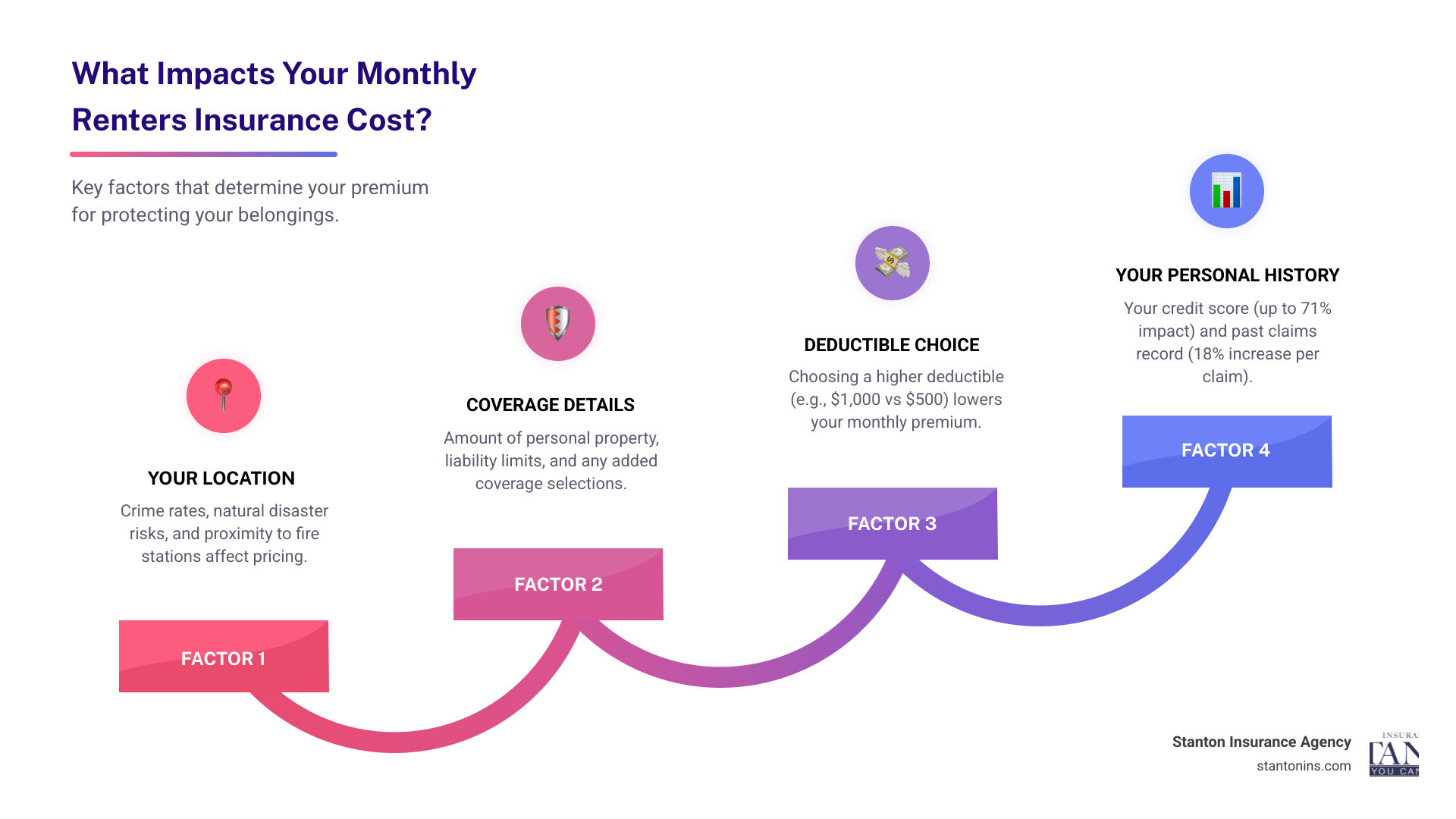
Your monthly renters insurance cost isn’t just a number pulled out of a hat. Insurance companies use complex algorithms to determine how much of a risk you represent. While we can’t control everything, understanding these factors helps us see where our money is going.
- Coverage Limits: The more stuff you have, the more it costs to protect. A policy with $10,000 in personal property coverage will naturally be cheaper than one with $100,000.
- Claims History: If you have filed multiple claims in the last five years, insurers might see you as “high risk.” A recent theft claim, for instance, can raise your premium by about 18%.
- Credit History: In many states, your credit-based insurance score plays a huge role. Nationally, renters with poor credit pay about 71% more than those with good credit. However, it is important to note that Massachusetts is one of the few states that does not allow insurers to use credit scores to set renters insurance rates! This is a huge win for residents in the Bay State.
- Property Age and Condition: Older buildings with outdated wiring or plumbing can sometimes carry higher risks for fire or water damage, which can nudge your premium up.
Before you buy, we always recommend taking a home inventory. Most people underestimate the value of their belongings by thousands of dollars. Documenting your possessions with photos and serial numbers ensures you get the right amount of coverage.
Take a home inventory to determine the right coverage: https://www.iii.org/article/how-create-home-inventory
How Deductibles Influence Your Monthly Renters Insurance Cost
The deductible is the amount you agree to pay out of pocket before your insurance kicks in. It has an inverse relationship with your premium: the higher the deductible, the lower the monthly renters insurance cost.
For example, increasing your deductible from $500 to $1,000 can lower your annual cost by about $11 to $26. While saving a dollar or two a month might not seem like a lot, it adds up over time. However, we always advise our clients to choose a deductible they can actually afford to pay on short notice. If a $1,000 bill would cause a financial crisis, it’s better to pay the extra dollar a month for a $500 deductible.
For more tips: https://stantonins.com/best-affordable-tenant-insurance-guide/
Why Location Impacts Your Monthly Renters Insurance Cost
Location is perhaps the biggest driver of insurance rates. Insurers look at your specific address to evaluate risks like:
- Crime Rates: If your neighborhood has a high rate of theft or vandalism, your premium will reflect that.
- Natural Disasters: Areas prone to heavy snow, coastal storms, or flooding (though flood is usually a separate policy) can see higher rates.
- Fire Protection: How close is the nearest fire station? If you live right next to one, your rate might be lower than if you live in a remote area.
In Massachusetts, a renter in a high-density area of Boston might pay slightly more than someone in a quiet suburb of Medford or a rural town in New Hampshire.
Explore more: https://stantonins.com/renters-insurance-ma/
How Coverage Types Affect Your Wallet
A standard renters insurance policy isn’t just one type of protection; it’s a bundle of four distinct coverages. Each one plays a part in your total monthly renters insurance cost.
- Personal Property: This covers your clothes, furniture, electronics, and even your bike.
- Liability Protection: This is arguably the most important part. If a guest trips in your apartment and sues you, or if your dog bites someone at the park, this coverage pays for your legal defense and any settlements (up to your limit). Increasing liability from $100,000 to $300,000 usually only costs about $1 extra per month.
- Loss of Use: If a fire makes your apartment uninhabitable, this pays for your hotel stays and extra food costs while you’re displaced.
- Medical Payments to Others: This covers small medical bills (usually $1,000 to $5,000) if a guest is injured, regardless of who is at fault. It’s a great way to settle small accidents without a lawsuit.
Learn more: https://stantonins.com/what-does-renters-insurance-cover/ and https://stantonins.com/renters-insurance-coverage/
Comparing ACV vs. Replacement Monthly Renters Insurance Cost
When you set up your policy, you’ll have to choose between Actual Cash Value (ACV) and Replacement Cost Coverage. This choice has a direct impact on your monthly renters insurance cost.
- Actual Cash Value (ACV): This pays out what your items are worth today. If your 5-year-old TV is stolen, ACV will pay you the “garage sale” price for a 5-year-old TV.
- Replacement Cost: This pays the cost to buy a brand-new version of the item. Using the same example, you’d get enough money to go to the store and buy a new TV of similar quality.
Opting for Replacement Cost coverage typically increases your premium by about 11%. We almost always recommend Replacement Cost. Why? Because if you lose everything in a fire, you don’t want a check for the depreciated value of your old clothes and furniture—you want enough money to actually replace them.
First-time buyer? https://stantonins.com/from-zero-to-covered-a-first-timers-renters-insurance-handbook/
Regional Cost Variations in Massachusetts and New Hampshire
We are proud to serve the New England community, and we know that “local” matters. While the state averages for both MA and NH are around $11 per month, the specific city can create small fluctuations.
- Massachusetts (MA): Cities like Boston or Worcester may see slightly higher rates due to higher crime statistics or older building densities. However, because Massachusetts prohibits using credit scores for pricing, many renters here find their rates are more stable than in other parts of the country.
- New Hampshire (NH): Generally, New Hampshire offers some of the lowest rates in the Northeast. With a lower population density and different risk profiles, many NH renters find they can get massive amounts of coverage for very little money.
Regardless of which side of the border you live on, the key is to get a quote custom to your specific ZIP code.
Find out more: https://stantonins.com/how-much-is-renters-insurance-in-massachusetts/ and https://stantonins.com/renters-insurance-massachusetts/
Practical Steps to Lower Your Monthly Bill
We love helping our clients save money. Here are the most effective ways to lower your monthly renters insurance cost without sacrificing protection:
- Bundle Up: This is the “king” of discounts. If you have your auto insurance with the same company, you can often save 5% to 25% on both policies.
- Install Safety Devices: Smoke detectors are standard, but adding a burglar alarm, deadbolts, or even a smart-home leak detector can trigger discounts.
- Go Paperless: Many insurers offer a small discount if you sign up for electronic documents and autopay.
- Pay in Full: If you can afford to pay the annual premium upfront (remember, it’s only about $130!), you can often avoid the “installment fees” that come with monthly billing.
- Stay Claim-Free: Insurance is for catastrophes. If you have a $200 loss and a $500 deductible, don’t file a claim. Keeping your record clean keeps your rates low.
Find more ways to save: https://stantonins.com/cheap-renters-insurance-massachusetts/
Frequently Asked Questions about Renters Insurance Costs
Why does renters insurance cost less than homeowners insurance?
Renters insurance is significantly cheaper because it only covers your personal belongings and liability. It does not cover the “bricks and mortar” of the building. Homeowners insurance must cover the entire cost to rebuild the house, which can be hundreds of thousands of dollars, leading to much higher premiums.
More info: https://stantonins.com/do-i-need-renters-insurance-in-massachusetts/
How much renters insurance coverage do I need?
The best way to find out is to walk through your apartment and tally up what it would cost to buy everything new. Most single people find that $20,000 to $30,000 is a good starting point. For liability, $100,000 is the standard minimum, but we often suggest $300,000 for the extra peace of mind, as the cost difference is negligible.
Get a quote: https://stantonins.com/your-instant-renters-insurance-quote-protect-your-stuff-today/
Does my credit score affect my monthly premium?
It depends on where you live. In New Hampshire, yes, insurers typically use a credit-based insurance score to help set rates. However, in Massachusetts, state law prohibits insurance companies from using your credit score to determine your renters insurance premium. This makes Massachusetts a very friendly place for renters who are still working on their credit.
Request a quote: https://stantonins.com/renters-insurance-quotes-massachusetts/
Conclusion
At the end of the day, the monthly renters insurance cost is a tiny price to pay for the massive financial safety net it provides. Whether you are in a studio in Medford or a townhouse in Nashua, protecting your hard-earned belongings and your future liability is a smart move.
At Stanton Insurance Agency, we pride ourselves on being more than just a place to buy a policy. We are your neighbors, and we’ve been part of this community for decades. We provide trusted protection, local expertise, and the kind of personalized service you just can’t get from a “1-800” number. We’ll help you steer the options, find every possible discount, and make sure that if the worst happens, you are fully covered.
Ready to protect your space? We make it easy.
Learn more: https://stantonins.com/renters-insurance/
